Introduction
This data warehouse project demonstrates a comprehensive end-to-end solution for consolidating sales data from multiple source systems into a unified analytical platform. Built with PostgreSQL and Docker, the warehouse enables business intelligence, reporting, and data-driven decision-making.The architecture follows industry best practices in data engineering, implementing the Medallion Architecture pattern with Bronze, Silver, and Gold layers for progressive data refinement.
Architecture Diagram
The data warehouse architecture implements a three-layer approach for data processing and transformation: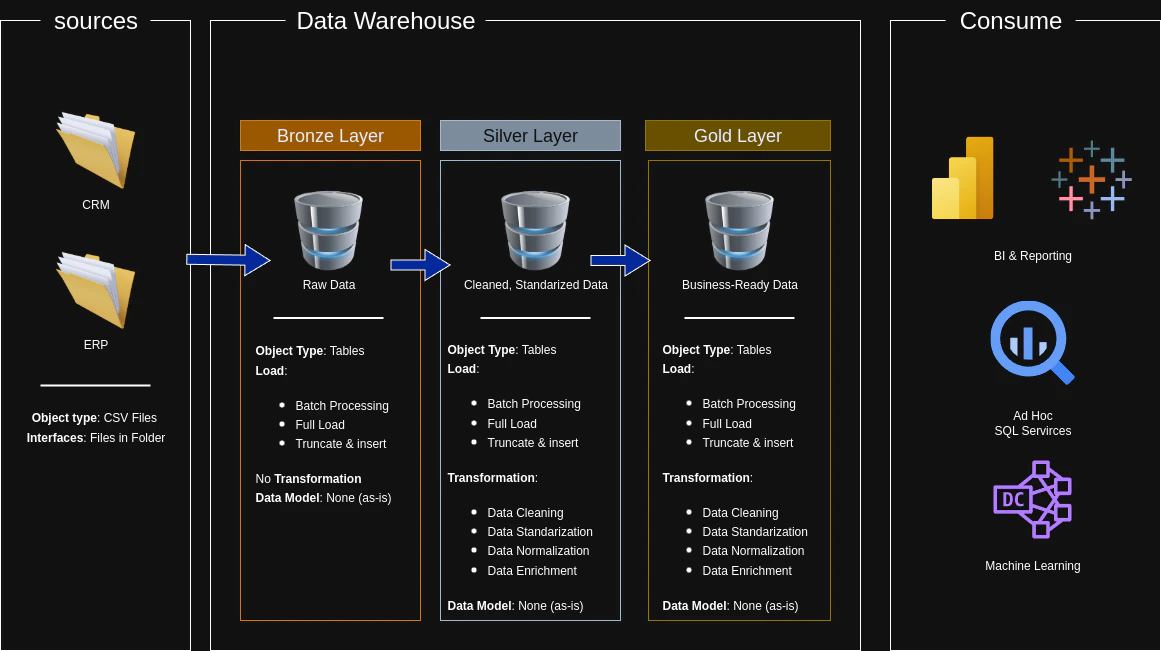
Data Flow
Data flows through the system in a structured, progressive manner:Source Systems
Raw data originates from two primary business systems:
- ERP System: Enterprise Resource Planning data
- CRM System: Customer Relationship Management data
Bronze Layer (Raw Ingestion)
CSV files are loaded directly into PostgreSQL tables with minimal transformation. This layer preserves the original data structure and serves as the single source of truth.
Silver Layer (Cleansing & Standardization)
Data undergoes quality checks, cleansing, and standardization:
- Remove duplicates and inconsistencies
- Standardize data formats and naming conventions
- Normalize data structures
- Resolve data quality issues
Technology Stack
The data warehouse is built with modern, proven technologies:PostgreSQL
Open-source relational database providing robust data storage, ACID compliance, and powerful SQL capabilities for data transformation and analytics.
Docker
Containerization platform ensuring consistent development and deployment environments. Simplifies setup and makes the warehouse portable across systems.
PL/pgSQL
PostgreSQL’s procedural language for implementing ETL logic, stored procedures, and complex data transformations within the database.
SQL
Standard SQL for data modeling, queries, and analytics. Enables business users and analysts to extract insights directly from the warehouse.
Key Capabilities
Data Integration
Data Integration
Consolidates data from multiple source systems (ERP and CRM) into a unified data model, eliminating data silos and providing a single source of truth for analytics.
Data Quality Management
Data Quality Management
Implements comprehensive data cleansing and validation in the Silver layer to ensure high-quality, trustworthy data for business decisions.
Analytical Optimization
Analytical Optimization
Star schema design in the Gold layer optimizes query performance for common analytical patterns, enabling fast reporting and ad-hoc analysis.
Scalability
Scalability
PostgreSQL’s robust architecture and Docker containerization provide a foundation for scaling the warehouse as data volumes and user demands grow.
Project Objectives
The data warehouse project fulfills multiple business and technical objectives:Consolidate Sales Data
Integrate sales information from disparate ERP and CRM systems into a unified repository.
Enable Analytics
Provide a foundation for SQL-based reporting, dashboards, and business intelligence tools.
Ensure Data Quality
Implement systematic data cleansing and validation to maintain high data integrity.
Support Decision-Making
Deliver actionable insights on customer behavior, product performance, and sales trends.
This project focuses on current state data. Historical tracking and slowly changing dimensions are not implemented in this version.
Next Steps
Explore the architecture in greater detail:- Medallion Layers - Deep dive into Bronze, Silver, and Gold layer implementations
- Data Model - Detailed star schema design and table structures