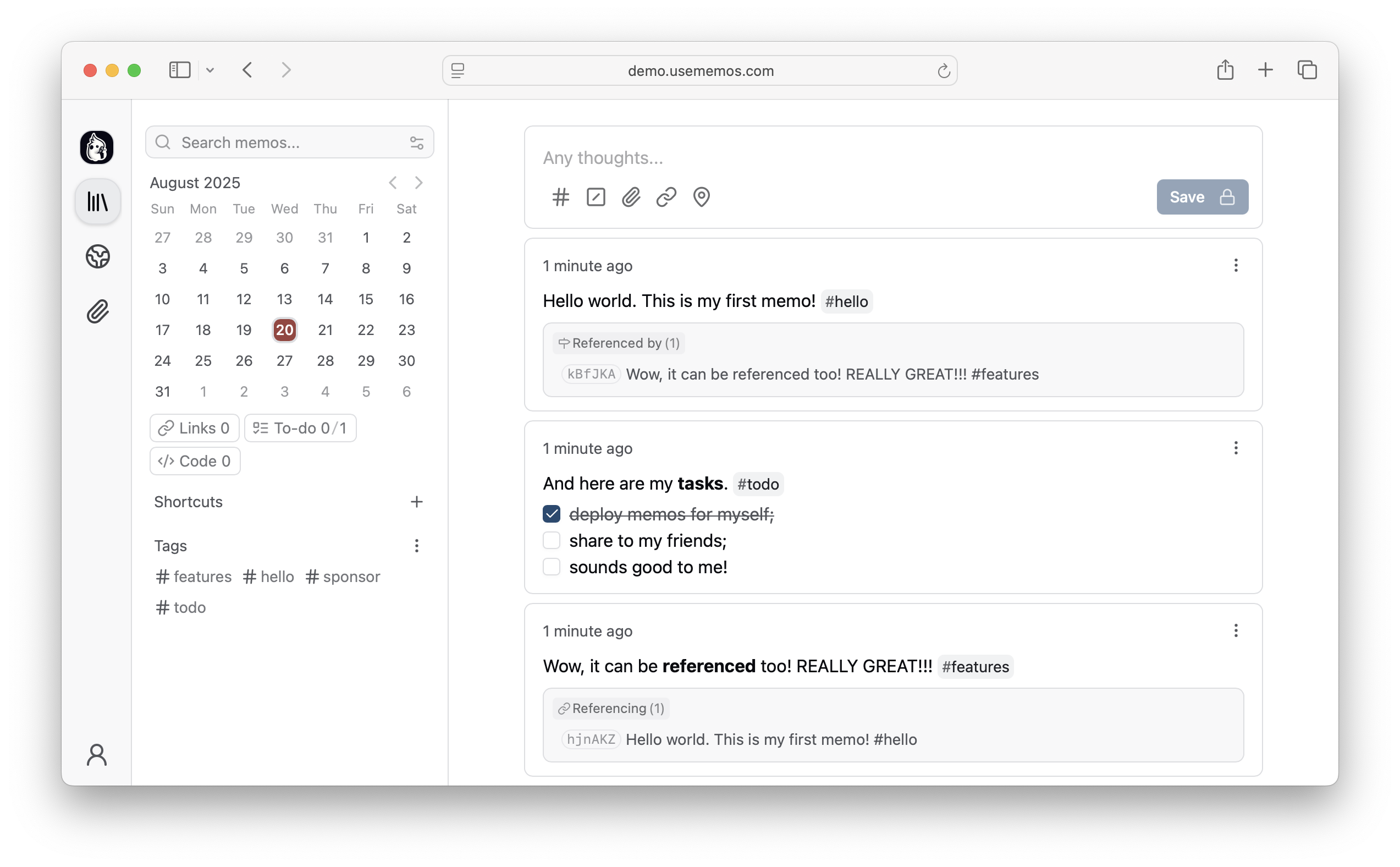
What is Memos?
Memos is a privacy-first, self-hosted knowledge base for personal notes, team wikis, and knowledge management. Built with Go and React, it runs as a single binary with minimal resource usage. Whether you’re capturing quick thoughts, building a personal knowledge base, or sharing information with your team, Memos provides a clean, distraction-free environment for your content.Key Features
Privacy-First
Self-hosted on your infrastructure with zero telemetry, no tracking, and no ads. Your data never leaves your server.
Markdown Native
Full markdown support with plain text storage. Your data is always portable and never locked in.
Lightweight
Single Go binary with React frontend. Low memory footprint (~50MB), starts in seconds.
Easy Deployment
One-line Docker install. Supports SQLite, MySQL, and PostgreSQL databases.
Developer-Friendly
Full REST and gRPC APIs. Connect RPC for browsers, gRPC-Gateway for external tools.
Rich Content
Attachments, code blocks with syntax highlighting, task lists, tables, and more.
Smart Organization
Auto-extracted tags from
#hashtags, pinned memos, visibility control (Public/Private/Protected).Clean Interface
Minimal design with dark mode, mobile-responsive layout, and masonry view for visual organization.
Architecture Overview
Memos is built with modern technologies designed for performance and maintainability:Core Concepts
Memos
A memo is a piece of content written in Markdown. Each memo has:- Content: Rich markdown with support for code blocks, tables, task lists, and more
- Visibility:
PUBLIC(anyone can view),PROTECTED(logged-in users), orPRIVATE(only you) - Tags: Automatically extracted from
#hashtagsin your content - Attachments: Images, videos, and files stored locally or in S3
- Relations: Link memos together for knowledge graphs
- Properties: Computed metadata (has links, has tasks, has code blocks)
Users & Authentication
Memos supports multiple authentication methods:- Password-based auth with secure JWT access tokens (15-min expiration)
- Personal Access Tokens (PAT) for API access and long-lived sessions
- SSO providers via identity providers (OAuth2/OIDC)
Storage Options
- SQLite
- MySQL
- PostgreSQL
Default and recommended for most users:
- Zero configuration
- Single file database
- Perfect for < 10,000 memos
- Automatic backups via file copy
Getting Started
Ready to start capturing your thoughts? Follow our quickstart guide:Quickstart Guide
Get Memos running with Docker in under 2 minutes
Use Cases
Personal Knowledge Base
Personal Knowledge Base
Build your second brain with quick notes, bookmarks, code snippets, and learning resources. Auto-tagging and full-text search make retrieval effortless.
Daily Journal
Daily Journal
Capture thoughts throughout the day with timestamps. Private by default, share selectively with public links.
Team Wiki
Team Wiki
Collaborate with team members using protected memos. Share knowledge, document processes, and build institutional memory.
Developer Notes
Developer Notes
Store code snippets with syntax highlighting, document API endpoints, track bugs, and maintain dev logs.
Content Drafting
Content Drafting
Write blog posts, articles, and documentation in Markdown. Export to your publishing platform when ready.
Community & Support
Discord
Join our community
GitHub
Star us and contribute
Live Demo
Try before you install
Open Source & Privacy
Memos is fully open-source under the MIT License. We’re committed to:- No telemetry: Zero data collection, no phone-home
- No tracking: No analytics, no usage monitoring
- No ads: Your attention is yours
- No subscriptions: Free forever
Read our full Privacy Policy and Security practices
Next Steps
Quickstart
Deploy Memos in under 2 minutes
Installation Options
Docker, Kubernetes, binaries, and more
Configuration
Environment variables and settings
API Reference
Build integrations with our API