What is an event?
An event is a data point that represents state changes in a system. It doesn’t specify what should happen and how the change should modify the system, it only notifies the system of a particular state change. When a user makes an action, they trigger an event.Components
Event-driven architectures have three key components:- Event producers: Publishes an event to the router.
- Event routers: Filters and pushes the events to consumers.
- Event consumers: Uses events to reflect changes in the system.
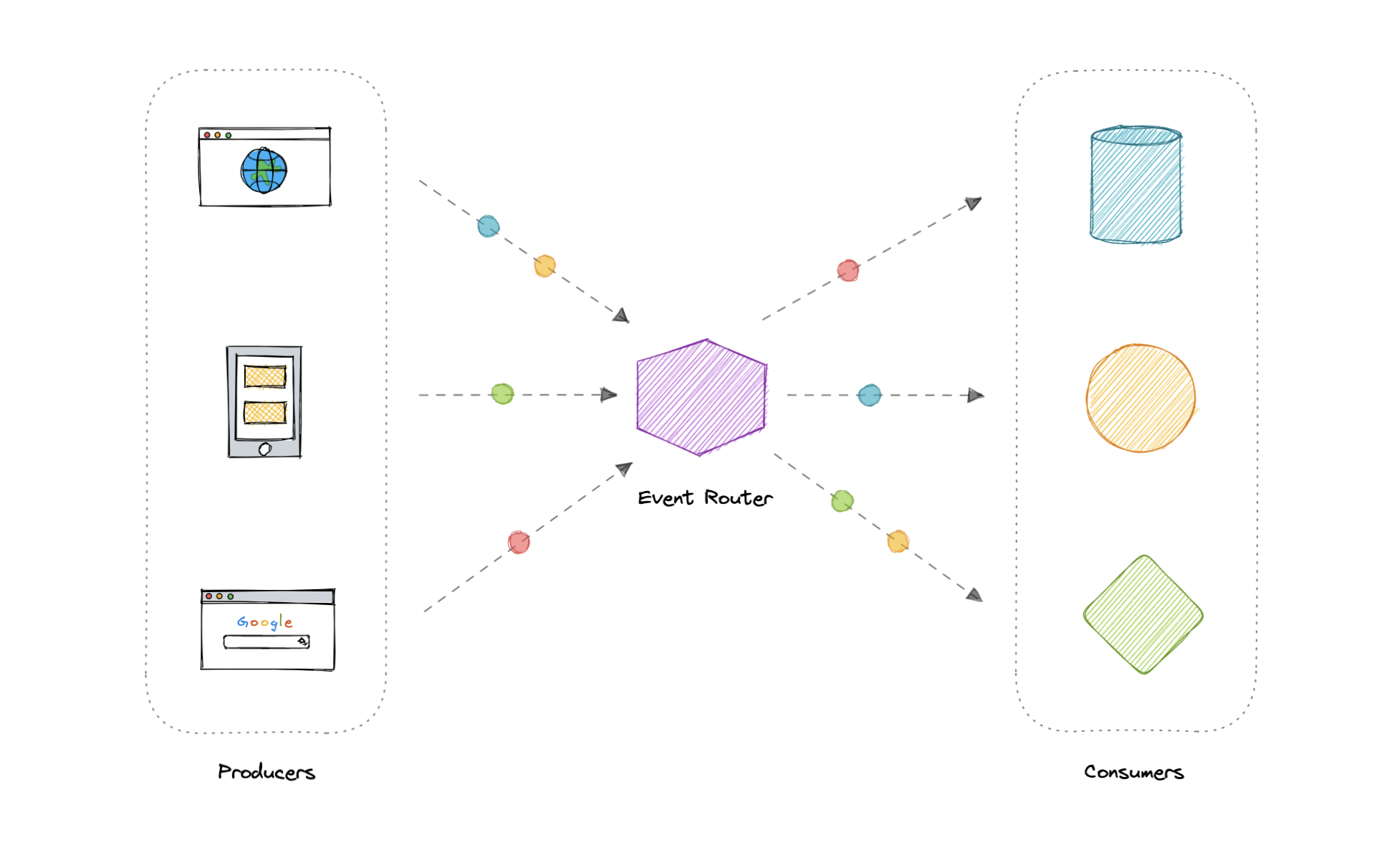
Dots in the diagram represents different events in the system.
Patterns
There are several ways to implement the event-driven architecture, and which method we use depends on the use case but here are some common examples:- Sagas
- Publish-Subscribe
- Event Sourcing
- Command and Query Responsibility Segregation (CQRS)
Each of these methods is discussed separately in this course.
Advantages
Let’s discuss some advantages:- Decoupled producers and consumers.
- Highly scalable and distributed.
- Easy to add new consumers.
- Improves agility.
Challenges
Here are some challenges of event-drive architecture:- Guaranteed delivery.
- Error handling is difficult.
- Event-driven systems are complex in general.
- Exactly once, in-order processing of events.
Use cases
Below are some common use cases where event-driven architectures are beneficial:- Metadata and metrics.
- Server and security logs.
- Integrating heterogeneous systems.
- Fanout and parallel processing.