Key features
Research-focused
Built specifically for historians, academics, and researchers working with large document collections
Domain-agnostic
Configure for any historical period, region, or research topic through simple YAML and Markdown files
Multiple AI models
Support for both cloud (Gemini default via LiteLLM) and local (Ollama) models with privacy mode
Smart deduplication
RapidFuzz lexical blocking + embedding similarity with per-entity-type thresholds
Profile versioning
Track how entity profiles evolve as new sources are processed
Citation-backed claims
Profile grounding verification ensures all claims are supported by source articles
What you can extract
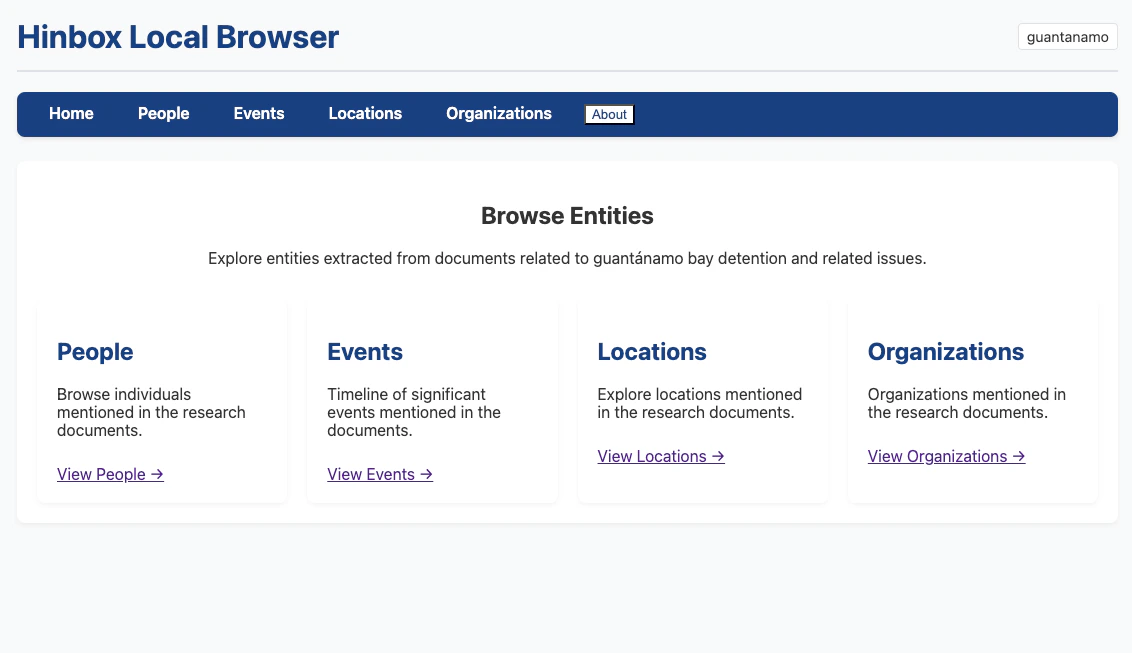
Hinbox extracts four core entity types from your historical sources:- People - Individuals mentioned in your sources with roles, affiliations, and biographical details
- Organizations - Groups, institutions, companies, and agencies
- Locations - Places, regions, facilities, and geographic entities
- Events - Historical events, incidents, meetings, and significant occurrences
How it works
Configure your domain
Create a research domain with custom entity types, extraction prompts, and data paths. No Python coding required.
Process your sources
Feed in historical documents in Parquet format. Hinbox extracts entities using AI models with automatic quality controls.
Smart merging
Entities are deduplicated using lexical blocking and embedding similarity. A second-stage LLM arbitrates ambiguous matches.
Advanced capabilities
Extraction quality controls
Deterministic QC validates extraction output with automatic retry when severe issues are detected:- Zero entities extracted
- High drop rates during processing
- Missing required fields
- Invalid name normalization
Merge dispute agent
Second-stage LLM arbitration for ambiguous entity matches near similarity thresholds. The dispute agent analyzes gray-band matches with low confidence scores.5-layer canonical name selection
Deterministic scoring picks the best display name across aliases:- Penalizes acronyms and generic phrases
- Prefers full, descriptive names
- Handles merge scenarios intelligently
Extraction caching
Persistent sidecar cache avoids redundant LLM calls:- Keyed on content hash, model, prompt, schema, and temperature
- Skips re-processing unchanged articles
- Configurable cache version for invalidation
Privacy mode
Use the--local flag to enforce local-only processing:
- Local embeddings only
- Disables all LLM telemetry callbacks
- Perfect for sensitive historical research
Get started
Installation
Install Hinbox with uv and set up your environment
Quick start
Create your first domain and process historical sources
Configuration
Learn how to configure domains for your research
API Reference
Explore the processing pipeline and modules
Built with
Hinbox is built with modern Python tools and libraries:- Python 3.12+ - Core language
- Pydantic - Schema validation and dynamic model generation
- FastHTML - Web interface with “Archival Elegance” design
- LiteLLM - Unified API for cloud and local models
- Instructor - Structured LLM output
- RapidFuzz - Fast lexical blocking
- Jina Embeddings - Cloud embedding generation
- Rich - Beautiful terminal logging
Example use cases
History of food in Palestine
Extract farmers, traders, cookbook authors, agricultural cooperatives, markets, harvest events, and recipe documentation from historical texts.Soviet-Afghan War (1980s)
Identify military leaders, intelligence agencies, battles, refugee movements, and border crossings from news archives and diplomatic cables.Medieval trade networks
Discover merchants, trading companies, trade routes, market fairs, and diplomatic missions from historical records.Hinbox was originally developed for analyzing Guantánamo Bay media coverage but is now fully domain-agnostic. You can configure it for any historical period, region, or research topic.