

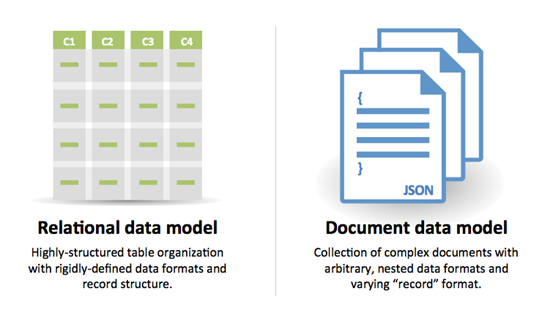
When to Use SQL
Reasons for choosing SQL (Relational Databases):Structured data with strict schema
Structured data with strict schema
SQL databases excel when your data has a well-defined structure with relationships between entities. The schema enforces data integrity and consistency.Examples:
- Financial transactions
- Customer relationship management (CRM)
- Enterprise resource planning (ERP)
- Inventory management
Complex joins and relationships
Complex joins and relationships
When your application requires complex queries involving multiple tables with foreign keys and relationships, SQL’s JOIN operations are highly optimized for this purpose.Examples:
- Reporting and analytics across related data
- Multi-table queries with aggregations
- Data warehouse queries
ACID transactions
ACID transactions
Applications requiring strong consistency and transactional guarantees benefit from SQL’s ACID properties:
- Atomicity - All or nothing transactions
- Consistency - Valid state transitions
- Isolation - Concurrent transaction isolation
- Durability - Committed data persistence
- Banking and financial systems
- E-commerce order processing
- Booking and reservation systems
Mature ecosystem
Mature ecosystem
SQL databases offer:
- Extensive developer community and resources
- Well-established tools and libraries
- Clear patterns for scaling (replication, sharding)
- Battle-tested in production environments
- Strong developer talent pool
SQL Database Summary
Choose SQL when you need:- ✅ Structured data
- ✅ Strict schema
- ✅ Relational data
- ✅ Need for complex joins
- ✅ Transactions
- ✅ Clear patterns for scaling
- ✅ More established: developers, community, code, tools, etc
- ✅ Lookups by index are very fast
When to Use NoSQL
Reasons for choosing NoSQL (Non-Relational Databases):Semi-structured or flexible schema
Semi-structured or flexible schema
NoSQL databases are ideal when your data structure:
- Changes frequently
- Varies between records
- Needs to evolve without migrations
- Has nested or hierarchical structure
- User-generated content
- Product catalogs with varying attributes
- IoT sensor data with different telemetry
- Rapidly evolving applications
Massive scale and throughput
Massive scale and throughput
NoSQL databases are designed for horizontal scalability:
- Store many TB (or PB) of data
- Very high throughput for IOPS
- Very data-intensive workload
- Distributed across multiple data centers
- Social media platforms
- Real-time analytics
- Content delivery networks
- Big data applications
No complex joins needed
No complex joins needed
When your data access patterns don’t require complex joins across multiple collections:
- Data is denormalized
- Each document/record is self-contained
- Joins happen in application code
- User profiles
- Session data
- Time-series data
- Event logs
Specific use cases
Specific use cases
Sample data well-suited for NoSQL:
- Rapid ingest - Clickstream and log data
- Leaderboards - Gaming or scoring data
- Temporary data - Shopping carts, sessions
- Hot tables - Frequently accessed data
- Lookup tables - Metadata and configuration
NoSQL Database Summary
Choose NoSQL when you need:- ✅ Semi-structured data
- ✅ Dynamic or flexible schema
- ✅ Non-relational data
- ✅ No need for complex joins
- ✅ Store many TB (or PB) of data
- ✅ Very data intensive workload
- ✅ Very high throughput for IOPS
Decision Framework
Start with these questions
Start with these questions
-
What is your data structure?
- Highly structured → SQL
- Flexible/evolving → NoSQL
-
What are your consistency requirements?
- Strong consistency (ACID) → SQL
- Eventual consistency acceptable → NoSQL
-
What is your expected scale?
- Vertical scaling acceptable → SQL
- Horizontal scaling required → NoSQL
-
What are your query patterns?
- Complex joins and aggregations → SQL
- Simple queries, key lookups → NoSQL
-
What are your performance requirements?
- Transaction throughput → SQL
- High read/write throughput → NoSQL
Hybrid approaches
Hybrid approaches
Many modern applications use both SQL and NoSQL databases:
- Polyglot persistence - Use the right database for each use case
- SQL for transactions - Critical business data with ACID guarantees
- NoSQL for scale - High-volume data like logs, sessions, cache
Real-World Examples
E-commerce platform
E-commerce platform
SQL databases for:
- User accounts and authentication
- Order management and payments
- Inventory tracking
- Financial transactions
- Product catalog (varying attributes)
- Shopping cart sessions (Redis)
- Product recommendations (Graph DB)
- User activity logs (Document store)
- Search functionality (Elasticsearch)
Social media application
Social media application
Migration Considerations
Moving from SQL to NoSQL
Moving from SQL to NoSQL
Challenges:
- Losing ACID transactions
- Rewriting join logic in application
- Managing eventual consistency
- Denormalizing data structures
- Horizontal scalability
- Flexible schema evolution
- Better performance for specific use cases
Moving from NoSQL to SQL
Moving from NoSQL to SQL
Challenges:
- Defining rigid schema
- Data migration and transformation
- Rewriting queries
- Strong consistency guarantees
- Simplified complex queries
- Better relational data support
- User authentication
- Financial/billing data
- Admin dashboard data
NoSQL databases for: