Terminology
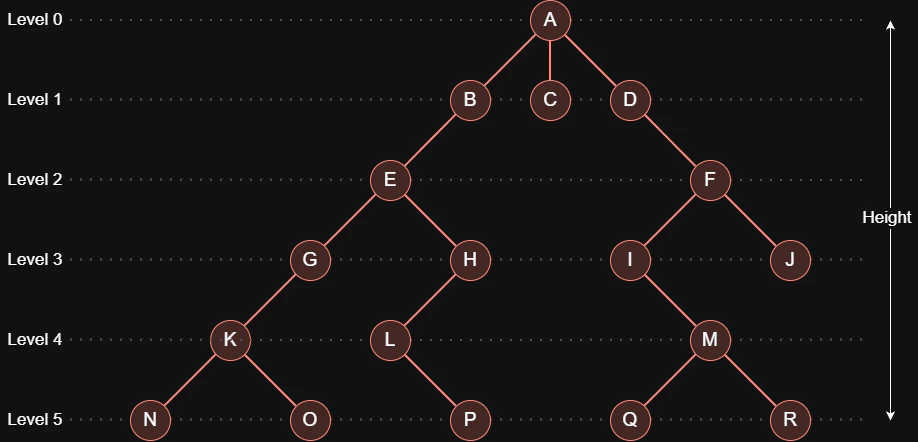
- Root: The top node that starts the tree and has no parent.
- Parent: A node that has one or more children. Each child has one parent.
- Child: A node directly linked to a parent. A parent can have many children.
- Sibling: Nodes that share the same parent and sit on the same level.
- Leaf: A node with no children.
- Edge: A link that connects two nodes.
- Path: A sequence of nodes connected by edges.
- Depth: The number of edges from the root to a node. The root has depth 0.
- Height: The number of edges on the longest path from the root to a leaf.
- Subtree: A smaller tree inside a larger one.
- Ancestor: Any node on the path from a node to the root.
- Descendant: Any node below a given node.
Tree Types
Binary Trees
Trees where each node has at most two children
Binary Search Tree
Ordered binary tree for efficient searching
Binary Heaps
Complete binary trees for priority queue implementation
Trie (Prefix Tree)
Tree for storing strings character by character
Radix Tree
Compressed trie for space-efficient string storage