Knowledge Graph
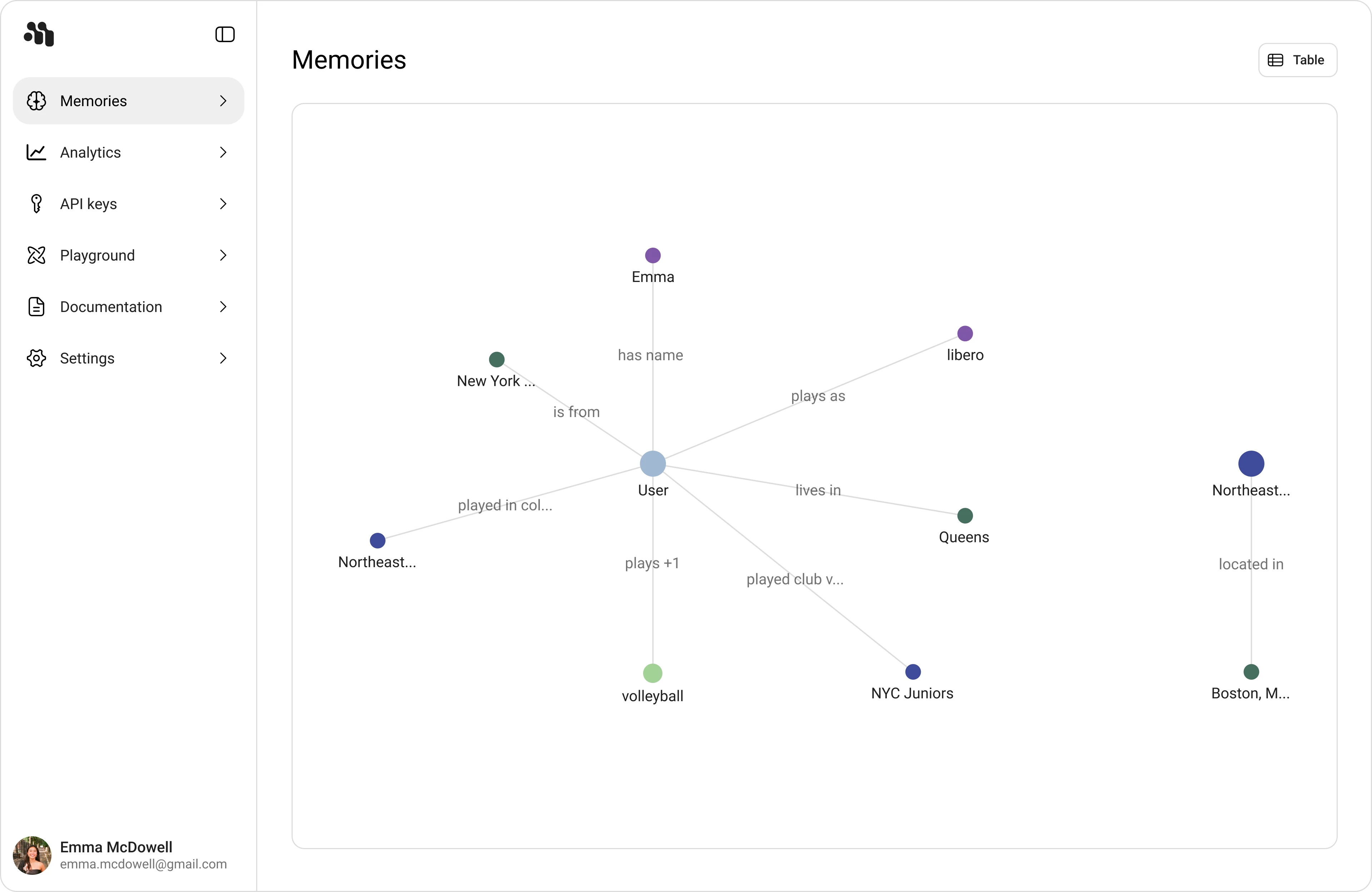
Memori automatically builds a knowledge graph from your AI conversations. Each time Advanced Augmentation processes a conversation, it extracts structured relationships — semantic triples — and connects them into a graph. This powers richer recall and gives your AI deeper understanding of each user.How It Works
- Conversation captured — Your user talks to your AI through the Memori-wrapped LLM client
- Augmentation processes — Memori analyzes the conversation in the background
- NER extraction — Named-entity recognition identifies key entities and relationships
- Triple creation — Relationships are expressed as subject-predicate-object triples
- Graph storage — Triples are stored and deduplicated in the knowledge graph
- Recall ready — The graph is available for semantic search on subsequent LLM calls
Semantic Triples
Every fact in the knowledge graph is a semantic triple — a three-part statement: [Subject] [Predicate] [Object].- “Alice” “prefers” “dark mode”
- “PostgreSQL” “is” “a relational database”
- “The project” “uses” “FastAPI”
Example Extraction
From “My favorite database is PostgreSQL and I use it with FastAPI for our REST APIs. I’ve been using Python for about 8 years”:| Subject | Predicate | Object |
|---|---|---|
| user | favorite_database | PostgreSQL |
| user | uses | FastAPI |
| user | uses_for | REST APIs |
| user | uses_with | PostgreSQL + FastAPI |
| user | experience_years | Python (8 years) |
Triple Deduplication
Memori automatically deduplicates triples to avoid storing redundant information: First mention:memori/memory/augmentation/augmentations/memori/_augmentation.py:246-251
Storage Structure
Normalized Tables
Triples are stored in a normalized schema to minimize redundancy:| Table | Purpose |
|---|---|
memori_subject | Stores unique subjects |
memori_predicate | Stores unique predicates |
memori_object | Stores unique objects |
memori_knowledge_graph | Links subjects, predicates, and objects into triples |
memori_entity_fact | Stores facts with vector embeddings for recall |
Knowledge Graph Table Schema
Visualizing the Graph
The Memori Playground at app.memorilabs.ai includes a Memory Graph Viewer that shows:| Element | What it shows |
|---|---|
| Nodes | Subjects and objects from semantic triples |
| Edges | Predicates (relationships) between nodes |
| Mention counts | How often a fact was discussed across sessions |
| Timestamps | When facts were first and last seen |
Scope
The knowledge graph follows the same scoping rules as other memory types:| Aspect | Scope |
|---|---|
| Triples | Per entity — shared across all processes |
| Visibility | All processes for an entity can see and use the graph |
| Growth | Conversations from any process contribute to the entity’s graph |
Querying the Graph
Via Recall API
The knowledge graph is automatically used during recall. When you callmem.recall() or make an LLM call through a wrapped client, Memori searches across both extracted facts and the knowledge graph to find the most relevant context.
Via Direct SQL (BYODB Only)
If you’re using BYODB, you can query the knowledge graph directly:View All Triples
View All Triples
Triples for an Entity
Triples for an Entity
Most Mentioned Relationships
Most Mentioned Relationships
Triple-to-Fact Conversion
Memori automatically converts semantic triples into natural language facts for embedding and recall:_augmentation.py:188-192, 221-236
Hybrid Approach
Memori uses both triples and facts for maximum flexibility:- Triples provide structured, queryable relationships
- Facts enable semantic search via embeddings
- Both are generated from the same extraction process
- Query precision (triples)
- Semantic understanding (facts with embeddings)
Integration with Recall
The knowledge graph enhances recall by providing additional context: Without knowledge graph:- Query: “What programming languages do I know?”
- Recall: Direct fact matches only
- Query: “What programming languages do I know?”
- Recall: Facts + related triples (experience_years, uses_with, projects)
- Result: Richer, more contextual answers
Building Relationships Over Time
As conversations accumulate, the knowledge graph builds deeper relationships: Conversation 1:- What the user uses (Python, FastAPI)
- How long they’ve used it (8 years)
- How they use it together (Python + FastAPI)
Knowledge Graph Schema (ERD)

The knowledge graph is built automatically — you don’t need to extract triples manually. Just have conversations through Memori, and the graph grows organically.
Performance Considerations
Triple Deduplication
Memori uses hash-based lookups to deduplicate triples efficiently:- O(1) lookup for existing triples
- Batched inserts for new triples
- Incremental mention count updates
Indexing
The knowledge graph tables are indexed on:entity_id(for per-entity queries)subject_id,predicate_id,object_id(for relationship queries)mention_count(for ranking)