Keep institutional knowledge findable, even when people leave
4 minutes read
Share this article
Share this article
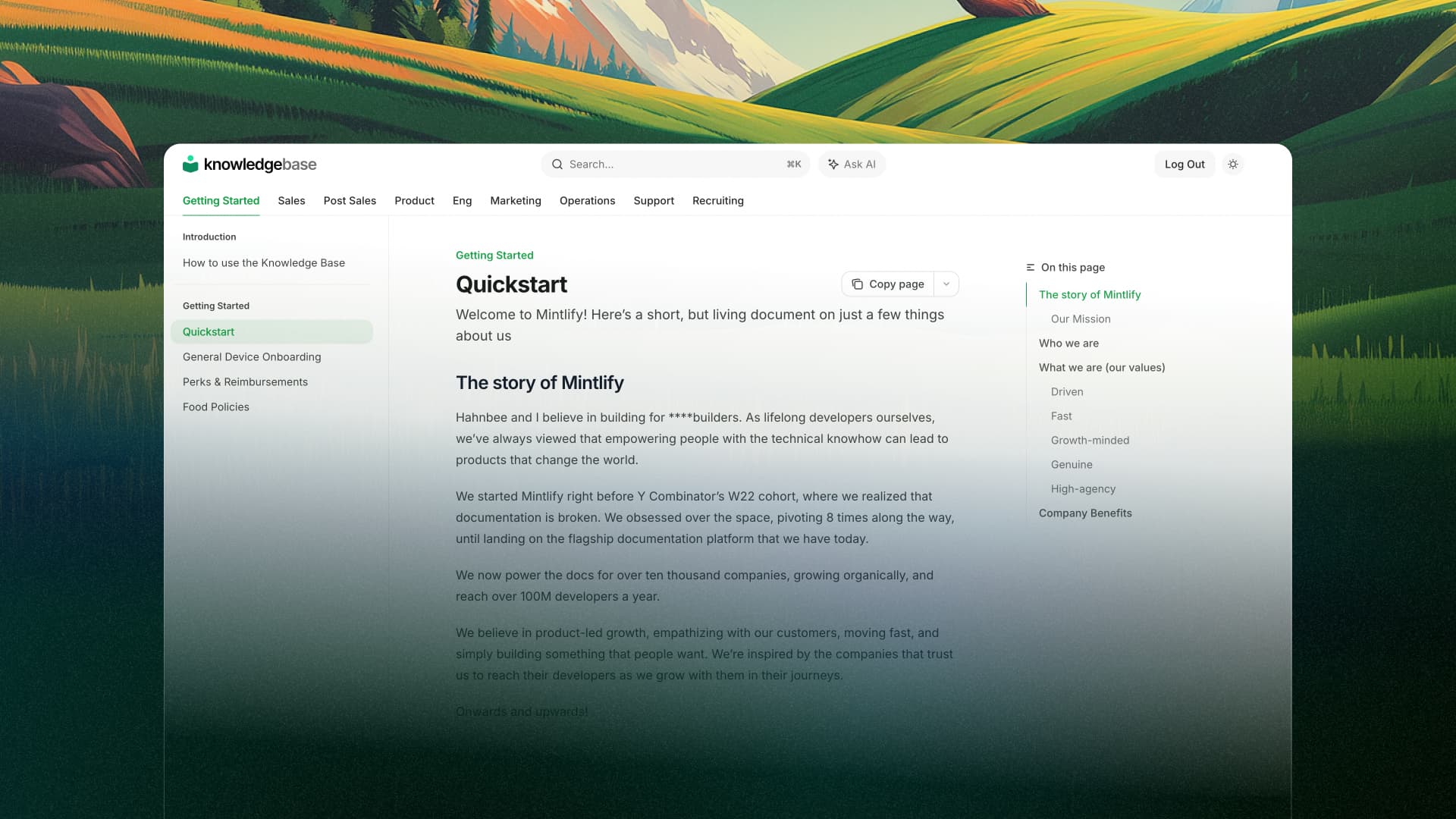
Most teams don't have a knowledge problem. They have a knowledge-finding problem. Information exists, but it's scattered across Slack threads, PR descriptions, and stale runbooks. Mintlify gives teams a searchable, AI-queryable knowledge base that engineers can update without leaving their workflow. Fidelity, Anaconda, Lovable, and Replit use Mintlify to keep institutional knowledge accessible.
The information exists. It's in a PR description from eight months ago, a Slack thread no one can find, a runbook that was accurate until the infrastructure migration. The cost only becomes visible when it's already expensive: a new engineer who can't ramp, a 2am incident where the runbook references infrastructure that's gone, a senior engineer who left and took three years of architecture decisions with them.
Most teams document fine. The problem is finding what's been documented.
Finding knowledge is the real challenge
The information exists: in a PR description, a Slack thread, a doc someone wrote when the system was different. By the time the gap shows up, it's already expensive.
"By the time knowledge issues become visible, they're already expensive."
— David Hou, Decagon
Engineers contribute without leaving their tools
Engineers live in their editors and their terminals. A documentation system that pulls them out of that workflow gets skipped.
With Git sync, engineers write and update docs in the same repo they're already in, with the same review process, the same commit history, and no separate login. Documentation becomes part of the work rather than a follow-up.
Fidelity rolled out Mintlify across engineering teams by meeting developers where they already work: Git. Adoption didn't require a behavior change; it required a better default.
Non-technical contributors can actually contribute
Not everyone who has knowledge worth documenting is comfortable in a code editor. Product managers know the product context. Support leads know what users ask. Operations staff know the process. The web editor lets anyone on the team write, update, and publish without a local dev environment or a markdown tutorial. Both paths (code and browser) write to the same source.
Anaconda uses Mintlify's web editor to let data scientists and product managers contribute to internal documentation alongside engineers, without anyone needing a git tutorial.
Start free. No credit card required. Connect your repo or start in the browser and be live in minutes.
Surface knowledge gaps before they cost you
You can't fix what you can't see. Analytics show which pages are being searched, which searches return nothing, and which topics people keep looking for. That's where your runbooks are missing and where your onboarding guide has holes. Fix the gap before someone opens a Slack thread asking the same question for the fourth time.
Docs that write themselves from Slack and PRs
Knowledge starts in a Slack thread, a pull request, a design review comment, not in a documentation system. The AI agent reads those sources and generates draft documentation for your team to review and publish. The draft is automatic; reviewing and publishing stays with you.
Lovable uses Mintlify's AI agent to convert engineering Slack threads and PR descriptions into draft runbooks. Their documentation keeps pace with how fast they ship.
Find any runbook by describing the problem
Semantic search means someone asking "how do we handle a failed deployment" finds the runbook even if it's titled "Rollback procedure." Engineers on-call find the right content by describing what's happening, not by guessing the right search term.
Replit uses Mintlify's semantic search so engineers on-call can find incident runbooks by describing the problem. After rolling out Mintlify, they saw a 10x increase in internal contributors to docs, with each PR saving 30 to 60 minutes compared to their previous setup.
Sensitive content stays with the right team
Role-based access control and SSO integration mean sensitive runbooks, compensation docs, and internal APIs are only visible to the people who should see them. You publish some docs broadly and restrict others to specific teams without managing two separate systems.
Trusted by 20,000+ companies. 50M monthly users. Customers include Anthropic, Coinbase, Microsoft, Perplexity, and Stripe.
Build a knowledge base that works when you need it
When knowledge is findable, engineers spend less time asking and more time building. Onboarding stops depending on whoever happens to be available. Runbooks work at 2am. Context stays at the company when people leave.
Zapier unified their internal and external documentation into a single platform and saw doc updates get 3x faster, with internal API usage jumping 30%.
Start free. No credit card required.
Connect your repo or start in the browser. Live in minutes.
More blog posts to read
Rise of the Knowledge Engineer
Agents are one of the largest audiences for company knowledge, accounting for 66% of measured web traffic across documentation powered by Mintlify. The emerging role responsible for keeping that knowledge accurate and retrievable is the knowledge engineer.
September 16, 2026David Isquick
Product Marketing
Highlights from the 2026 State of Knowledge Report
AI agents overtook humans as the primary readers across Mintlify-powered sites. In August alone, agents made 257 million web requests compared to 131 million human page loads, which means agent traffic now outnumbers human traffic by nearly 2:1.
September 16, 2026Lauren Volpi
Marketing