AI agents are shipping faster than anyone can document
9 minutes read
Hahnbee Lee
Co-Founder
Share this article
Hahnbee Lee
Co-Founder
Share this article
AI agents are shipping code faster than teams can document it, and the gap is compounding. Automations lets you define triggers and instructions so Mintlify's agent autonomously updates your documentation when your product changes, keeping docs current without manual intervention.
The only thing shipping faster than AI agents are all the hot takes about AI agents. If you take extrapolated two year old Gartner and Goldman data as gospel, we can expect that the software profit pool will shift toward AI agents by 2030 from roughly $30 billion to north of $50 billion.
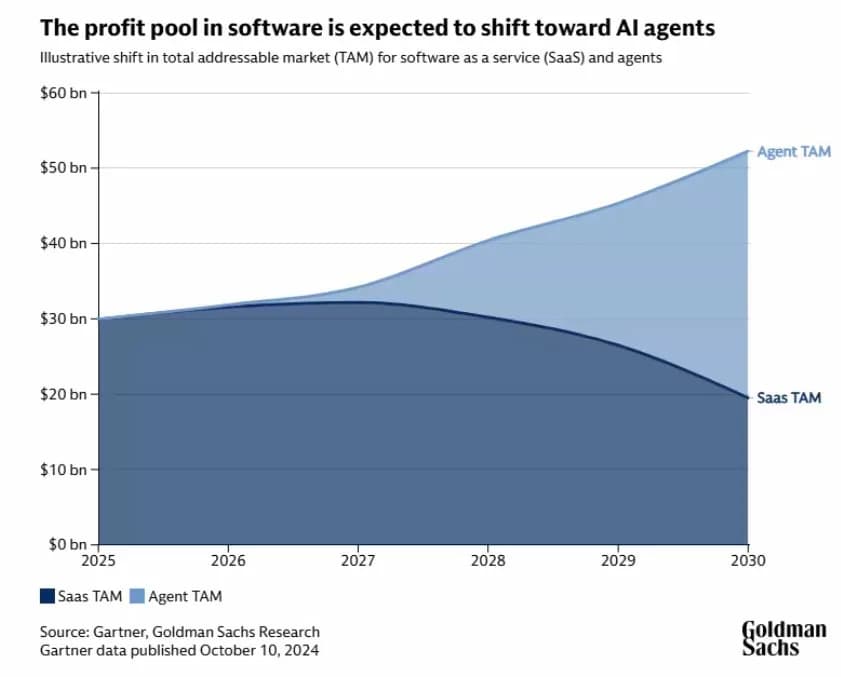
As agents eat up the growth SaaS used to own, every SaaS founder who saw that chart knows that all those agents everyone's building need to know things about the product, and they get that knowledge from the documentation. Yet the documentation is wrong simply because the pace of change we're living has outrun the human process of writing it down properly as it is happening.
That's how on a Tuesday morning, for example, a customer asks your AI chatbot how to set up billing and the chatbot answers confidently though the answer is wrong. It's not because the model hallucinated, but because the docs it pulled from haven't been updated since your team redesigned billing two months ago. Nobody noticed because nobody remembered to update them because they were busy shipping the next thing.
The customer follows the steps, something breaks, they open a ticket, then your support team spends an hour figuring out that the agent was technically correct: it read the docs, and the docs were wrong.
Your support deflection rate drops because the chatbot you deployed in January to reduce tickets is now generating them in March because every feature your team shipped in between missed its documentation getting updated, so the chatbot got more and more confidently wrong about it.
If you're running a product with more than a few engineers and any kind of AI-facing documentation, some version of this has already happened to you, or it's about to.
The chatbot giving the wrong answer is not an AI problem, but a documentation problem. This is not some abstract future scenario. Your documentation is out of date right now, today, and it's only compounding as your team ships faster.
AI agents need to know things, and they need to understand your product, your codebase, and your processes. They do this through documentation, which is what they reference for all of it, which is why the very thing every team neglects is about to become the most critical infrastructure in the stack. At these speeds, stacks cannot risk falling behind as shipping skyrockets.
Output is exploding but documentation isn't keeping up with it
We went from "move fast and break things" to moving so fast you forgot what you were breaking.
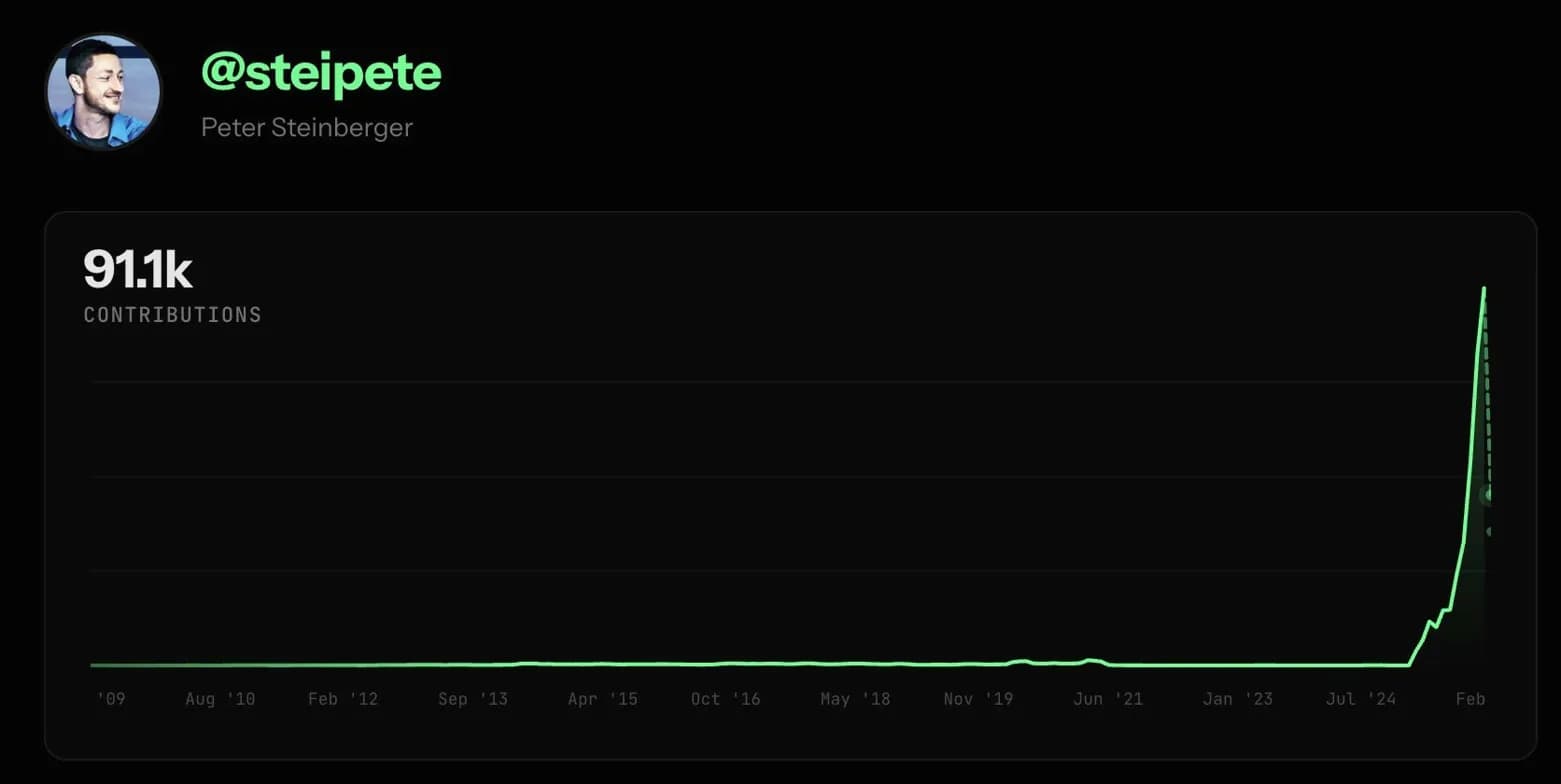
AI agents are shipping code faster than anyone is documenting it, a story seen in the velocity of OpenClaw's Peter Steinberger's GitHub contribution graph. Fifteen years of flat, steady output were disrupted by late 2024 as the line exploded upwards, spiking vertically with 91,000 contributions. It isn't just limited to one developer, as OpenCode has 100k+ GitHub stars with 2.5 million developers using it monthly. Agents have also moved well beyond engineering, like when Corey Haines' marketing-skills.com went viral, pulling over a thousand likes and 1,700 bookmarks.
Beyond software development, marketing, sales, and ops teams are all shipping with agent swarms now too. Every enterprise function is producing dramatically more output, yet just as shipping speeds up, we are forgetting to scribble what is happening and all of it is evaporating like the best conversation at a party. Incredible things are being said, nobody's writing any of it down, and by morning it's gone. The fundamental infrastructure layer underneath all of it, the documentation, it all technically exists, but realistically, at these speeds, nobody's updating it properly as things develop.

Imagine what this looks like inside your company. Your army of coding agents ship a feature Monday, change the behavior Wednesday, and refactor Thursday. On Friday, a new engineer joins and follows the onboarding guide to set up a new agent swarm, but the guide references a setup process your team changed last quarter using a service that got migrated to a different repo two months ago. They spend half a billion tokens solving it before someone on Slack says "oh yeah, that's outdated, here's the new one."
On Monday, your support team is handling the customer's inquiry, while your sales team references a capability in a deck that no longer works the way the deck says, and no one can remember how or why this changed. Support references a runbook that describes how the product worked four months ago, but the runbook doesn't match the help article and the sales team agrees it may be time to escalate to engineering. Engineering checks the codebase, which describes how the product works now, which matches neither the help article, the runbook, nor the deck. Someone suggests getting all the agents between the support, sales, and engineer together to reconcile. The agents meet and produce a document. The document recommends updating the documentation.
Nobody's wrong, everyone's just behind since they're so busy shipping, and that gap keeps compounding, leaving documentation in the dust.
We had an insight about infrastructure
We recognized it first because we hit the same wall at Mintlify, and that's what made our newest feature in Automations possible. Mi casa es tu casa is now mi documentation problem is su documentation problem.
When we started building our own AI features, we learned quickly that you can't just point a model at a codebase and tell it to go update the docs. That's how you get chaos with a byline. The agent needs a real environment where it can read your code, understand what changed, and make edits safely without anyone worrying about what it might break.
So we gave it one — Mintlify's agent runs on OpenCode and Daytona, inside sandboxed environments provisioned with your documentation and codebase. It's the same infrastructure that powers our Slack agent. Day in, day out, we're running on this, not just talking about it.
When an automation fires, Daytona spins up an ephemeral sandbox with your docs repo and any context repos cloned in. Inside that sandbox, a headless OpenCode session powered by Opus 4.6 reads your content, plans the changes, edits files, and either opens a PR or merges directly depending on your configuration.
Triggers flow into a job queue, workers hand off to the sandbox, and results are reported back through GitHub checks and the dashboard. The whole loop runs without anyone touching it.
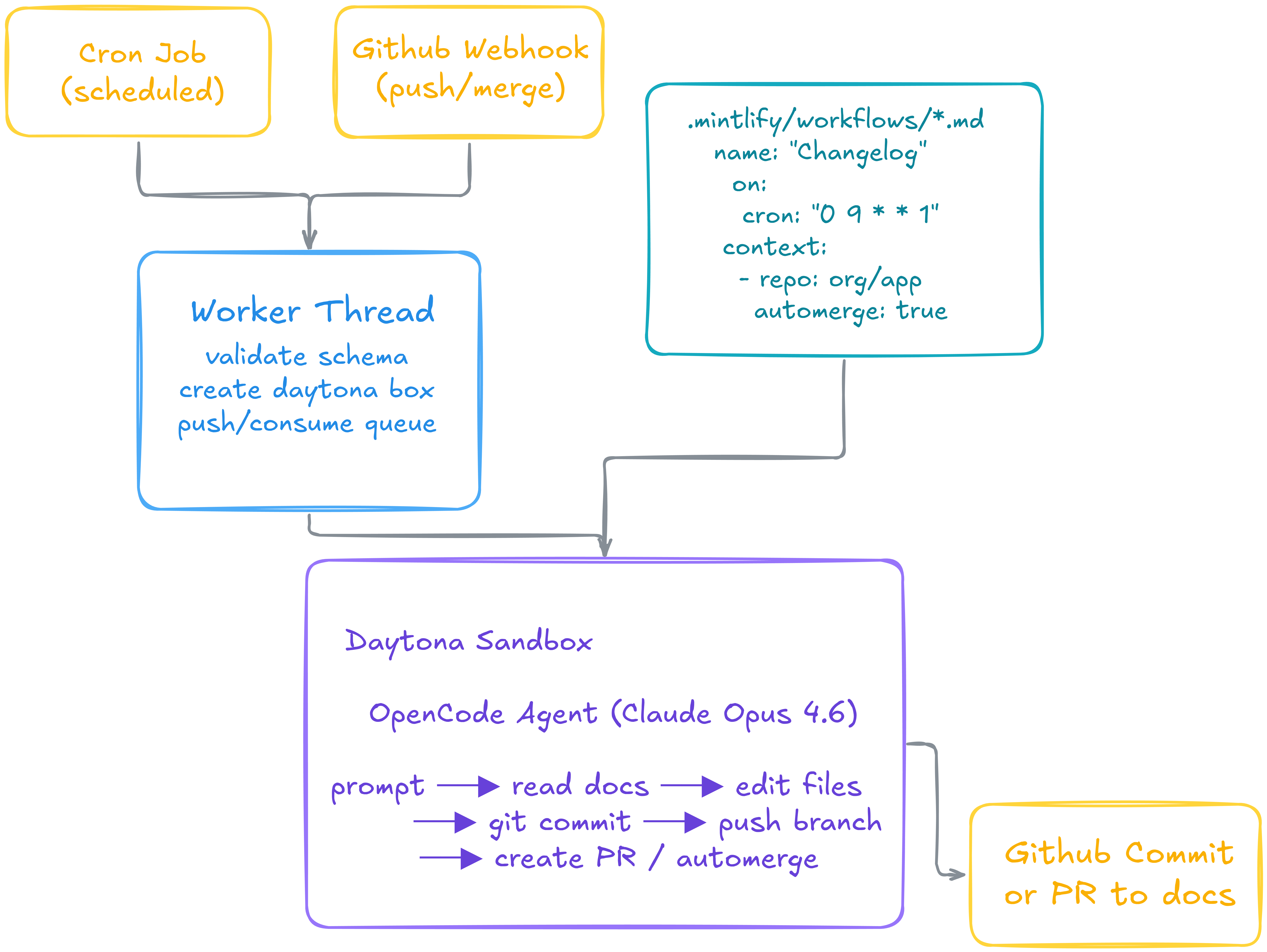
The pattern is the same one every serious agent product is converging on by giving the AI a sandbox, letting it operate, and keeping humans in the review loop. You wouldn't let a new hire push to prod without a code review, and the same principle applies here.
What Automations does
Automations is our feature that lets you define when and how Mintlify's agent takes autonomous action on your documentation, specifying triggers and instructions. It answers a simple question: when your product changes, how do your docs keep up? Automatically, of course.
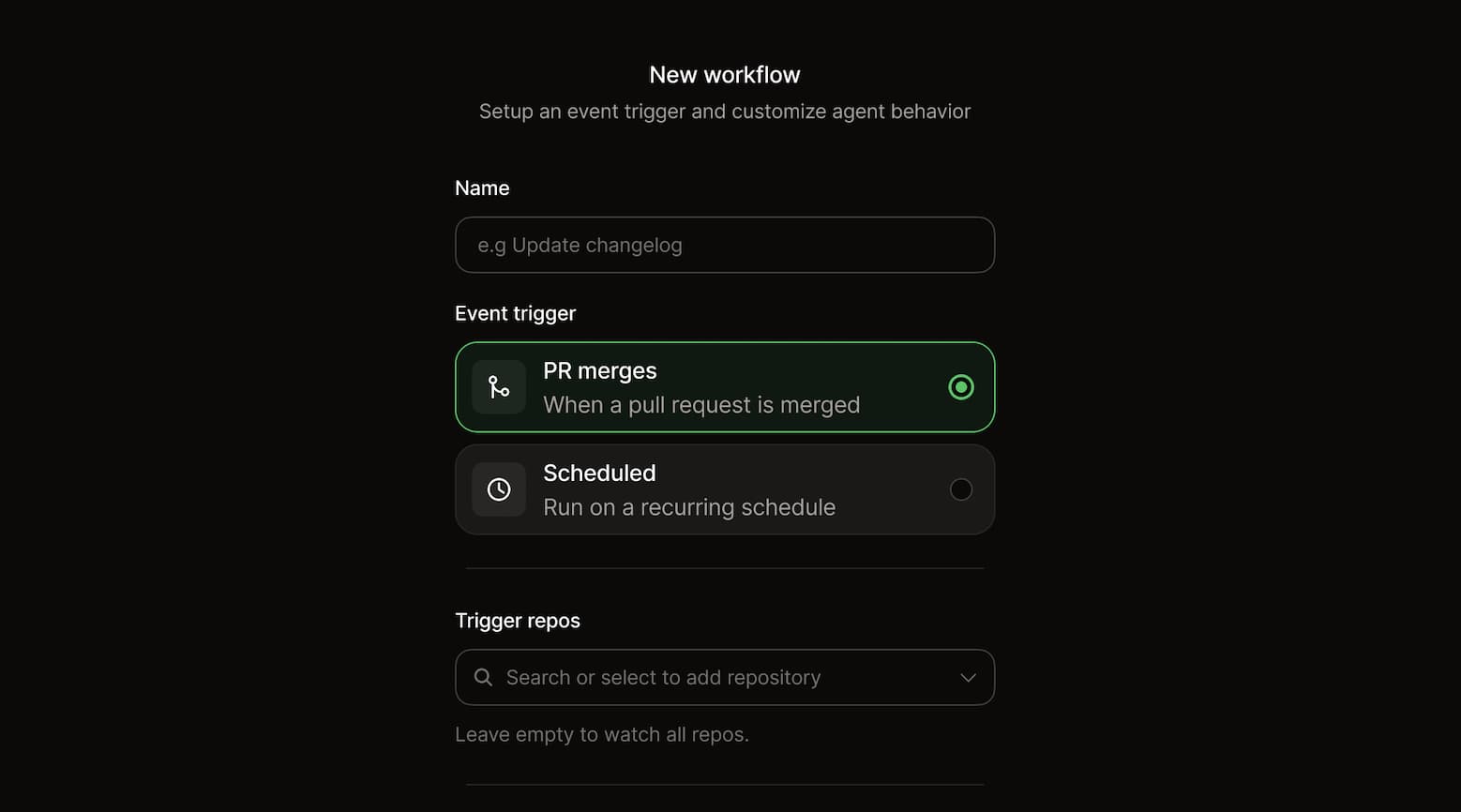
You do this by setting a trigger, either a schedule or an event like code getting pushed to a repo. You point the agent at the repos it needs for context, write instructions describing what you want done in plain language, and choose whether it opens a PR or commits directly. It's a version-controlled YAML-like config that lives in your repo. Consider how using the feature would change your week.
Say your team merges a PR that adds a new feature. Automations detects the change, reads the diff, drafts the documentation, and opens a PR. You didn't assign it, file a ticket, or Slack anyone.
That means you didn't schedule a docs sync where the agent tags the tech writer who left six months ago and whose Jira tickets are still open, which is why the agent keeps trying to message them, burning through your tokens one unanswered ping at a time (which is coincidentally the working title of their memoir about the tech industry.) You also didn't spin up a working group to determine which team owns the docs only to discover the answer is a contractor from 2023 who still has repo access and has been quietly approving PRs from a beach in Portugal.
You simply review it, leave a comment, and merge it. All your docs are current before your next standup. With Automations, documentation has become a downstream event of shipping. It is not an action item someone assigns and everyone ignores until something breaks.
The bigger picture
To document or not to document, that is the AI agent's question. We think that the teams who win in the agent era won't be the ones with the most agents, but the ones whose agents actually know what's going on because of documentation. History is written by the victors, and in the agent era, the victors will be the ones who actually wrote it down.
Quantity continues to grow with AI agents, so the question everyone will be facing is this: what's the quality of your quantity? Our thesis is that agents are already being used to produce work, so they should also be used to document, track, and maintain knowledge about that work.
Automations is our big bet on this future through using AI via triggers, context, and autonomous action while incorporating human review.
We are now all managing agent swarms that ship at superhuman speeds. Automations is our answer to what happens when you leave the record-keeping to the humans who were already behind and changes keep compounding.
Nobody is properly documenting the work the agents produce and keeping it updated seamlessly, though the velocity of agent swarms and their output is skyrocketing. That means each quarter over quarter that your team ships faster is a quarter over quarter the docs fall further behind.
It's how new hires learn how the product worked six months ago, sales references specs that don't match reality, or the AI tools your customers rely on to serve answers are based on information that's already out of date. The gap will keep widening between agent swarms and shipping until something breaks loudly because it got lost in documentation.
Automations is our first swing at closing that gap. If your team is shipping faster than your docs can follow and you know it's going to get worse, we want to hear from you. The people closest to the pain are the ones who help build the right thing. Someone has to keep track of what all these agents are doing, so it might as well be another agent keeping up with the most critical infrastructure layer as it emerges.
So we think! Stay tuned.
More blog posts to read
Autopilot: Always-on agent for self-updating docs
Autopilot is an always-on agent that reads your code and the context around it, drafts doc updates when something changes, and opens a pull request for your review.
October 20, 2026David Isquick
Product Marketing
Improved Admin MCP
The Mintlify Admin MCP server can now leave comments and suggestions, and its edits no longer need a pull request.
October 19, 2026David Isquick
Product Marketing