Kyle Finken
Engineering
Share this article
Kyle Finken
Engineering
Share this article
Agents can already browse the web, but most still operate it indirectly, and every inferred step adds latency and another opportunity for failure.
That's the problem WebMCP is designed to solve. WebMCP is a proposed web standard that lets websites expose typed tools directly to browser agents. Instead of guessing how a search box works, an agent can call a registered tool like search_docs with a defined input schema and receive a structured response.
Consider what happens when someone asks a browser agent, “How do I configure SSO?”
Without WebMCP, the agent must:
- Inspect the page and identify the search input
- Enter the search query
- Wait for the results to render
- Find the result cards and choose the correct page
- Open the page and inspect its rendered content
- Extract the relevant information and provide a response
With WebMCP, the agent can:
- Discover the site’s registered
search_docstool - Call
search_docswith the query “How do I configure SSO?” - Select a result from the structured response
- Call
read_pagewith the result’s URL - Answer using the returned Markdown
The same task moves from a sequence of inferred and attempted browser actions to two explicit tool calls.
WebMCP in Mintlify
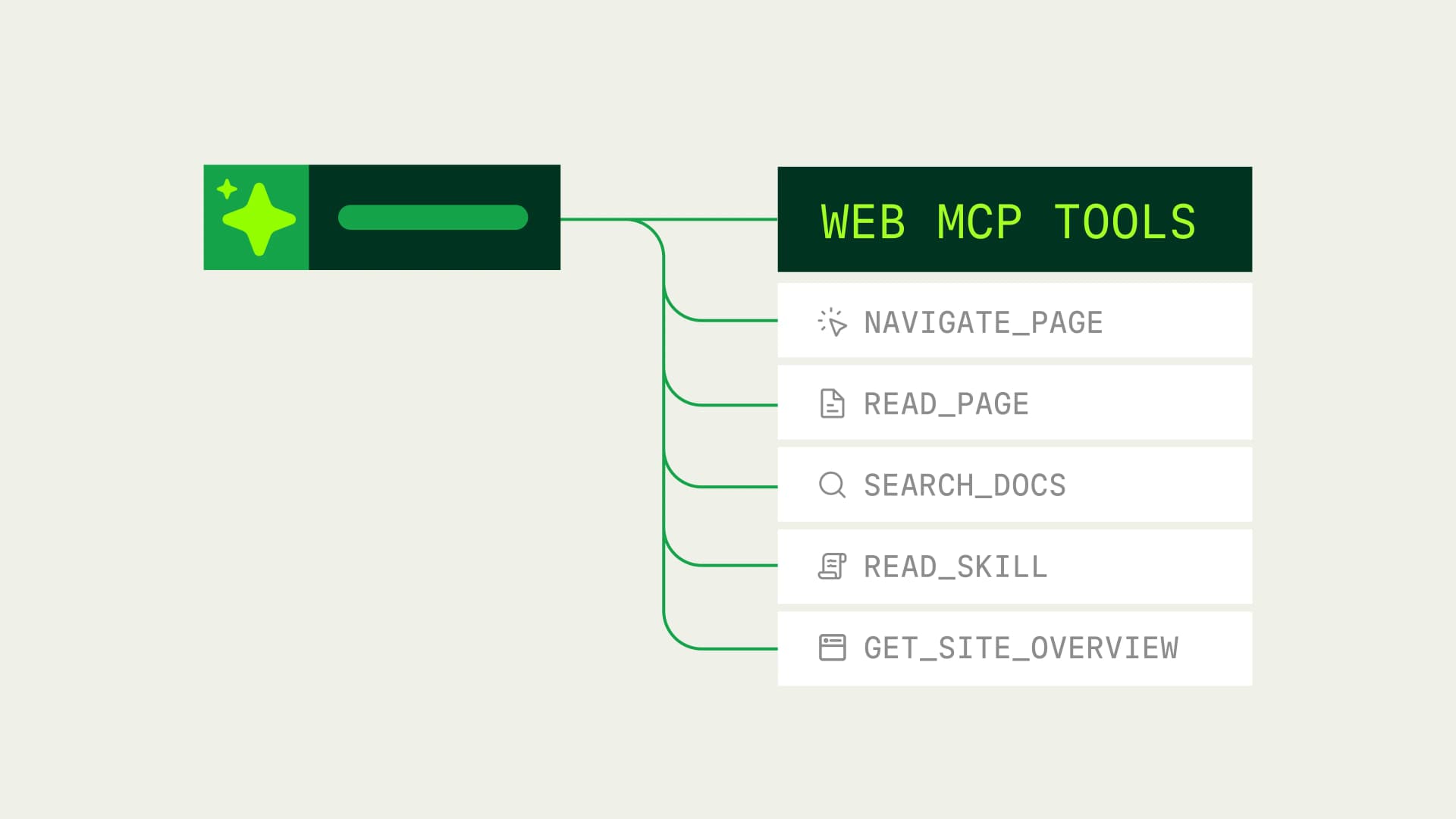
Starting today, Mintlify documentation sites on Pro plans and above will automatically expose five new WebMCP tools:
search_docs- finds relevant documentationread_page- returns a page as Markdownget_site_overview- provides an outline of the documentationread_skill- reads an available agent skillnavigate_page- moves the current browser tab to another documentation page
Together, these tools give agents structured ways to discover, retrieve, and navigate documentation without having to interpret the rendered interface. There’s nothing for teams to update or configure to enable support. When a supported browser agent opens a Mintlify documentation site, these tools become available alongside the existing interface. In browsers without WebMCP support, the site continues to work exactly as it does today.
What comes next
These five tools cover the core documentation workflows: discovering a site’s structure, finding relevant content, reading pages, and navigating between resources to find information. As agents begin using them, we’ll use real-world behavior to improve quality, refine schemas and responses, and identify additional tools worth exposing. If there's a tool you want registered on your docs, tell us on the roadmap.
Chrome plans to enable WebMCP by default in Chrome 157, expected in early November. As the standard and browser support evolve, Mintlify will adopt those improvements automatically for supported documentation sites.
We believe the future of the web is agent-first and will be built on the foundation of the web we already use today. WebMCP is an early step towards that future, and Mintlify sites are ready for it.
More blog posts to read

Rise of the Knowledge Engineer
Agents are one of the largest audiences for company knowledge, accounting for 66% of measured web traffic across documentation powered by Mintlify. The emerging role responsible for keeping that knowledge accurate and retrievable is the knowledge engineer.
September 16, 2026David Isquick
Product Marketing

Highlights from the 2026 State of Knowledge Report
AI agents overtook humans as the primary readers across Mintlify-powered sites. In August alone, agents made 257 million web requests compared to 131 million human page loads, which means agent traffic now outnumbers human traffic by nearly 2:1.
September 16, 2026Lauren Volpi
Marketing