Self-updating external docs is an infinite market
4 minutes read
Patrick Foster
Software Engineer
Share this article
Patrick Foster
Software Engineer
Share this article

Self-updating external docs will be an infinite market.
Alexandr Wang used the term "infinite market" in an interview with YC last year to describe markets that can keep growing indefinitely. His example was AWS: demand for compute keeps rising, and AWS keeps serving it. Docs are on the same path. Three trends make this clear to me.
Companies' surface areas are growing exponentially
Coding agents have dramatically increased engineering throughput. This lets companies build much larger product surface areas and take on more ambitious problems. For instance, OpenAI, Anthropic, and Notion are all building PowerPoint competitors, even though presentations are not a core competency for any of them and each is traditionally a large engineering project.
The productivity gains from agents will spread to most other parts of the business. Internally, we've considered building customer support agents, code harnesses, and deterministic SDK builders. We can only consider these because our product org now ships new products so much faster.
GitHub PR counts correlate fairly strongly with growth in a company's product surface area, and the number of PRs on GitHub has doubled in the past year. At this rate, monthly code contributions in 2035 will be roughly 500x what they are in 2026.
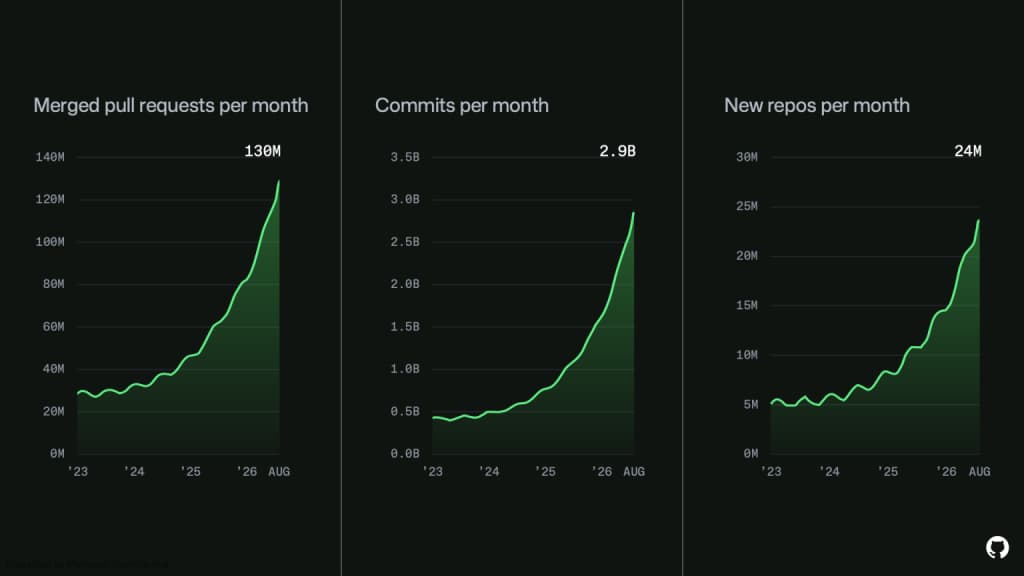
When companies build at this pace, some will end up with surface areas far larger than anything we see today.
The documentation burden is already too large to manage by hand. Our ~20 person product org has merged over 100 docs changes in the last two weeks.
Agents are your users
More than 75% of docs traffic now comes from agents. Many of my own interactions with software products are proxied through an agent. Agents already build my presentations, write docs, send Slack messages, review code on GitHub, and more.
To do this, agents need to know how to work with your entire product surface area.
Because agents can process large amounts of unstructured information, they need a product explained differently than humans do. A human skims a quickstart and gives up on a 200-page API reference, while an agent can read every endpoint, parameter, and edge case in seconds. Products should maximize the information agents can access, so agents can use them fully and correctly.
External agents cannot access primary sources
We make our personal agents more effective by giving them access to all of our primary sources of information. My Claude Code has access to PostHog, Datadog, customer support threads, our entire codebase, and more. Internal agents don't need a distilled version of these sources. They can read everything directly and draw whatever conclusions the task requires. As models and harnesses improve, this access becomes even more important because it unlocks more use cases.
However, when customers' agents interact with our product, we cannot give them access to those primary sources. Reading the codebase is a security risk, and Slack threads expose personal information. External agents need a curated subset of our internal information.
Every company will need self-updating docs
Together, these trends leave every software company with the same problem: "We have an enormous, exponentially growing product surface. Agents are our users, and to maximize their usage of our platform, we need to share as much information as possible without exposing anything private."
As models improve and agents take on more work, this problem will only get bigger. Every product company will run into it.
The vision for self-updating docs is to be the truth engine that builds the external-facing representation of your product.
This is a hard problem to solve well. It requires understanding most of the business to make judgment calls about what should and shouldn't be shared publicly. It needs to understand who's who in the organization so it can verify information and capture knowledge that was shared offline. And it needs to organize all of that information in the structure that is most accessible to the agents reading it.
As companies' product surface areas grow exponentially, there will be growing demand to distill all of their information into an external agent-ready representation.
More blog posts to read

Bring your own skills to the Mintlify agent
You can now upload custom skills to the agent in the web editor. Give it your style guide, review checklist, or page templates once, and it uses them whenever a task calls for them.
October 23, 2026David Isquick
Product Marketing
Autopilot: Always-on agent for self-updating docs
Autopilot is an always-on agent that reads your code and the context around it, drafts doc updates when something changes, and opens a pull request for your review.
October 20, 2026David Isquick
Product Marketing