Highlights from the 2026 State of Knowledge Report
5 minutes read
Lauren Volpi
Marketing
Share this article
Lauren Volpi
Marketing
Share this article

Something major happened this year: AI agents overtook humans as the primary readers across Mintlify-powered sites. In August alone, agents made 257 million web requests compared to 131 million human page loads, which means that agent traffic now outnumbers human traffic by nearly 2:1.
There are still people behind every one of those agent requests. They've just stopped doing the reading themselves.
The 2026 State of Knowledge Report digs into what this shift means, what it costs companies that aren't ready, and what leaders are doing differently. Here's a preview of what we found.
Agents aren't bots, they're your customers
It's tempting to lump agent traffic in with crawlers and filter it out. But that is a mistake. As Chris Riley of HubSpot puts it, treating non-human traffic as noise "means you're now filtering out your customers."
The data backs him up. In August, 83% of agent traffic arrived through deliberately machine-friendly routes—Markdown versions of pages, llms.txt files, and agent skills. And MCP tool calls exploded that same month, tripling since February.
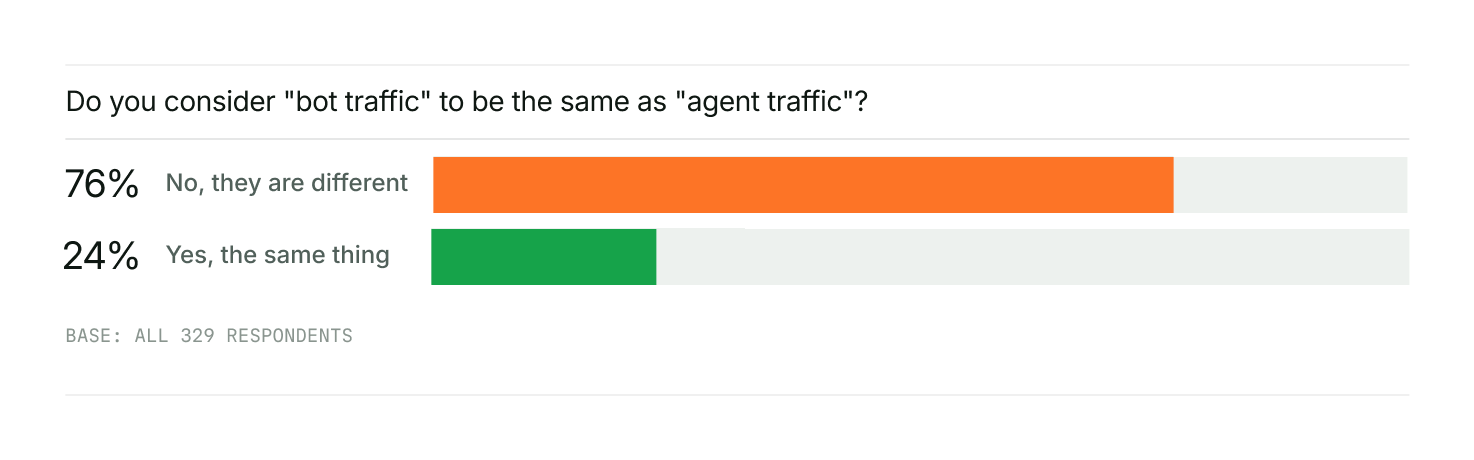
Bots crawl indiscriminately while agents are sent to accomplish tasks. Yet 24% of surveyed companies still don't see the distinction.
Navigation is the failure point
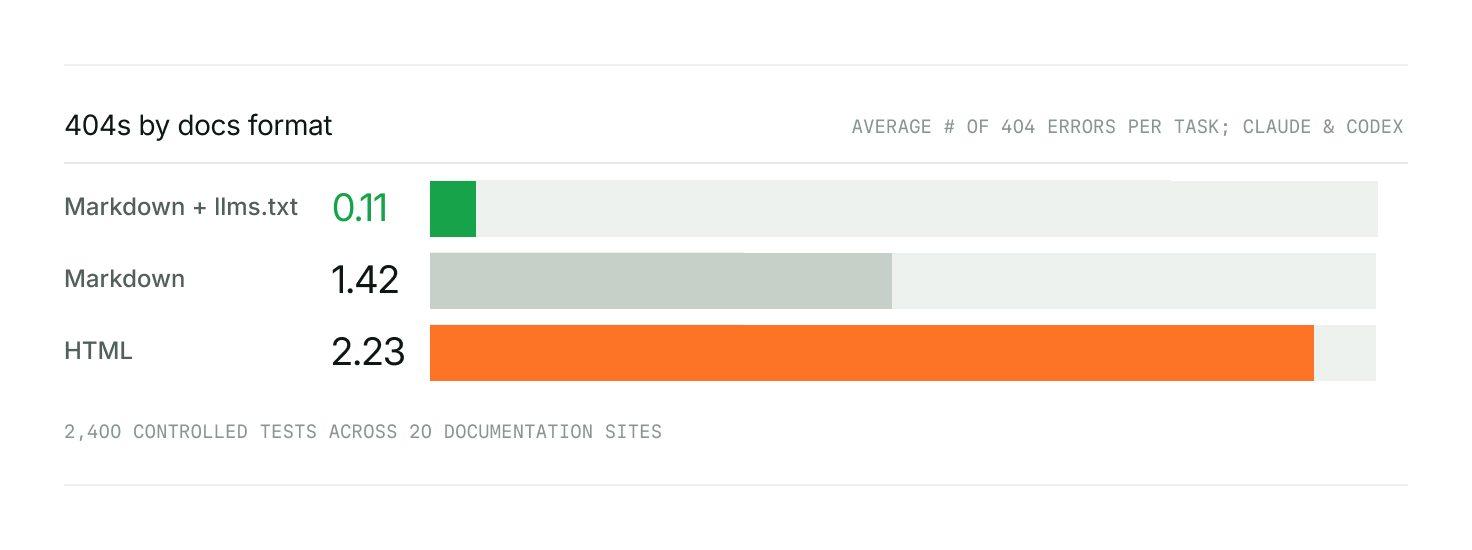
We kept noticing agents requesting pages that didn't exist. They'd hit a 404, back up, and guess again. So we ran 2,400 controlled tests across 20 documentation sites to see if we could get agents to navigate to live pages rather than just guess at URLs.
Initially, we thought it might be a matter of file format. Markdown is more efficient than HTML—Markdown versions of pages result in fewer failed requests per task—but serving Markdown can strip navigation elements that show how pages relate to each other.
Adding a link to a site's llms.txt in the Markdown versions of pages made a 20x improvement over HTML. The failed requests per task dropped significantly when agents were given a path to all the content on the site via the llms.txt file. This optimization also cut token consumption by up to 60%, meaning you can save your customers money by making your docs better.
Agents are writing docs too
Keeping documentation current has always been the hardest part of the job, and the pace is accelerating. Merged pull requests are up 3.6x since 2023, but no team is manually documenting 3.6x more.
The same page that misled one developer now misleads an unknowable number of agents, which then propagate that misunderstanding to downstream users.
— Sarah Deaton, Technical Content Engineer for Claude Code, Anthropic
So agents are stepping in. Between February and August 2026, users directed the Mintlify agent to update documentation nearly 367,000 times. By the end of that window, 95% of that volume was fully automated via webhooks and cron jobs, and more than 61% of the resulting pull requests were merged.
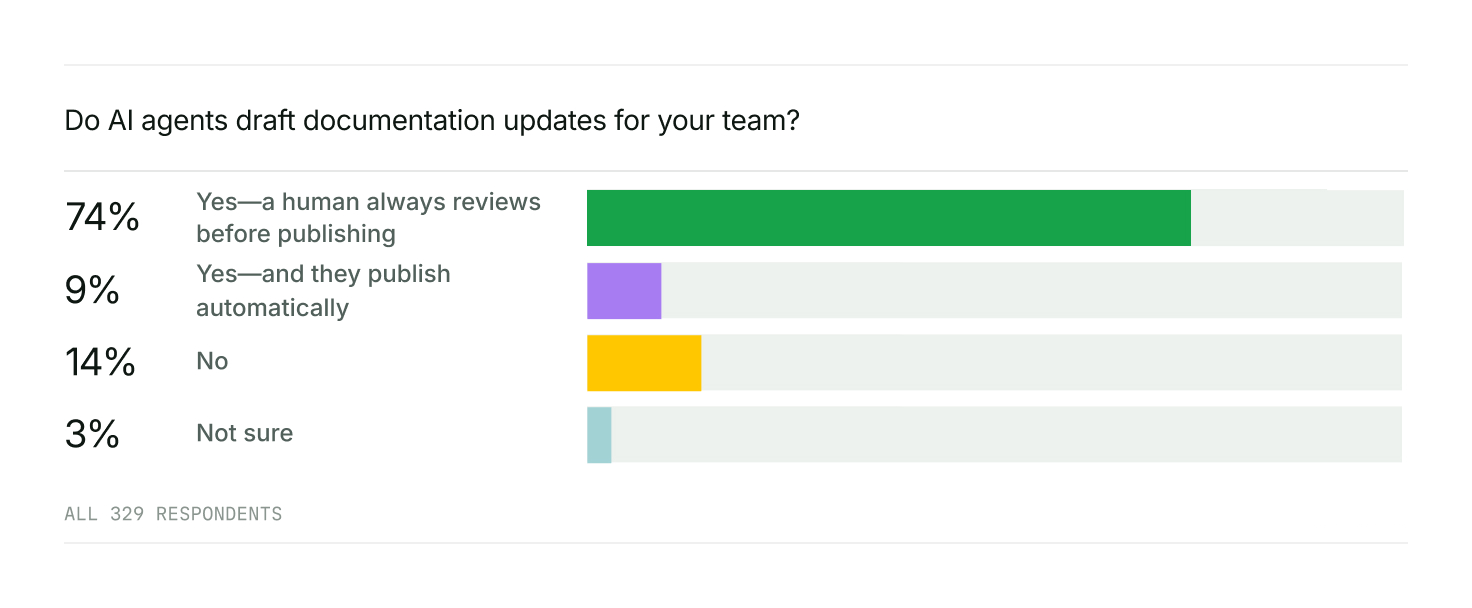
Our survey confirms the trend: 83% of respondents say AI agents now draft documentation updates for their team. But humans haven't left the loop—only 9% let agents publish without review. Documentation is becoming a system that reads itself and drafts its own improvements, with people deciding what's true and what ships.
It doesn't stop at docs
Docs are just one knowledge surface, and agents answer from whatever they can reach. This includes help centers, community forums, changelogs, and support archives. More than half of respondents say their company's knowledge is spread across five or more surfaces, yet less than a third rate "most" or "all" of it as AI-ready.
Docs vs. Knowledge
| Term | What it covers |
|---|---|
| Documentation | What you publish for people building with your product: guides, tutorials, API reference. |
| Knowledge | All of that, plus everything else that explains your product, your company, and how it all works: the help center, the community forum, the changelog, support tickets, sales enablement, premium customer portals behind auth, and more. |
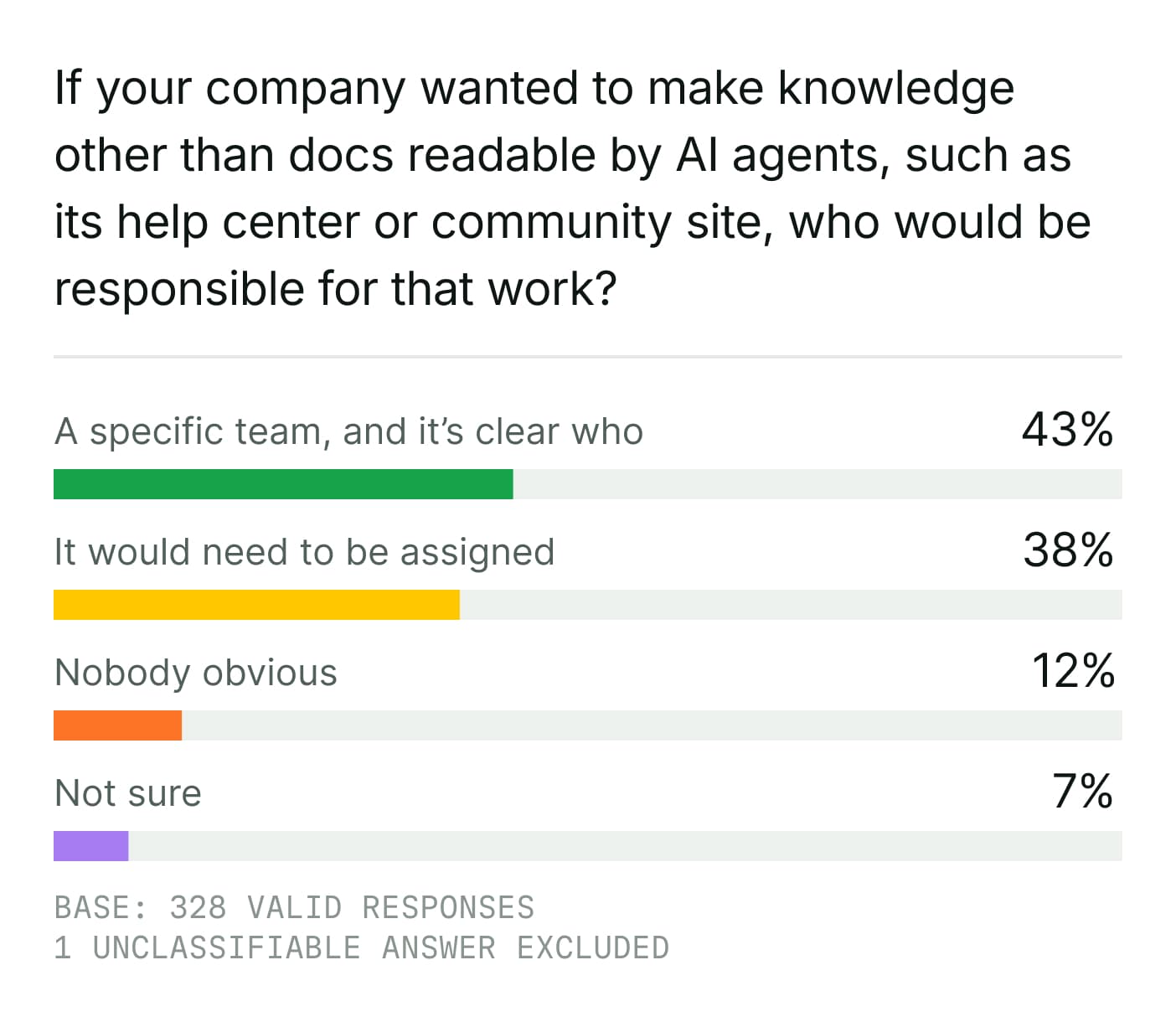
Lack of ownership and know-how are largely to blame for the lag. Docs can sit with DevRel, the help center with support, community with marketing, the changelog with product—four teams, four tools, four versions of "truth." And as Mintlify Co-founder and CEO Han Wang says, "Knowledge and the ability to make it agent-accessible often don't sit in the same place."
Ironically, confidence is running well ahead of readiness: 79% of companies rate their knowledge as average or ahead of the pack, but just 7% have made every surface they own readable by an agent.
What the full report covers
This is only a sample of what our research uncovered. The full 2026 State of Knowledge Report includes:
- Complete survey findings from 329 respondents on AI-readiness, tooling, and ownership
- Full methodology and results from our 2,400-test navigation benchmark, plus the open-source tool to test your own docs
- How Anthropic runs Claude Code documentation with a single person and an agent-powered feedback loop
- The rise of the "knowledge engineer" and what the role entails
- Insight from industry leaders at Decagon, HubSpot, Gauge, and more
Agents aren't waiting for your knowledge strategy to get sorted. They're already reading everything they can reach—and answering from whatever they find.
More blog posts to read

Rise of the Knowledge Engineer
Agents are one of the largest audiences for company knowledge, accounting for 66% of measured web traffic across documentation powered by Mintlify. The emerging role responsible for keeping that knowledge accurate and retrievable is the knowledge engineer.
September 16, 2026David Isquick
Product Marketing
Automations, rebuilt
We redesigned automations for quicker setup with pre-built automations optimized for common use cases. Choose the right automations for your project and you're set. No context engineering required.
September 15, 2026Patrick Foster
Software Engineer