Dub is the open-source link-management platform that turns every click into attribution infrastructure for 48,000+ customers and 4,000+ active companies.
What began as Steven Tey's side project grew into an API-first business whose links connect the user journey from first click to final conversion.
48,000+
customers and 4,000+ active companies supported
150+
commits in a single month driven by docs feedback
Challenge
As Dub grew from a side project into an API-first platform, documentation became essential to scaling support. Building and maintaining a documentation site and API playground from scratch would have taken development time, while customers needed a way to find answers on their own.
Solution
The team had consolidated every doc and help article onto Mintlify so all their support content lived in one place. On every push to main, those changes synced to a database. A custom chat interface then retrieved content from that vector store and generated responses using the AI SDK and Claude Sonnet. The AI agent could even use tool calling to pull in a user's workspace and partner data, so responses were specific to whoever was asking.
An AI support system
The founder of Dub, Steven Tey, recently posted what he called "the magic formula" for AI support. Dub, the open-source link management infrastructure, had built a system where customers could ask questions in a chat interface and get accurate, context-aware answers pulled directly from their documentation. When a human was needed, the system seamlessly created a support ticket with full context attached.
At the center of the whole thing was Mintlify.
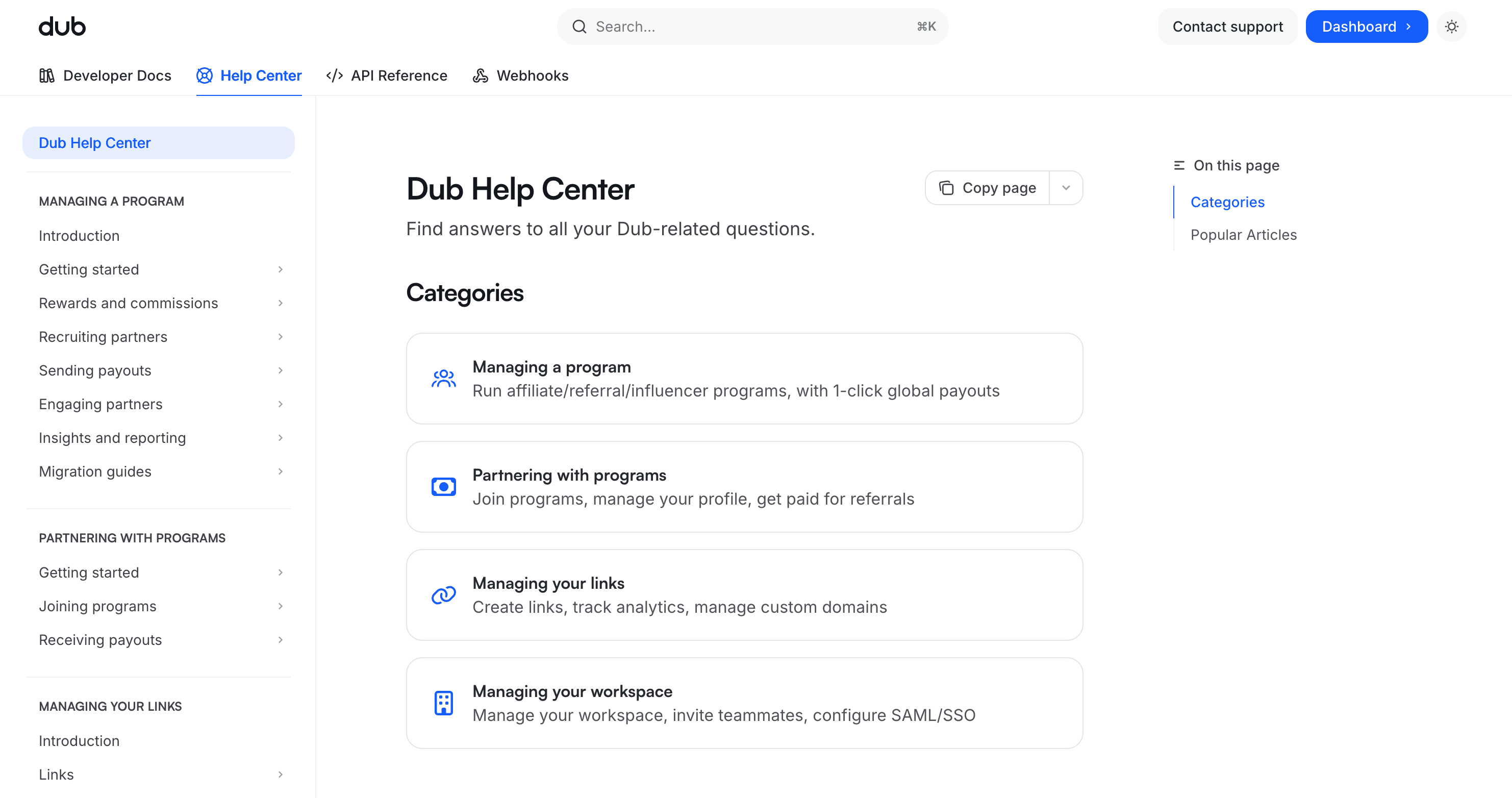
When a conversation needed a human touch, the system surfaced a ticket upload UI where users could attach screenshots and add context before a ticket was created on Plain. And because the chat interface was embeddable, Dub could surface it in both their Mintlify docs and their support portal.
Since we launched this, it's been a gamechanger for scaling support, reducing support workload and creating a much better experience for our users.

Steven Tey
Founder of Dub
From side project to API-first platform
But the story of how Dub got here starts years earlier.
Steven introduced Dub in 2022 with an ambitious idea: reimagine links, one of the most foundational pieces of the web, from simple resource locators into a full attribution engine that could visualize the user journey from first click to final conversion.
The natural next step was a REST API so users could programmatically create short links. Steven started building, and from day one, he chose Mintlify for the documentation and API playground.
"Mintlify provides a stellar experience for your users that you don't need to spend a month building and polishing," Steven said. He was drawn to the OpenAPI-compatible interactive docs, cross-language support, and dark mode. "Best part? Your users can test out your endpoints directly in the docs."
Documentation as an early investment
The side project became a business in January 2024 and quickly scaled to 48,000+ customers and 4,000+ active companies.
"Building a performant, in-depth documentation site is vital to scale support as an early-stage company," Steven said. "We invested in it early and it has returned dividends for us."
Three capabilities proved especially important as Dub grew.
The first was Mintlify's API playground. "An API playground is indispensable for us," Steven said. Building one from scratch would have been a time sink. Mintlify's OpenAPI-compatible interactive playground gave users an environment to make requests and preview endpoints without leaving the docs.
The second was pre-built UI components. Steven particularly liked using the <Steps /> component for Dub's self-hosting guide. "You can create gorgeous step-by-step instructions for your docs in just a few lines of code."
The third was GitHub integration, critical for an open-source company where community contributions matter. "GitHub issues and discussions are like a feature request board for us," Steven explained. The team moved Dub's API docs to a separate repository for faster deployments, and Mintlify's GitHub integration made that seamless. The feedback buttons in the docs drove 150+ commits in a single month.
From precise anchor links to code snippets to dark mode, Mintlify provides everything you need to create delightful docs. I'm absolutely loving the product and experience.
Steven Tey
Founder of Dub
Docs as infrastructure
What makes Dub's story compelling is the arc. They're using Mintlify to build a docs site, but they also turned that docs site into the foundation for an AI-powered support system that serves tens of thousands of customers. The investment in high-quality, well-structured documentation became the data layer that powers their entire support operation.
"If you're building an API," Steven said, "Mintlify is the perfect docs platform to provide stellar DX to your users."