Overview
Airbnb has transformed the hospitality industry by creating a global marketplace connecting hosts and guests. From its humble beginnings as a simple website to becoming a platform operating in 200+ countries, Airbnb has served over 1.5 billion guests and empowered 4 million hosts worldwide. This case study explores Airbnb’s remarkable architectural journey from a monolithic application to a sophisticated Service-Oriented Architecture (SOA) that powers one of the world’s largest marketplaces.The Journey: 0 to 1.5 Billion Guests
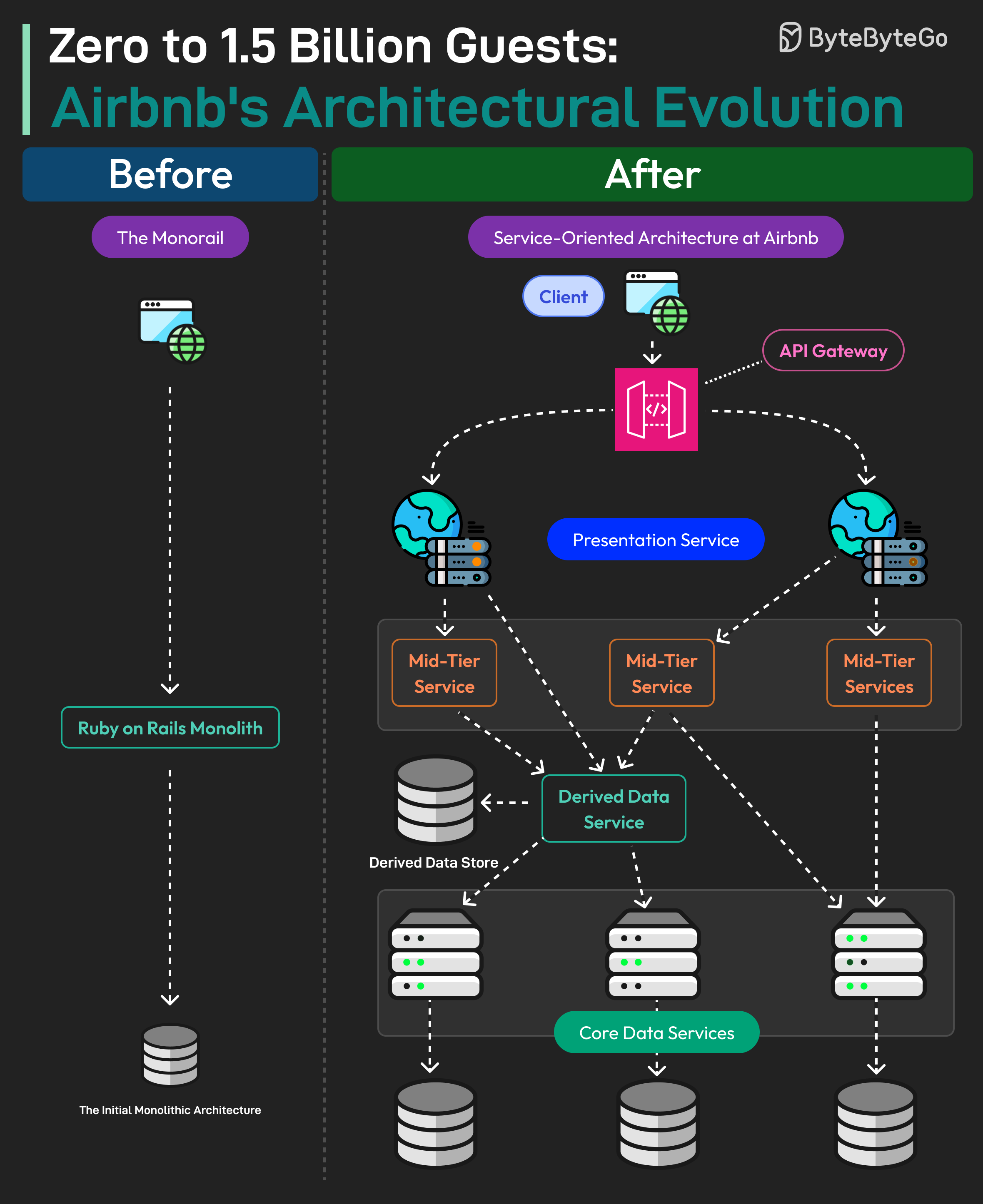
Stage 1: Monolithic Architecture (2008-2017)
The Monorail
Airbnb started with a monolithic application built using Ruby on Rails, internally known as the Monorail.Monolith Architecture
Monolith Architecture
Characteristics:
- Single-tier application
- Client and server-side functionality combined
- All code in one repository
- Deployed as a single unit
- Ruby on Rails: Web framework
- PostgreSQL: Primary database
- Memcached: Caching layer
- AWS: Infrastructure
- Simple to develop and deploy
- Easy debugging
- Fast iteration for small team
- No network overhead between components
- Single codebase to maintain
Growing Pains
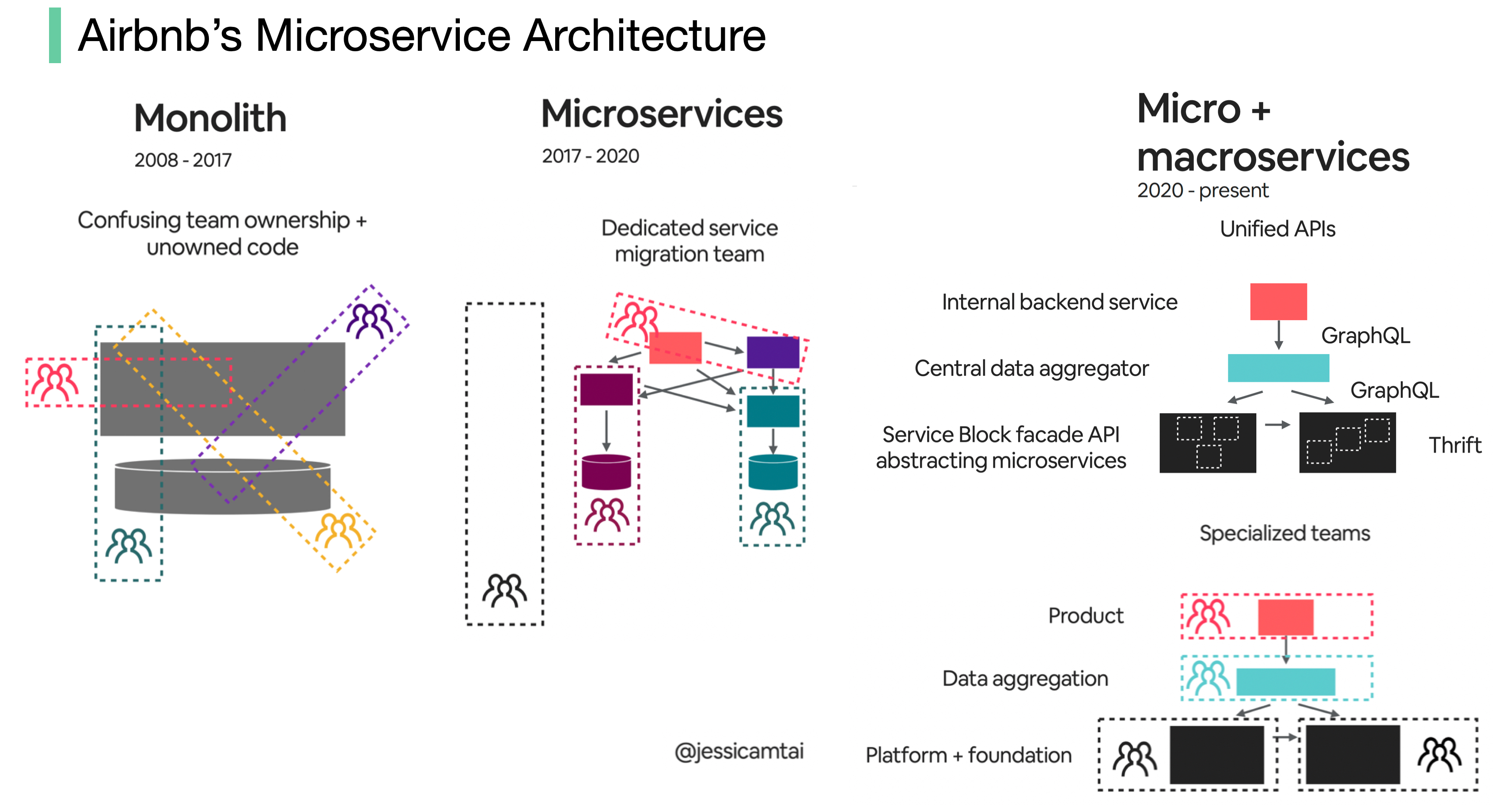
As Airbnb entered hypergrowth phase, the Monorail began facing critical challenges:Scalability Issues
- Difficult to scale specific features independently
- Entire app needed redeployment for small changes
- Resource contention between features
- Database bottlenecks
Development Velocity
- Large codebase difficult to navigate
- Conflicts between teams
- Long build and test times
- Risky deployments affecting entire platform
Team Organization
- Unclear code ownership
- Unowned code accumulated
- Cross-team dependencies
- Difficult to parallelize work
Technical Debt
- Tightly coupled components
- Difficult refactoring
- Performance optimization challenges
- Limited technology choices
Stage 2: Microservices Architecture (2017-2020)
Service-Oriented Architecture at Airbnb
Airbnb defined their SOA as:“A network of loosely coupled services where clients make requests to a gateway, and the gateway routes these requests to multiple services and databases.”
Service Layers
Airbnb organized their services into four distinct layers:Layer 1: Data Service
Layer 1: Data Service
Role: Entry point for all data operationsResponsibilities:
- CRUD operations on data entities
- Data validation
- Access control
- Database abstraction
- User Service (user profiles, authentication)
- Listing Service (property data)
- Reservation Service (booking data)
- Payment Service (transaction data)
- One service per major data entity
- Strong consistency within entity boundaries
- RESTful API design
- Clear ownership by domain teams
Layer 2: Derived Data Service
Layer 2: Derived Data Service
Role: Read from data services and apply basic business logicResponsibilities:
- Data aggregation
- Simple transformations
- Computed fields
- Derived metrics
- Search Service (aggregates listing data with availability)
- Pricing Service (derives pricing from multiple sources)
- Recommendation Service (computes suggestions)
- Read-heavy operations
- Can cache aggressively
- Eventual consistency acceptable
- Composes data from multiple data services
Layer 3: Middle Tier Service
Layer 3: Middle Tier Service
Role: Complex business logic that doesn’t fit in other layersResponsibilities:
- Orchestration of multiple services
- Complex business workflows
- Cross-entity transactions (using Sagas)
- Domain-specific logic
- Booking Workflow Service
- Cancellation Service
- Host Onboarding Service
- Trust & Safety Service
- Orchestration over choreography
- Saga pattern for distributed transactions
- Service-to-service authentication
- Idempotency for reliability
Layer 4: Presentation Service
Layer 4: Presentation Service
Role: Aggregate data for specific client interfacesResponsibilities:
- BFF (Backend for Frontend) pattern
- UI-specific aggregations
- Response formatting
- Client-specific business logic
- iOS BFF Service
- Android BFF Service
- Web BFF Service
- Partner API Service
- Client-optimized responses
- Reduce client-side complexity
- Handle client-specific logic
- GraphQL for flexible queries
Migration Strategy
Phased Approach:- Identify Boundaries: Domain-driven design to identify service boundaries
- Extract Services: Gradually extract services from monolith
- Route Traffic: Gateway routes to new services
- Maintain Monorail: Monolith continued serving legacy endpoints
- Complete Migration: All reads/writes eventually migrated
- No “big bang” migration
- Continuous delivery throughout
- Rollback capability at each step
- Incremental validation
- Team-by-team migration
Technology Choices
Service Development:- Primarily Ruby and Java
- Kotlin for newer services
- GraphQL for client APIs
- Thrift for service-to-service communication
- Kubernetes for orchestration
- AWS as cloud provider
- Envoy as service mesh
- Kafka for event streaming
- MySQL for transactional data
- PostgreSQL for analytical workloads
- Redis for caching
- Elasticsearch for search
- S3 for object storage
New Challenges
While microservices solved many problems, they introduced new ones:Complexity
- Hundreds of services to manage
- Complex dependency graphs
- Difficult to understand end-to-end flows
- Debugging across service boundaries
Operational Overhead
- More infrastructure to maintain
- Service discovery and routing
- Distributed tracing needed
- Circuit breakers and fallbacks
Data Consistency
- Distributed transactions
- Eventual consistency challenges
- Data duplication across services
- Cache invalidation complexity
Performance
- Network latency between services
- Cascading failures
- More complex optimization
- Resource overhead
Stage 3: Micro + Macro Services (2020-Present)
The Hybrid Model
Airbnb recognized that pure microservices architecture had gone too far in some areas. The solution: a hybrid approach combining microservices with macro services.The Philosophy
The Philosophy
Key Principles:Micro Services:
- For rapidly changing domains
- When teams need independence
- For experimental features
- When scale requirements vary
- For stable, mature domains
- When tight integration is beneficial
- To reduce operational complexity
- When consistency is critical
- Not every component needs to be a separate service
- Group related functionality into macro services
- Reduce number of network hops
- Simplify operational model
Unified API Layer
Focus on unification of APIs across the organization: API Gateway Strategy:- Single entry point for clients
- GraphQL Federation for unified schema
- Domain teams own their subgraphs
- Gateway orchestrates queries
- Clients have single API to integrate
- Backend can reorganize without client changes
- Better developer experience
- Versioning handled centrally
Service Consolidation
Strategic consolidation of related microservices: Consolidation Criteria:- Services with tight coupling
- Frequent cross-service transactions
- Services owned by same team
- Low independent scale requirements
- Multiple listing-related services → Listing Domain Service
- Small payment services → Unified Payment Service
- Related search services → Search Platform Service
- Reduced operational complexity
- Improved performance (fewer network calls)
- Easier reasoning about business logic
- Better reliability
Key Technologies and Patterns
Communication Patterns
Synchronous
- REST APIs for simple queries
- GraphQL for flexible data fetching
- gRPC for high-performance service-to-service
Asynchronous
- Kafka for event streaming
- Event sourcing for audit trails
- Saga pattern for distributed transactions
Data Management
Database per Service:- Each service owns its data
- No shared databases
- Data duplication accepted
- Event-driven synchronization
- Distributed transaction management
- Compensating transactions for rollback
- Event-driven coordination
- Used for booking, cancellation workflows
Observability
Three Pillars:Metrics
Metrics
- Service-level metrics (latency, error rate, throughput)
- Business metrics (bookings, revenue)
- Infrastructure metrics (CPU, memory)
- Custom dashboards per team
Logging
Logging
- Structured logging across all services
- Centralized log aggregation
- Search and analysis tools
- Automated alerting on error patterns
Tracing
Tracing
- Distributed tracing with unique request IDs
- End-to-end request visualization
- Performance bottleneck identification
- Cross-service dependency mapping
Resiliency Patterns
Circuit Breakers
Prevent cascading failures by failing fast when dependencies are down
Retries
Automatic retry with exponential backoff for transient failures
Timeouts
Aggressive timeouts to prevent resource exhaustion
Bulkheads
Isolate resources to prevent failures from spreading
Fallbacks
Graceful degradation with cached or default responses
Rate Limiting
Protect services from being overwhelmed
Organizational Impact
Team Structure
Before Microservices:- Teams organized by technical layer (frontend, backend, DBA)
- Unclear ownership of features
- Cross-team dependencies for every feature
- Teams organized by business domain
- Full-stack ownership (frontend to database)
- Clear accountability
- Autonomous deployment
Development Process
Service Ownership
Service Ownership
Each service has:
- One owning team
- Clear SLA commitments
- On-call rotation
- Documentation and runbooks
- Monitoring and alerting
- Accountability
- Faster decision-making
- Better code quality
- Domain expertise
API-First Development
API-First Development
Process:
- Define API contract first
- Review with consuming teams
- Generate client SDKs
- Implement service
- Versioning strategy for changes
- OpenAPI/Swagger specs
- Automated SDK generation
- Contract testing
- API documentation portal
Lessons Learned
The Human Side: Airbnb’s journey highlights that architectural decisions are as much about people and organization as they are about technology. Team structure must evolve with architecture.
Key Takeaways
1. Monoliths Aren’t Evil:- Perfect for early-stage startups
- Appropriate until scale demands otherwise
- Don’t prematurely adopt microservices
- Introduce significant operational complexity
- Require mature DevOps practices
- Organizational readiness is critical
- Can go too far (hundreds of tiny services)
- Combine micro and macro services
- Consolidate when it makes sense
- Not everything needs to be separate
- Optimize for team productivity
- Clear separation of concerns
- Predictable dependency patterns
- Easier to reason about architecture
- Prevents tight coupling
- GraphQL Federation works well at scale
- Single API surface for clients
- Teams maintain autonomy
- Better developer experience
- Conway’s Law is real
- Team boundaries should match service boundaries
- Clear ownership is essential
- Communication patterns follow architecture
Scale and Impact
By the Numbers
- 1.5 billion guests served
- 4 million hosts empowered
- 200+ countries and regions
- Hundreds of microservices
- Thousands of engineers
- Millions of listings
Business Impact
The architectural evolution enabled:- Faster feature development
- Better reliability and uptime
- Improved performance
- Global expansion
- New product lines (Experiences, etc.)
- Ability to handle massive traffic spikes