Overview
The Dollar MEP/CCL Calculator provides real-time exchange rates across all available instruments, helping you identify the most favorable rates for buying or selling dollars through financial markets.MEP vs CCL: Dollar MEP (Mercado Electrónico de Pagos) uses local market instruments (D suffix), while Dollar CCL (Contado con Liquidación) uses foreign market instruments (C suffix) that can be sold abroad.
What is Dollar MEP and CCL?
Dollar MEP (Mercado Electrónico de Pagos)- Buy bonds in pesos, sell them in dollar-denominated version
- Settled domestically in Argentina
- Typically has tighter spreads
- Lower transaction costs
- Buy bonds in pesos, sell them in foreign markets (NYSE, etc.)
- Dollars can be transferred abroad
- Usually trades at a premium to MEP
- Subject to international settlement timing
Scanner Interface
- Dollar MEP
- Dollar CCL
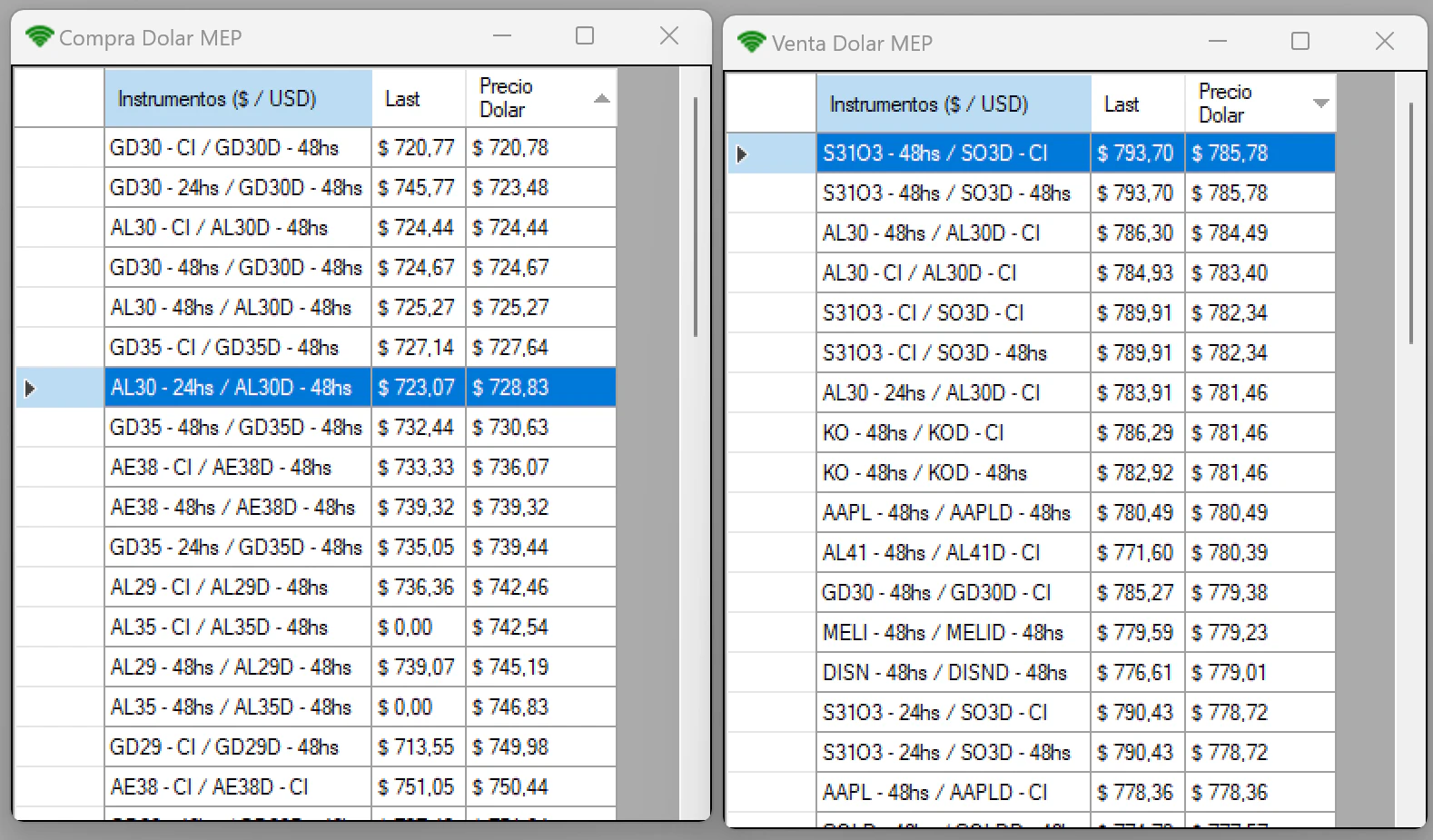
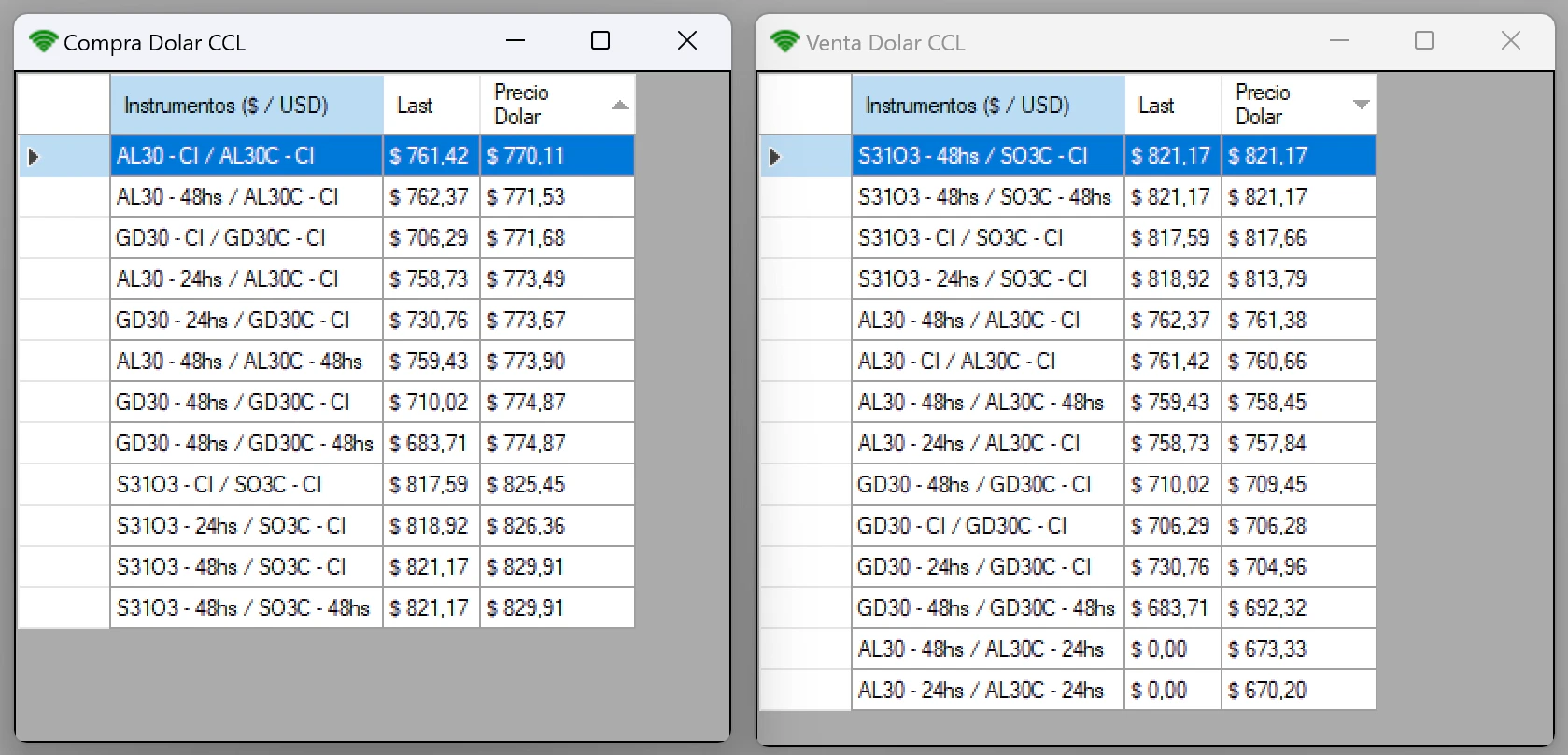
How to Access
Open the Dollar MEP/CCL scanners from the main menu:- Dolar → MEP (for Dollar MEP)
- Dolar → CCL (for Dollar CCL)
Calculation Logic
The exchange rate is calculated using real-time market data:Buying Dollars (Pesos → Dollars)
Selling Dollars (Dollars → Pesos)
Last Price (Reference Only)
Scanner Columns
| Column | Description |
|---|---|
| Instrument | Bond or asset ticker (e.g., AL30, GD30, GGAL) |
| Trade | Settlement terms (CI/CI, 24hs/24hs, etc.) |
| Last | Reference exchange rate from last traded prices |
| Buy Price | Exchange rate to BUY dollars (higher = worse) |
| Sell Price | Exchange rate to SELL dollars (higher = better) |
| Spread | Difference between buy and sell prices |
Operation Workflow
Buying Dollars (Pesos → USD)
Example - Buying $1,000 USD via MEP:
- Scanner shows AL30 MEP buy price: $550 pesos/dollar
- Buy AL30 in pesos: 550 nominals × 550,000 pesos
- Wait for settlement (parking period required by regulation)
- Sell AL30D: 550 nominals × 1,000 USD
- Net cost: ~1,000 USD (plus fees)
Selling Dollars (USD → Pesos)
Parking Period: Argentine regulations require a mandatory waiting period between legs of MEP/CCL operations (typically 1-2 business days). Check current CNV regulations.
Settlement Term Options
The scanner shows different settlement combinations:CI / CI
Both legs settle immediately. Requires both instruments available in CI.
24hs / 24hs
Both legs settle next business day. Most common for liquid bonds.
CI / 24hs
Mixed settlement terms. Consider financing costs for the mismatch.
24hs / CI
Reverse mixed settlement. May offer arbitrage opportunities.
Supported Instruments
ChuchoBot monitors all configured instruments and automatically creates MEP/CCL pairs:Automatic Ticker Convention
Common Instruments for Dollar Operations
- Sovereign Bonds: GD30, AL30, AE38, AL29
- Treasury Bills: S31Y4, X20Y4
- Corporate Bonds: Various PYME CNV bonds
- CEDEARs: GGAL, YPF, BMA (less common for dollar ops)
Liquid sovereign bonds like GD30 and AL30 typically offer the best spreads and deepest markets for dollar operations.
Configuring Instrument Exceptions
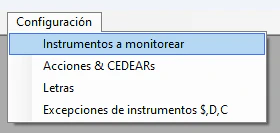
Some instruments don’t follow the standard ticker convention:- Go to Configuración → Excepciones de instrumentos $;D;C
- Add exceptions in format:
{Ticker Pesos};{Ticker MEP};{Ticker CCL} - Example:
X20Y4;XY4D;XY4C
Understanding Market Data
The scanner uses real-time WebSocket data to calculate rates:Fees and Costs
Consider all transaction costs when calculating effective dollar rates:Per-Transaction Fees
- Broker commission: 0.10% - 0.60% per leg (2 legs total)
- Market rights: 0.01% for bonds, 0.001% for treasury bills
- VAT: 21% on commissions
Implicit Costs
- Bid/ask spread: Difference between buy and sell prices
- Slippage: Price movement during execution
- Parking period: Opportunity cost of locked funds
Best Practices
Choose Liquid Instruments
Choose Liquid Instruments
Stick to high-volume bonds (GD30, AL30) for tighter spreads and better execution.
Compare Multiple Instruments
Compare Multiple Instruments
The scanner shows all available rates. Small differences can be significant on large amounts.
Monitor CI Availability
Monitor CI Availability
CI settlement offers speed but may have wider spreads or limited availability.
Consider Total Costs
Consider Total Costs
The scanner shows exchange rates, but factor in all commissions and fees for true cost.
Watch Market Hours
Watch Market Hours
Best liquidity and spreads typically occur mid-morning through early afternoon.
Respect Parking Period
Respect Parking Period
Violating the mandatory parking period can result in penalties from CNV.
MEP vs CCL: Which to Use?
| Factor | Dollar MEP | Dollar CCL |
|---|---|---|
| Transfer abroad | No | Yes |
| Typical rate | Lower | Higher (premium) |
| Spreads | Tighter | Wider |
| Liquidity | Higher | Lower |
| Settlement | Domestic | International |
| Best for | Peso/dollar conversion | Moving money abroad |
If you don’t need to transfer dollars abroad, MEP typically offers better rates due to higher liquidity and lower spreads.
Troubleshooting
Why do some instruments show zero prices?
Why do some instruments show zero prices?
The instrument may not be trading in that settlement term, or there’s no current bid/offer. Check if the market is open.
Why is the spread so wide?
Why is the spread so wide?
Low liquidity instruments have wider spreads. Consider using more liquid bonds like GD30 or AL30.
Can I execute directly from the scanner?
Can I execute directly from the scanner?
No, ChuchoBot is view-only. You must execute orders through your broker’s platform (Matriz/Primary).
Why do MEP and CCL rates differ?
Why do MEP and CCL rates differ?
CCL allows dollar transfer abroad, creating demand pressure and typically a higher rate.
Related Features
Settlement Arbitrage
Arbitrage price differences between settlement terms
Bond Ratios
Analyze relative value between different bonds
Market Data
Real-time WebSocket data powers all calculations
Technical Reference
The Dollar MEP/CCL calculator is implemented in:DolarCalculatorProcessor.cs- Main calculation engineDolarTradedInstrument.cs- Instrument pair managementBuySellTrade.cs- Exchange rate calculation logicFrmDolarPrices.cs- Scanner UI implementation