Auto-generating documentation sites from GitHub repos
4 minutes read
Dens Sumesh
Engineering
Share this article
Dens Sumesh
Engineering
Share this article
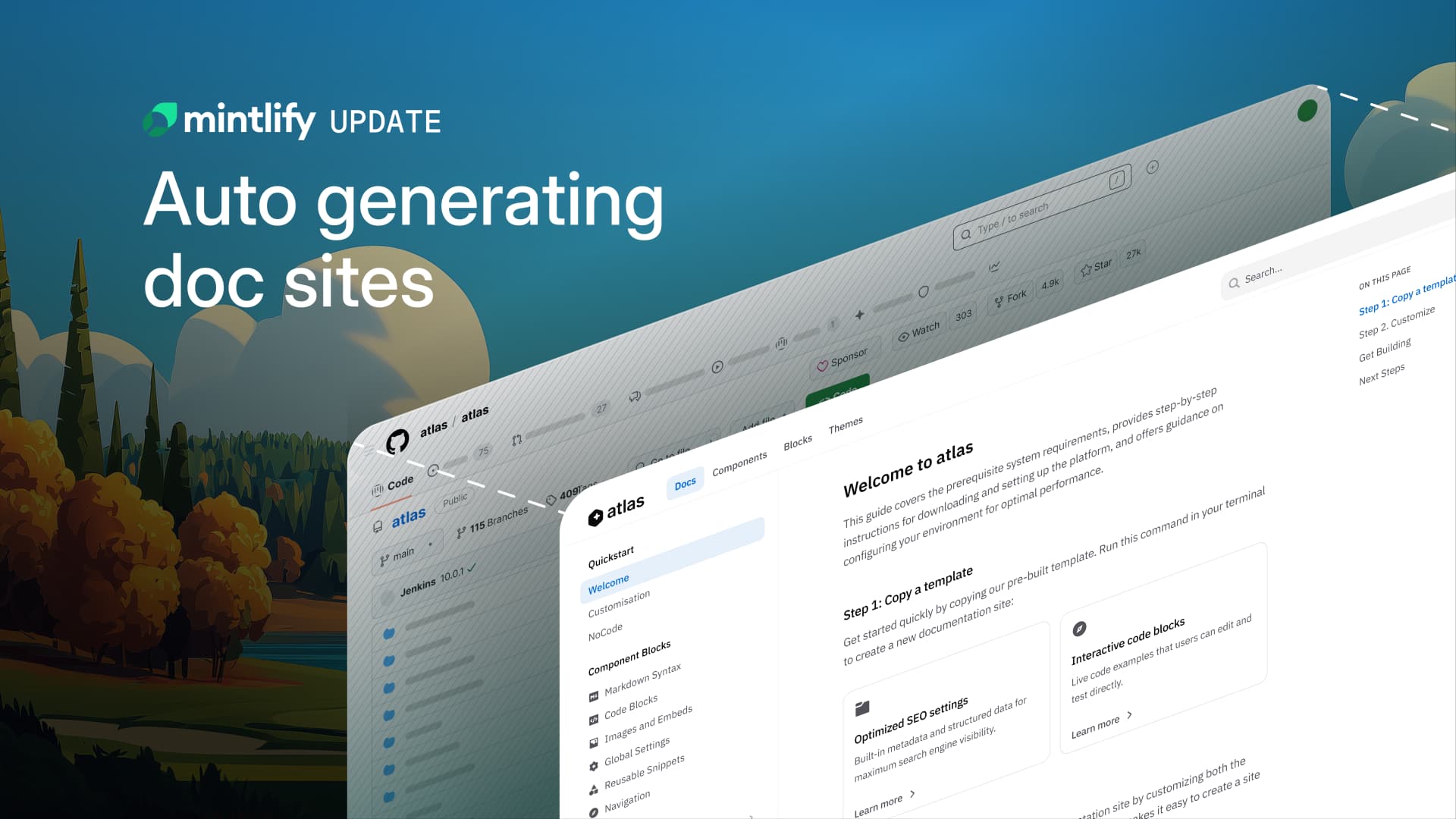
We built a tool that turns any GitHub repo into a complete Mintlify documentation site. Replace github.com with mintlify.com in any repo URL and get a branded, structured docs site you can clone and ship.
I originally built Broccoli, a fair queueing library for Rust, to solve a specific infrastructure challenge I encountered at work. After I open-sourced the project and wrote about the architecture, it quickly gained traction, growing to over 600 stars on GitHub.
But like countless other open-source maintainers, I hit a wall: my code was solid and my README was good, but I didn't have the time to write long-form tutorials, quickstarts, and guides. The desire to help my users was there, but the bandwidth to architect a documentation site was not.
At Mintlify, we built a tool for exactly this situation.
By simply replacing github.com with mintlify.com in any public repo URL, you can generate a structured, branded documentation site. Here's what it generated for Broccoli.
Instead of starting from scratch, I can clone this generated output directly into my Mintlify account, tweak it, and publish it. It's not a replacement for human editing, but it gives maintainers a massive head start, turning a multi-week chore into a few minutes of review.
Here's a look under the hood at how we built this.
The pipeline
Our pipeline runs entirely on sandboxed AI agents. We queue jobs through Bull on Redis, provision ephemeral sandboxes with Daytona, and power the generation using Claude Sonnet 4.6.
Locking down the sandbox
First, both the source repository and the destination docs repository are cloned into an isolated environment where the agent gets full filesystem and bash access.
Because we give the agent bash access, the network becomes a critical surface to control. We run a mitmproxy instance as a separate user inside the container, using iptables to transparently redirect all traffic through it. The proxy enforces a strict allowlist — anything not on it gets a 403. Direct IP access is blocked so the agent can't sidestep DNS, and raw TCP egress is blocked entirely.
GitHub writes are locked down even further. The agent is strictly limited to pushing to its designated docs branch, and the only GraphQL mutations it is authorized to execute are createPullRequest and updatePullRequest.
To safeguard credentials, the agent's environment only contains placeholder tokens. When a request leaves the container, the proxy swaps those placeholders with real values at the transport layer.
Understanding the project
Generic AI documentation usually reads poorly because the generator starts writing before it actually understands what it's writing about.
Before generating a single page, the Mintlify agent scrapes the repo's README and GitHub metadata, finds its homepage, and uses heuristics to extract brand assets. Those assets automatically populate the docs.json fields that style every Mintlify site: name, theme, colors.primary, colors.light, colors.dark, favicon, and a core navigation object.
Plan first, write second
We initially tried generating pages on the fly, but the results were messy. We ended up with redundant sections, confusing navigation, and pages that openly contradicted each other.
In hindsight, the fix was obvious: generating a documentation site without a structural plan is like hiring writers for each chapter of a book without telling them what the other chapters cover. Each part might be fine in a vacuum, but they won't add up to a coherent whole.
Now, before writing any pages, the agent browses the source code — reading exports, entry points, and command definitions to infer what the project actually does. The agent then produces a JSON file defining the project summary, brand info, and full navigation architecture.
{
  "projectType": "react-component-library",
  "projectName": "Excalidraw",
  "projectDescription": "Open source virtual hand-drawn style whiteboard",
  "primaryColor": "#6965db",
  "navigation": {
    "tabs": [
      {
        "tab": "Documentation",
        "groups": [
          { "group": "Get Started", "pages": ["introduction", "installation"] },
          { "group": "Core Concepts", "pages": ["elements", "app-state"] }
        ]
      }
    ]
  },
  "keyFeatures": ["infinite-canvas", "real-time-collaboration"],
  "publicApiSurface": ["Excalidraw", "MainMenu", "Sidebar"]
}
Because pre-analysis, generation, and review all run in the same session, generation subagents are instructed to read this JSON map first. Every section is written with total awareness of the broader context.
Generate, validate, ship
With the structure locked in, the orchestrator spins up subagents to write sections in parallel, grouping them one per navigation tab. For a large repository like Excalidraw, this cuts generation time from roughly 70 minutes down to 45.
When the subagents finish, the orchestrator reconciles their outputs and resolves cross-references. If one section references an API documented in another, those links are automatically verified and wired up correctly.
Finally, the agent uses the Mintlify CLI to validate the build and check for broken links, executing a final review sweep across both repositories to catch any remaining gaps or redundancies.
Try it
As for me, I've finally got a massive head start on Broccoli's documentation. I can edit this generated output, fill in any highly-specific gaps, and publish it using a workflow I'm already familiar with. I finally have a structure to build on instead of a daunting blank page.
Take any public open-source project you care about. Replace github.com with mintlify.com in the URL, and get a docs site that's ready to ship.
See some of the documentation sites that have been generated and try it yourself.
More blog posts to read
Autopilot: Always-on agent for self-updating docs
Autopilot is an always-on agent that reads your code and the context around it, drafts doc updates when something changes, and opens a pull request for your review.
October 20, 2026David Isquick
Product Marketing
Improved Admin MCP
The Mintlify Admin MCP server can now leave comments and suggestions, and its edits no longer need a pull request.
October 19, 2026David Isquick
Product Marketing