Han Wang
Co-Founder
Share this article
Han Wang
Co-Founder
Share this article

We survived the saaspocalypse. But at some point, every team is still having the same conversation.
"Do we really need to pay for this? Can we build it ourselves?"
It's a fair question.
Recently, I've been talking to a lot of teams who are trying to build their own content infrastructure. Markdown to HTML isn't rocket science. You can stand up a static site with a single prompt if you know what you're doing. If you have dedicated engineering resources, why buy something you could build?
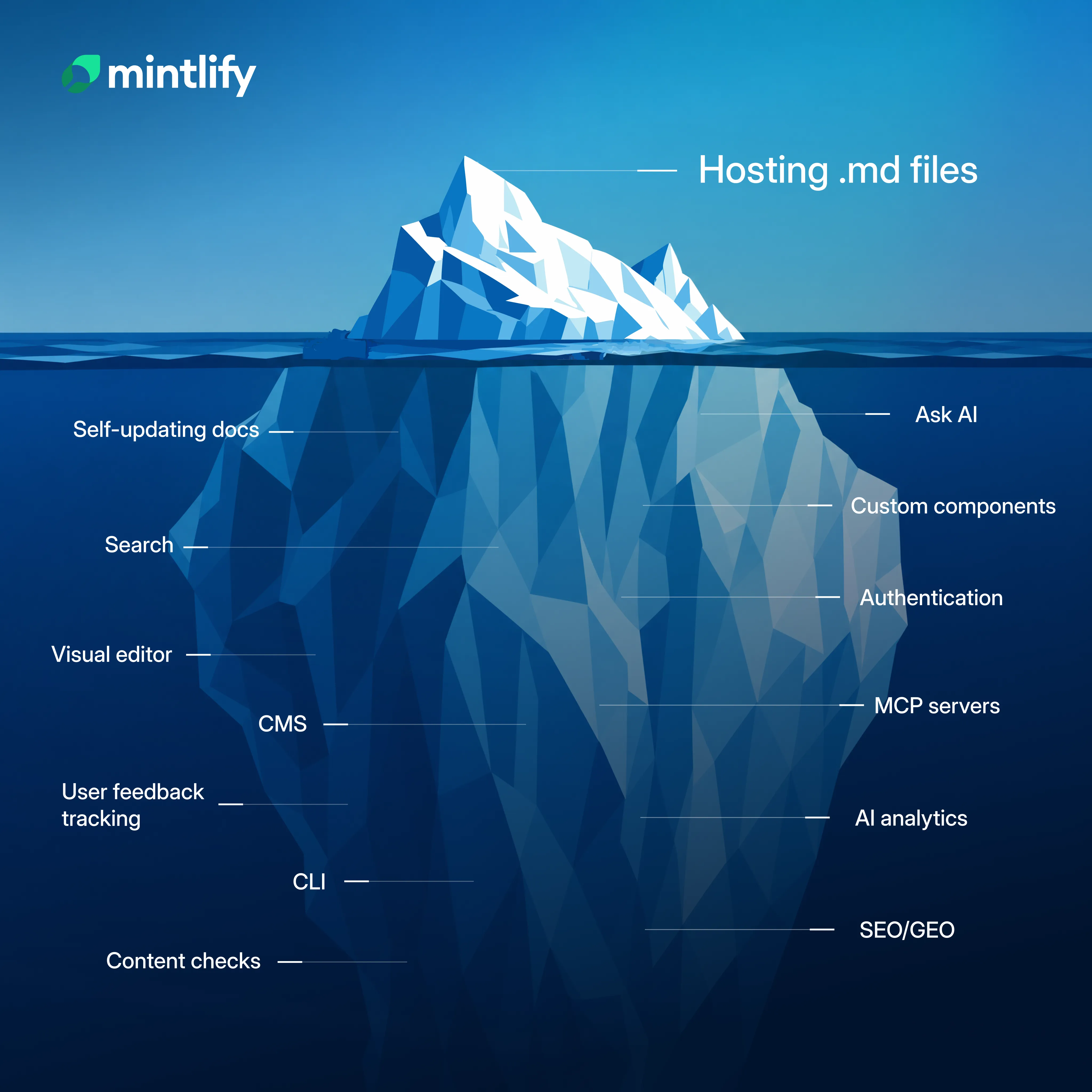
When it comes to maintaining the knowledge infrastructure that powers your team and agents, Markdown hosting is just the tip of the iceberg.
What you see
The visible part of Mintlify to your end users is, yes, a website that renders your Markdown content. Clean, fast, looks great. That part is obvious. It's often the reason people first become interested in what we have to offer.
But the reason people stay, and the reason people don't build their own solution, is everything else.
What's underneath
If you start taking apart the most beloved developer tools, you find layers of intention, taste, and domain knowledge built into the product. Every element builds off of accumulated knowledge and carries a maintenance burden.
Self-updating content
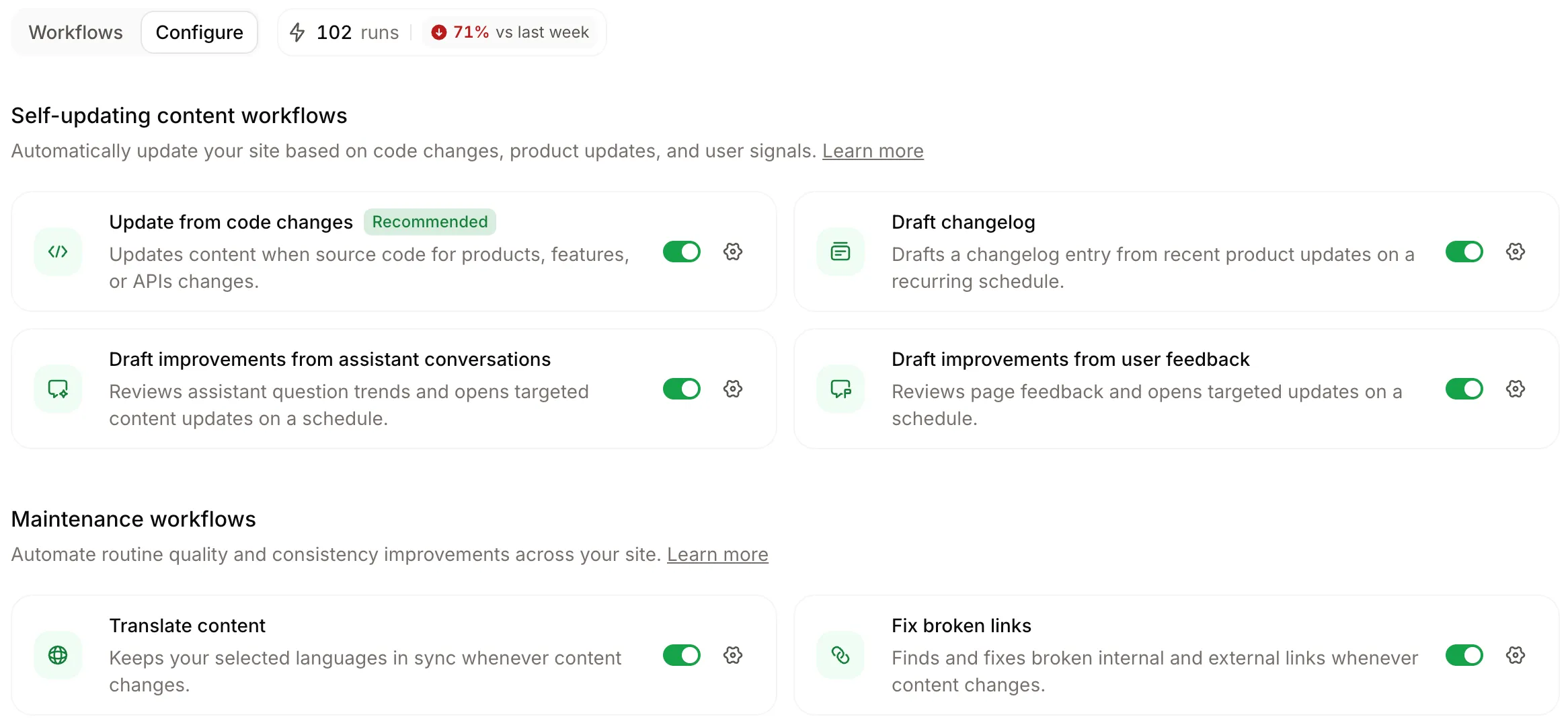
Let's start with one of the biggest things: self-updating content.
When your product changes, you have to update every relevant content surface. Your developer docs, internal knowledge bases, help centers, and so on.
With Mintlify, you can connect a source code repository as context and update your content whenever you ship. So your hosted Markdown files are always up to date with your product, your users (people and agents) have accurate information, and you free up time for other tasks.
Search
Building search that feels good to use is a product in itself. The difference between "it technically works" and "it returns results that help users" is small and nuanced.
Search that understands your content structure, handles typos, returns relevant results, and updates the instant your content changes is a fun challenge to solve for some people. But it's going to take time and effort to keep running.
Visual editor, CMS, CLI
A web-based writing environment. An API for programmatic content management. A CLI for people who want to work locally and deploy in CI. These offer different interfaces for different people on your team, but they all point at the same content.
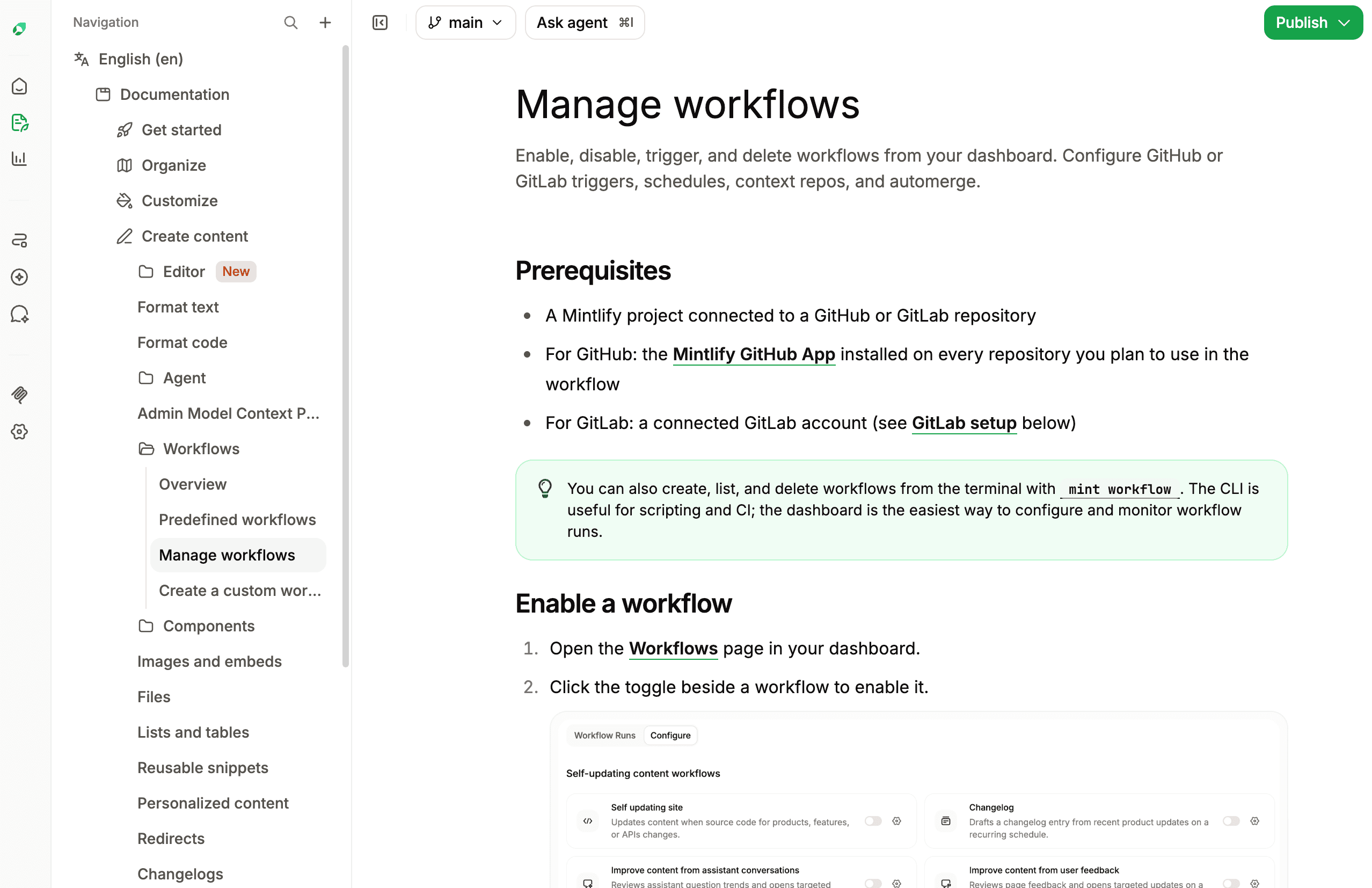
When you're building an in-house tool, do you consider the different preferences and needs of everyone on your team? Or do you build a single interface and force it to work for everyone?
User feedback tracking
User feedback on your content is some of the most valuable data you can collect. Your users tell you what they want to know about your product, what's challenging, when they're frustrated. And sometimes even when they're happy. With feedback, it's easy to improve your content over time exactly how your users want it. If you put content out into the world without a way to collect feedback, you're leaving so much on the table.
Content checks
Automated checks for simple things like broken links or more complex problems like factual drift and contradictions. Automate this with Mintlify.
Ask AI
People expect chat interfaces for querying knowledge. If your site doesn't have a native AI assistant, your users are going to ask another tool and risk getting inaccurate answers. You should power AI-mediated conversations with your own content. But do you want to maintain one yourself?
Custom components
What's better than hosting Markdown? Hosting Markdown that you can build on top of.
MDX supports interactive components. But you have to build them. Or use a platform with a library of components for all the most common patterns.
Authentication
SSO, SAML, per-page access control. The full security surface for protecting private or gated content goes deep. Every one of these is a spec, a build, an integration with your IdP, a maintenance burden. Or a toggle in a dashboard.
MCP servers
When developers use Claude, Cursor, or any other AI tool, you want them to pull from your content directly. If you have an MCP server for your content, they can do this easily.
And you can offer an agent-first content management experience for your team with an MCP server for updating content. Mintlify automatically generates and hosts these MCP servers.
AI analytics
Most teams don't measure agentic traffic at all. Even though it's the majority of traffic to sites.
User interactions with AI are even more valuable than page views. If you can see what users ask chatbots about your content or what your MCP returns, you can understand how your content is being used and how to improve it. And if you're mapping your AI spend to business outcomes, this is the data that connects content investment to P&L categories.
SEO and GEO
People need to find your content. Mintlify handles all this behind the scenes. Structured for crawling, metadata added, optimized for both traditional search and AI-powered answer engines. Getting this right has compounding returns.
The build versus buy question
None of these features are impossible to build.
You need to build each of them though.
For any devtool, build versus buy might look simple if you only look at the outcome of using the tool. Ask the people using it what makes the tool nice to use, how often they turn to it to solve a problem, when it saves them time and money.
Building a content platform means building out every feature for the maintainers and users. Search is a product. An agent that updates content well is a product. Authentication is a product. Analytics is a product. And you need to maintain these while building your actual product.
The teams that built their own content infrastructure and then migrated to Mintlify rarely encountered technical challenges they couldn't overcome if they dedicated the resources to it. But they could never justify how long it took, how much it cost, and how many times they wished they could have shipped something else instead.
You can look at a build versus buy decision as a line item or as freeing up six months of engineering time, an on-call rotation, and a pile of half-finished internal tools.
Where to start
- Read our build vs buy guide.
- Get a preview of what your docs could look like on Mintlify.
- Or start for free and compare it with what you run today.
If you want to chat about how Mintlify can help your team, get in touch.
More blog posts to read

Mintlify saves your team time and money, and now we can show you how.
The new Savings section in Mintlify Analytics shows the time and money your team saves with automations and the assistant.
October 15, 2026Neha Halebeed
Product
Less is more: Improving editor performance
The Mintlify editor now opens, navigates, and edits very large pages up to 100x faster by doing less work.
October 14, 2026Hunter Chen
Engineering