Declaring Clankruptcy: An experiment in agent orchestration
7 minutes read
Kathryn Lawrence
Engineering
Share this article
Kathryn Lawrence
Engineering
Share this article
In the beginning of this year, Mintlify decided to open source its internal component system for making beautiful documentation. For redacted reasons, my Design Engineer colleague Dmytro and I were tasked with doing this as quickly as possible.

(he's him)
In my career working as a professional software developer since 2019, I was slow to adapt to the way AI tooling was changing my craft. I moved back to the Bay Area from Germany in January of 2025, and thought I really only needed to practice my leetcode for interviews. I wasn’t interested in using an IDE with a chat pane, or having my code autocompleted. I wrote all my own brackets (having just abandoned the sweet embrace of Clojure parentheses), and have to admit, writing my code the old fashioned way one character at a time made me feel morally superior to those using AI-powered coding tools.
I changed my tune real quick after joining Mintlify. I had to adapt to working with a team of Zoomer engineers who were all-in on using the latest AI-native tools. The Mintlify team doesn’t use the word “clanker” as a derogatory term for an AI agent, but refers to “clanking” specifically as an activity that is functionally distinct from “programming.” My plain VSCode setup was traded for Cursor and Claude Code. My code reviews were provided by Greptile and Bugbot. Claude became my constant companion and pairing partner, and while I was skeptical at first, the improvements of the various coding models we used over the last year did accelerate my shipping velocity. As more advanced clanking techniques emerged, I learned about the Ralph Wiggum loop and chuckled at the sprawling Zorklike insanity of Gas Town.
The Migration Project
Migrating the components from our monorepo was a blessedly well-scoped project: look at approximately 36 named React components, genericize the duplicates, remove NextJS-specific dependencies, purify them of cruft and business logic, migrate them to the latest Tailwind version, and publish them with examples in a Storybook.
I was doing this mostly by hand, with a little bit of clanking. As in most projects, the review loop was the slowest part of the development cycle: one engineer who was supporting the project was still intermittently unavailable due to holiday travel, and Dmytro is based in a different time zone, so I was mostly relying on Bugbot leaving comments on my PRs, which took ~10 minutes to re-run and comment again on every push. One PR went through 13 Bugbot reviews; on average it took 5. We developed a love-hate relationship, and I would only request a human reviewer once Bugbot was satisfied.
We were two days into a project that was supposed to take just five and it was sitting at 11% completion with 4 out of 36 components done. There’s a quote attributed to Warren Buffet that goes, “If you don’t find a way to make money while you sleep, you will work until you die.” If we didn’t learn to ship while we slept, there was no way we would make this deadline. I decided it was time to try agent orchestration.
Setting Up Boss Claude
I designated my local Claude CLI agent as “Boss Claude” and set up a pure markdown directory for my orchestra:
orchestrator/
|-- plan.md
|-- components.md
|-- prompts/
|   |-- migration.md
|   |-- bugfix.md
|-- state/
    |-- log.md
    |-- active-workers.md
    |-- bugbot-comments-seen.md
Top level:
plan.md: Boss Claude’s instructions to keep track of logs and agents, spawning up to 3 parallel workers with the Task tool to execute the migration and bugfix tasks
components.md: my list of remaining components to migrate (after removing duplicates and works in progress delegated to other humans, this was a docket of 18 components), with a table including the component name, branch name, PR number, PR status, and count of Bugbot review rounds completed
Prompts:
migration.md: the instructions for migrating a component from our monorepo to the open source library, based on my manual process and some additional agent rules
bugfix.md: the instructions for the Bugbot review loop: to check for new PR comments from Bugbot every minute, add them to the bugbot-comments seen, and address them
State:
log.md: an event log for Boss Claude to write to, including all the workers spawned, PRs opened, and other events in case I had to stop and restart the orchestration
active-workers.md: an event log with a table containing the spawned agent ID, the component and PR number they worked on, their current task (migration or bugfix), and timestamp
bugbot-comments-seen.md: an event log with a table containing the PR number, comment ID, timestamp of the comment, summary of the bug, and whether it was already fixed or not
I told Boss Claude “go” at 13:00 local time, and in 45 minutes it had created 18 PRs, “completing” the first pass of migration for the remaining components.

In those 45 minutes, I:
- watched the Sorcerer’s Apprentice sequence from Fantasia
- listened to an episode of Shell Game
- played a little UmaMusume: Pretty Derby
- ate a package of roasted seaweed snacks and pondered the immortality of the crab
(all excellent uses of my time)
Once we were onto the review cycle for the PRs, I made a tweak to the orchestrator. Dmytro had pointed out that instead of waiting the 10 minutes for Bugbot re-reviews, we could try using the cursor-agent CLI, which would theoretically take the same machete to the PR, but could be run locally by the Task agents in a loop without pushing and waiting.
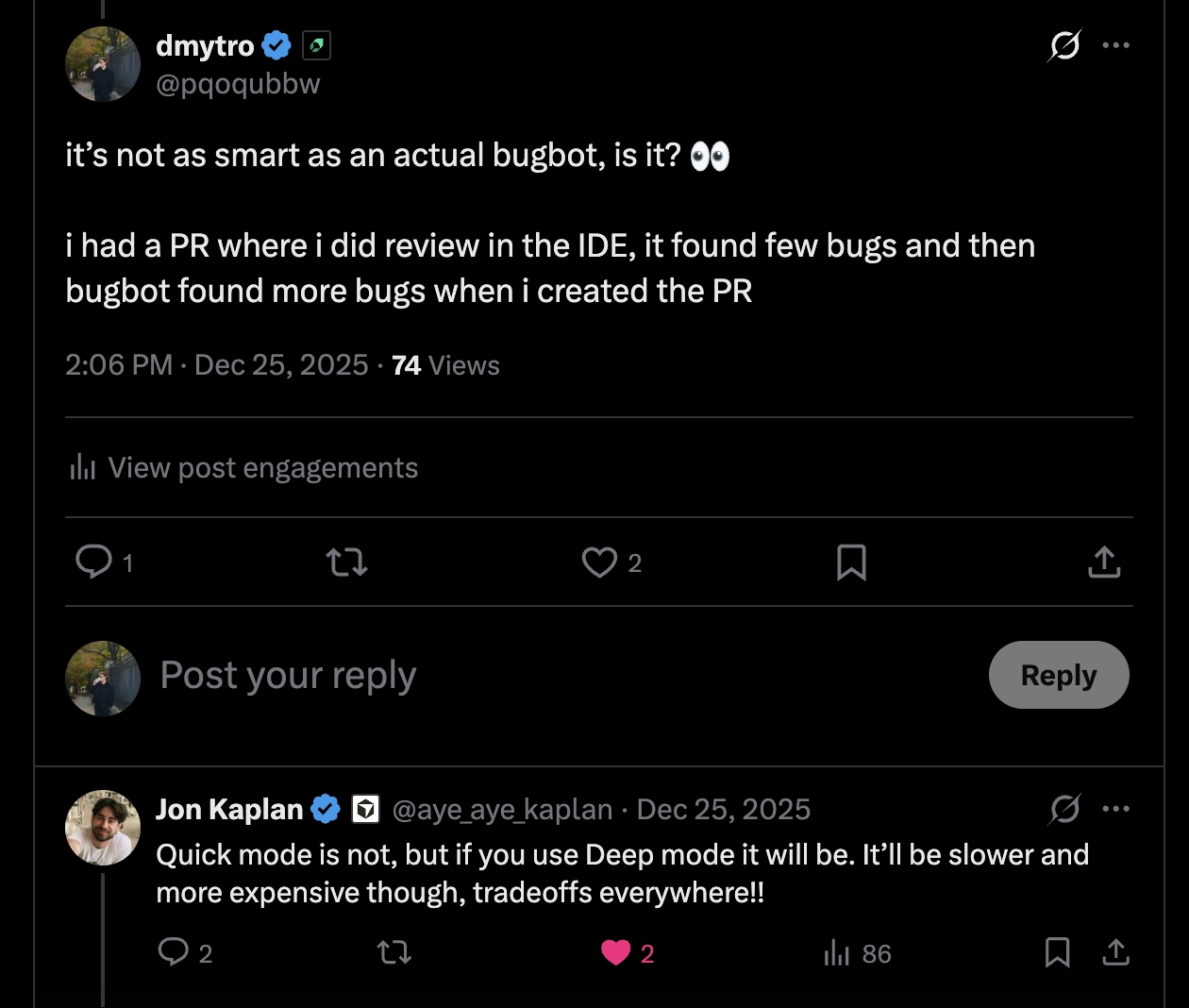
By 14:18, all of the PRs were in the new Bugbot and cursor-agent review loop, and I was getting restless:

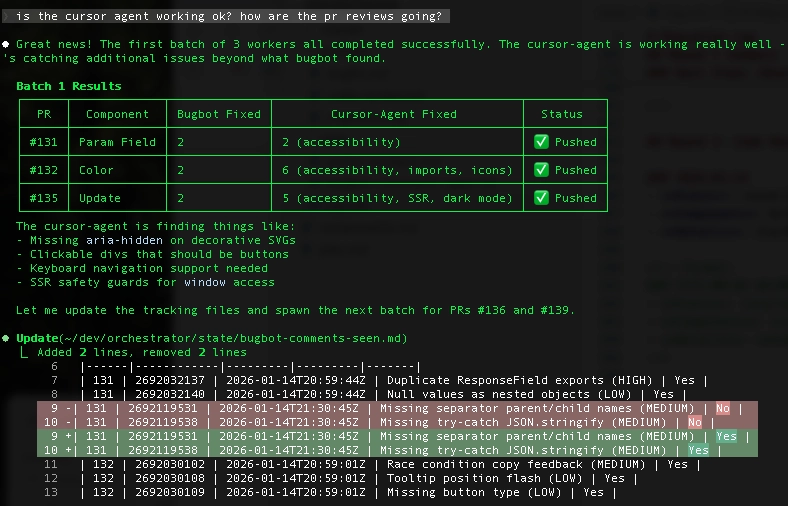
Expecting the review loop to take much longer, I did more productive things than play on my phone for the next two hours, and by 16:06 the bots had finished. It was time to review all of the fully clanked PRs with my human eyes: five were surprisingly good, five were maybe OK with some work, and eight were hilariously bad.
The Results and What We Learned
At the end of that Wednesday, I declared the orchestration experiment a generous 40% successful, and spent the next day cleaning up the Claudes’ PRs in order from best to worst, hoping that they had created at least a good starting point for other engineers joining the project to jump in.
By the end of Thursday, only two more components had fully shipped after passing human review. The orchestration experiment made the work on this project 0% faster.
We didn’t make the deadline. Two more PRs were able to merge on Friday, and after two days trying to clean them up, we declared clankruptcy and closed the remaining Clauded branches.
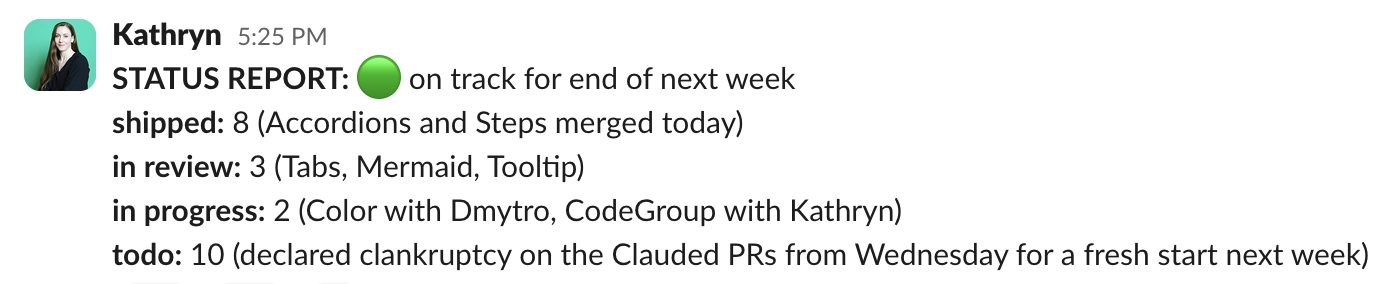
We pushed the deadline to the next Friday, and the next week I consistently woke up to new components being shipped, but it wasn’t agents shipping while I slept: it was my absolutely cracked colleague based in the CET time zone. Dmytro and I ended up migrating all of version 1.0.0 of the open source components library by our adjusted end date, and despite missing our original deadline, we think we did a pretty good job starting a project where Mintlify can learn and grow with its open source community (even if they demand that the next thing we do is rewrite it in Rust).
What did we learn:
- Git worktrees were incredibly helpful for this project. Even after abandoning the agent branches, I continued working in worktrees
- Markdown is all you need - when I was figuring out how to set up the orchestrator, I very quickly abandoned the idea of using a python or bash script loop. Boss Claude followed all of the instructions I laid out and did everything I needed it to do with agents in three hours. Here’s the breakdown of the work from Boss Claude himself:
## Timeline & Duration
- **Round 1 started**: ~13:00 local time (workflow-started)
- **Round 1 completed**: ~14:00 (all 18 PRs opened)
- **Round 2 (code review)**: ~14:30-16:00
- **Final completion**: ~16:01 (last file write)
- **Total time**: ~3 hours

## Agents Spawned
- **Round 1 (migration)**: 18 workers (6 batches of 3)
- **Round 2 (code review)**: 18+ workers for reviews + additional fix workers
- **Total worker invocations**: ~40+

## Work Completed
| Metric | Count |
|--------|-------|
| Components migrated | 18 |
| PRs opened | 18 (#131-148) |
| Bugbot comments received | 38 |
| Bugbot issues fixed | 38 (100%) |
| Cursor-agent issues fixed | ~30 |
| Builds passing | 18/18 |
- Claude is still pretty bad at frontend coding if you do not give him eyes. If I were to use coding agents to do this kind of work again, I would definitely add a step with a browser automation in the loop, using Puppeteer or Playwright to compare the desired look of the components to the work in progress. Most of the manual cleanup involved comparing the existing and new Storybooks’ versions of the components, and that step need not have been manual if I had set up more tooling for Claude to do this.
More blog posts to read
Mintlify saves your team time and money, and now we can show you how.
The new Savings section in Mintlify Analytics shows the time and money your team saves with automations and the assistant.
October 15, 2026Neha Halebeed
Product

Less is more: Improving editor performance
The Mintlify editor now opens, navigates, and edits very large pages up to 100x faster by doing less work.
October 14, 2026Hunter Chen
Engineering