What Are Design Patterns?
Design patterns are reusable solutions to common design problems, resulting in a smoother, more efficient development process. They serve as blueprints for building better software structures. Patterns help developers communicate complex ideas quickly and provide proven solutions that have been refined over time.The 18 Essential Design Patterns
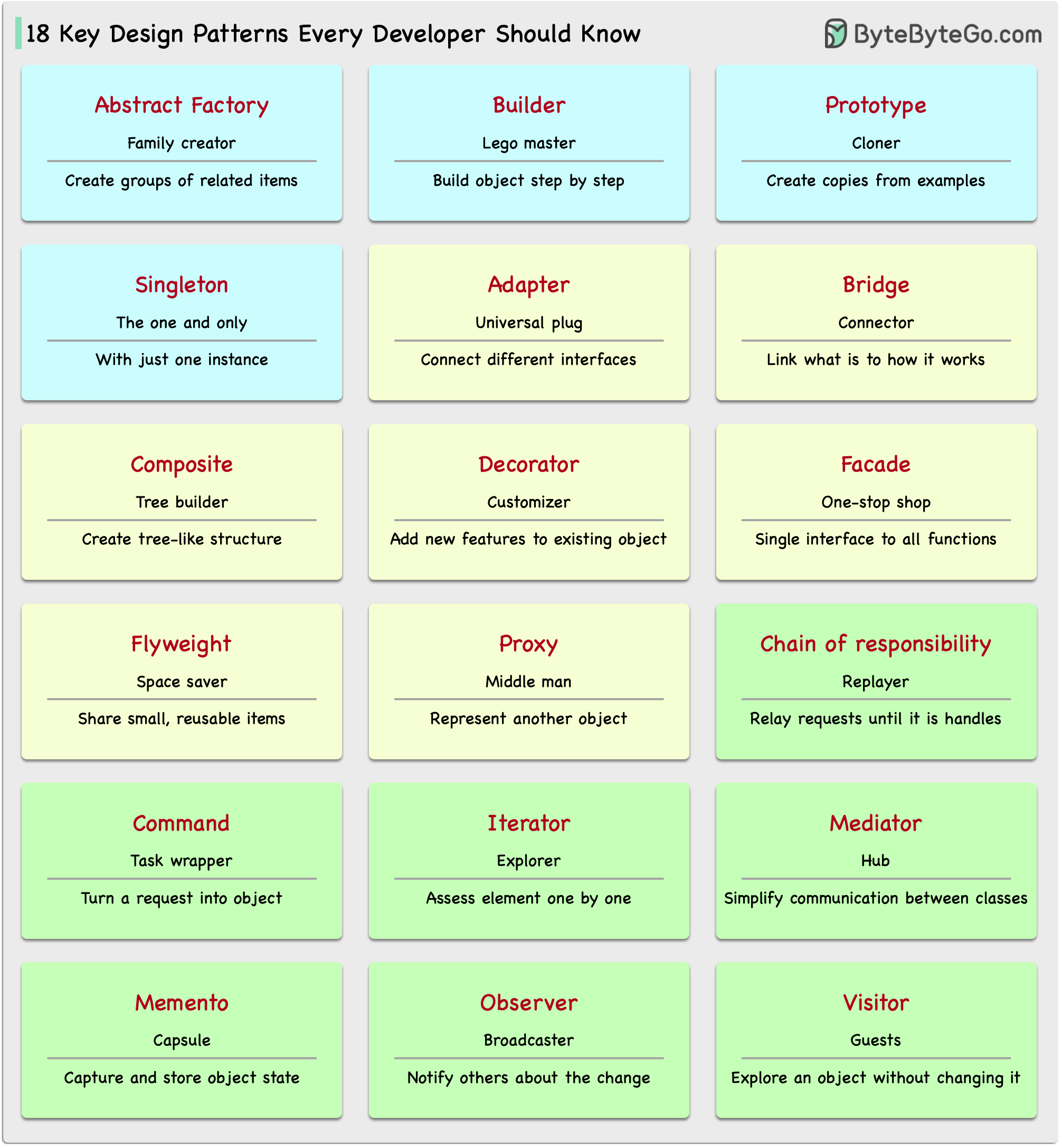
Creational Patterns
Creational patterns deal with object creation mechanisms, trying to create objects in a manner suitable to the situation.Abstract Factory
Family Creator - Makes groups of related items without specifying their concrete classes.
Builder
Lego Master - Builds objects step by step, keeping creation and appearance separate.
Prototype
Clone Maker - Creates copies of fully prepared examples.
Singleton
One and Only - A special class with just one instance.
Abstract Factory Pattern
When to Use
When to Use
Use Abstract Factory when:
- You need to create families of related objects
- You want to ensure compatibility between created objects
- You want to hide the creation logic from clients
- UI toolkit libraries (Windows, Mac, Linux themes)
- Cross-platform applications
- Database connection factories
Builder Pattern
The Builder pattern is perfect for constructing complex objects step by step. It separates the construction process from the representation, allowing the same construction process to create different representations.
- Clearer code for complex object creation
- Different representations using the same construction code
- Step-by-step construction with optional parameters
Prototype Pattern
Singleton Pattern
Key Characteristics:- Ensures only one instance exists
- Provides global access point
- Lazy or eager initialization
- Configuration managers
- Logger instances
- Database connection pools
- Cache managers
Structural Patterns
Structural patterns explain how to assemble objects and classes into larger structures while keeping these structures flexible and efficient.Adapter
Universal Plug - Connects things with different interfaces.
Bridge
Function Connector - Links how an object works to what it does.
Composite
Tree Builder - Forms tree-like structures of simple and complex parts.
Decorator
Customizer - Adds features to objects without changing their core.
Facade
One-Stop-Shop - Represents a whole system with a single, simplified interface.
Flyweight
Space Saver - Shares small, reusable items efficiently.
Proxy
Stand-In Actor - Represents another object, controlling access or actions.
Adapter Pattern
Implementation Details
Implementation Details
The Adapter pattern acts as a bridge between two incompatible interfaces. It wraps an existing class with a new interface.Real-world examples:
- Converting XML to JSON
- Integrating legacy code with new systems
- Third-party library integration
Decorator Pattern
The Decorator pattern allows you to add new functionality to objects dynamically without altering their structure. This is achieved by wrapping the original object with decorator objects.
- More flexible than inheritance
- Responsibilities can be added/removed at runtime
- Combine multiple decorators
Facade Pattern
Provides a simplified interface to a complex subsystem. Great for:- Simplifying complex libraries
- Providing a unified interface
- Reducing dependencies on subsystem details
Behavioral Patterns
Behavioral patterns are concerned with algorithms and the assignment of responsibilities between objects.Chain of Responsibility
Request Relay - Passes a request through a chain of objects until handled.
Command
Task Wrapper - Turns a request into an object, ready for action.
Iterator
Collection Explorer - Accesses elements in a collection one by one.
Mediator
Communication Hub - Simplifies interactions between different classes.
Memento
Time Capsule - Captures and restores an object’s state.
Observer
News Broadcaster - Notifies classes about changes in other objects.
Visitor
Skillful Guest - Adds new operations to a class without altering it.
Observer Pattern
Use Cases:- Event handling systems
- Model-View-Controller (MVC) architectures
- Real-time data updates
- Notification systems
Command Pattern
Encapsulates a request as an object, allowing you to:- Parameterize clients with different requests
- Queue or log requests
- Support undoable operations
Chain of Responsibility Pattern
Benefits and Trade-offs
Benefits and Trade-offs
Benefits:
- Decouples sender and receiver
- Adds or removes responsibilities dynamically
- Flexibility in assigning responsibilities
- No guarantee a request will be handled
- Can be difficult to observe and debug
Multithreading Design Patterns
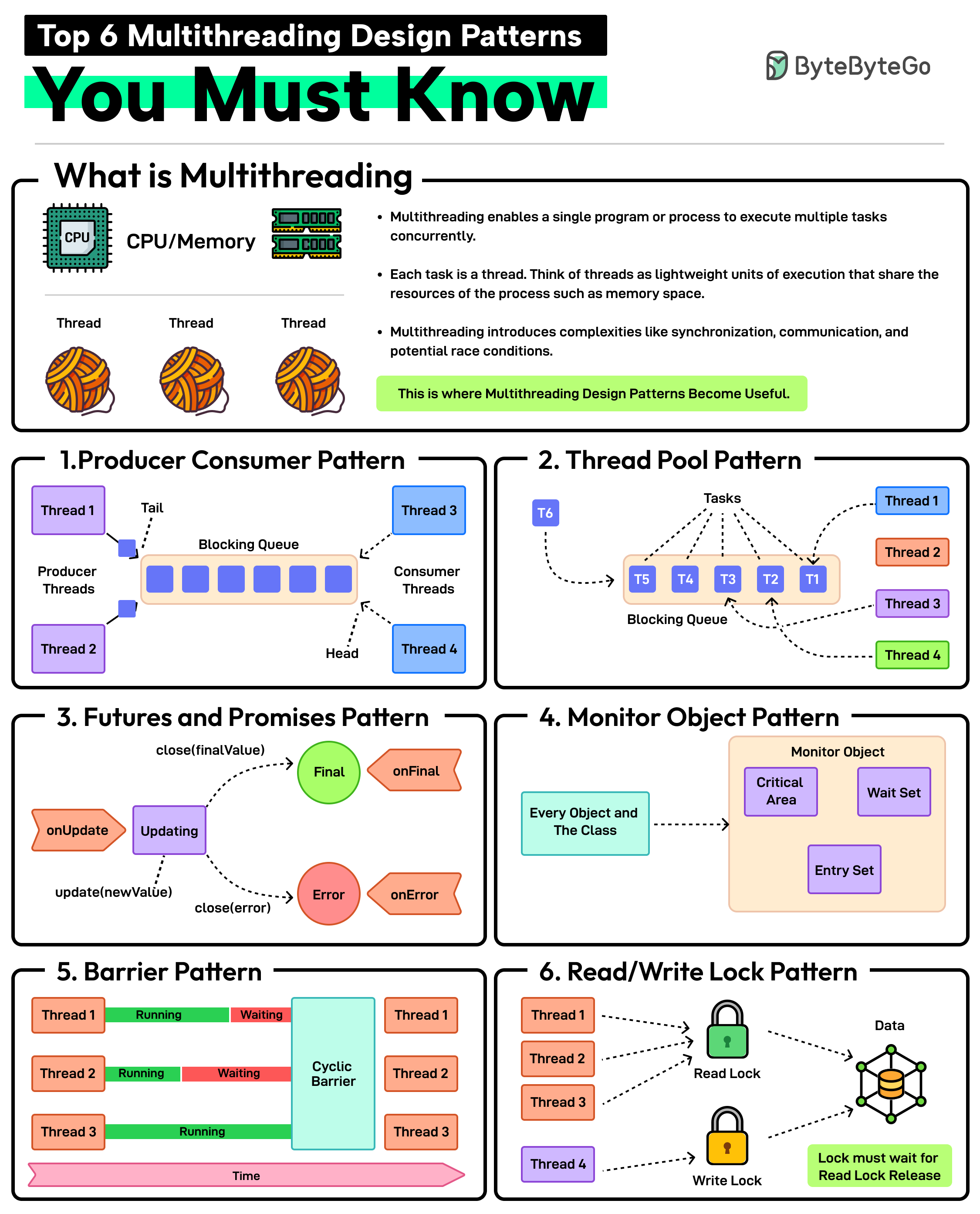 Multithreading enables a single program to execute multiple tasks concurrently. However, it introduces complexities like synchronization and race conditions.
Producer-Consumer Pattern
This pattern involves two types of threads: producers generating data and consumers processing that data. A blocking queue acts as a buffer between the two.Key Benefits:
- Decouples production from consumption
- Natural load balancing
- Thread-safe communication
Thread Pool Pattern
A pool of worker threads that can be reused for executing tasks. Using a pool removes the overhead of creating and destroying threads. Perfect for:- Executing a large number of short-lived tasks
- Server applications handling multiple requests
- Background job processing
Futures and Promises Pattern
How It Works
How It Works
The promise is an object that holds the eventual results and the future provides a way to access the result.Great for:
- Executing long-running operations concurrently
- Non-blocking asynchronous operations
- Avoiding callback hell
Monitor Object Pattern
Ensures that only one thread can access or modify a shared resource within an object at a time. This helps prevent race conditions.Barrier Pattern
Synchronizes a group of threads. Each thread executes until it reaches a barrier point in the code and blocks until all threads have reached the same barrier. Ideal for:- Parallel tasks that need to reach a specific stage
- MapReduce-style operations
- Multi-phase algorithms
Read-Write Lock Pattern
Allows multiple threads to read from a shared resource but only allows one thread to write to it at a time. Benefits:- Better concurrency than exclusive locks
- Ideal when reads are more frequent than writes
- Improved performance for read-heavy workloads
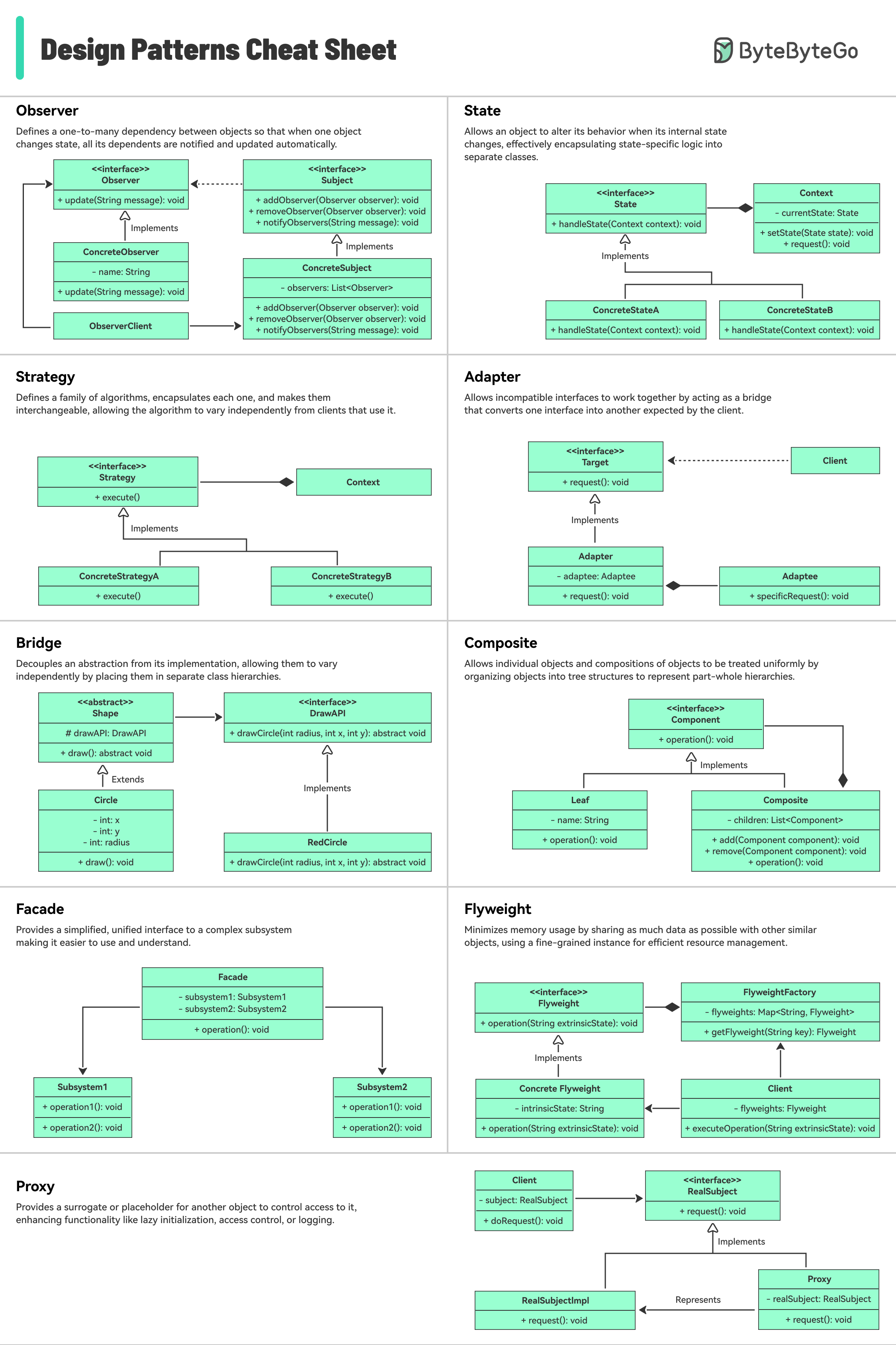
Design Pattern Cheatsheet
Creational Patterns
Factory, Builder, Prototype, Singleton - Focus on object creation
Structural Patterns
Adapter, Bridge, Composite, Decorator, Facade, Flyweight, Proxy - Focus on composition
Behavioral Patterns
Chain of Responsibility, Command, Iterator, Mediator, Memento, Observer, Visitor - Focus on communication
Best Practices
Common Anti-Patterns to Avoid
What NOT to Do
What NOT to Do
Pattern Overuse:
- Don’t use patterns just to use them
- Avoid premature optimization
- Keep it simple (KISS principle)
- Understand your requirements first
- Consider scalability and maintainability
- Think about team familiarity
- Adapt patterns to your needs
- Don’t follow implementations blindly
- Focus on solving your specific problem
Next Steps
Software Architecture
Explore broader architectural patterns
Microservices
Learn microservices-specific patterns
Scalability
Discover scalability design patterns