Introduction to Software Architecture
Software architecture is the blueprint for system design, detailing how components interact with each other to deliver specific functionality. A well-designed architecture provides solutions to common problems, saves time and effort, and leads to more robust and maintainable systems. Choosing the right software architecture pattern is essential for solving problems efficiently and building systems that can evolve over time.Core Architectural Patterns
Layered Architecture
Each layer plays a distinct and clear role within the application context. Great for applications that need to be built quickly.
Microservices
Break down large systems into smaller, manageable components. Systems are fault tolerant with independent scaling.
Event-Driven
Services communicate by emitting events. Promotes loose coupling but testing becomes more challenging.
Client-Server
Two main components - clients and servers communicating over a network. Great for real-time services.
1. Layered Architecture
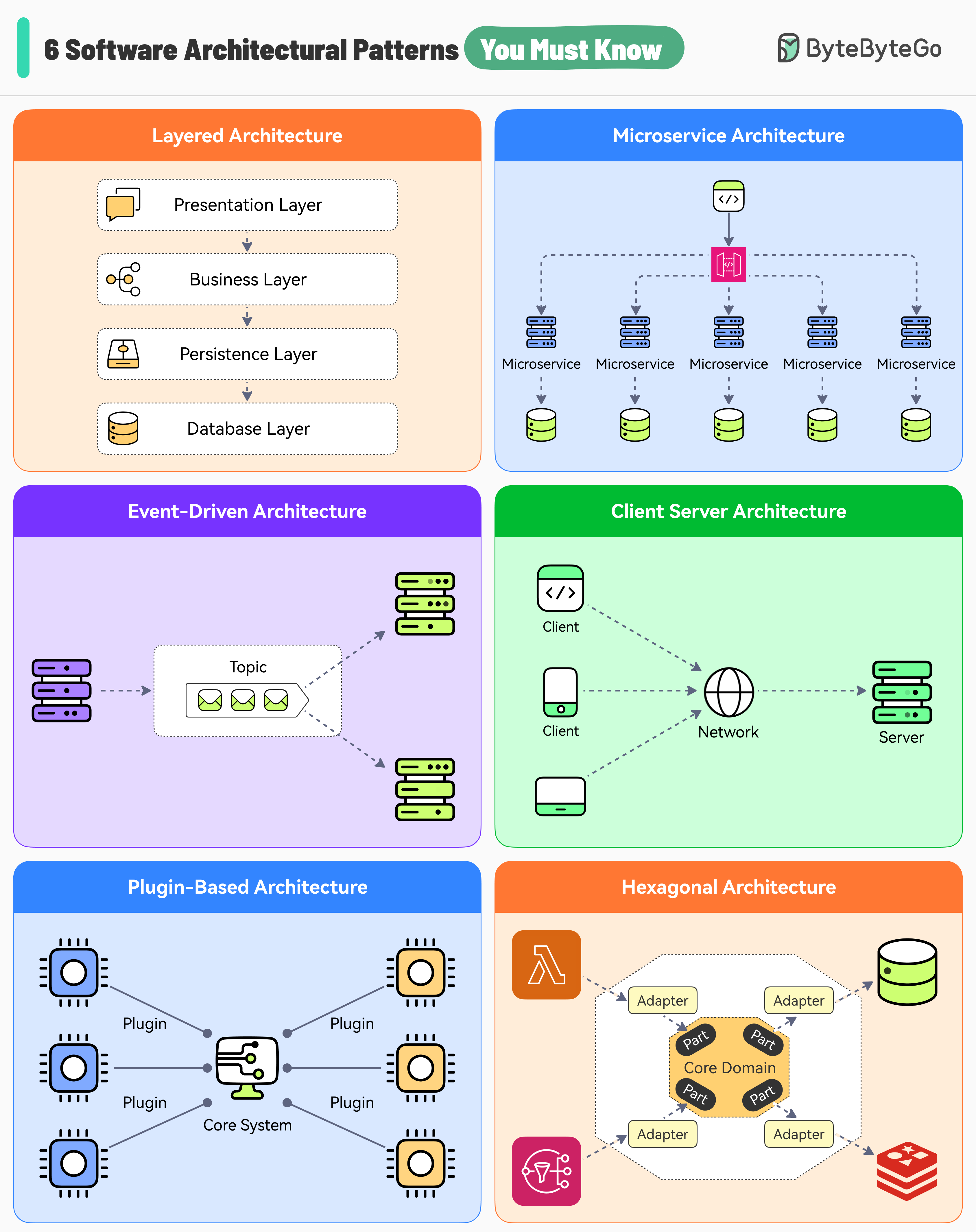 Each layer plays a distinct and clear role within the application context.
Key Characteristics
Key Characteristics
- Clear separation of concerns: Each layer has a specific responsibility
- Quick development: Great for applications that need to be built rapidly
- Structured organization: Natural code organization by functionality
- Source code can become unorganized if proper rules aren’t followed
- Changes may ripple across multiple layers
2. Microservices Architecture
Break down a large system into smaller and more manageable components.Systems built with microservices architecture are fault tolerant. Each component can be scaled individually, but it might increase the complexity of the application.
- Fault tolerance built-in
- Independent scaling of components
- Technology flexibility per service
- Team autonomy and ownership
- Increased system complexity
- Distributed system challenges
- Service discovery requirements
- Data consistency concerns
3. Event-Driven Architecture
Services talk to each other by emitting events that other services may or may not consume. When to Use:- Real-time data processing
- Asynchronous workflows
- Systems requiring high scalability
- Loosely coupled microservices
- Testing individual components becomes challenging
- Event ordering and consistency
- Debugging distributed flows
4. Client-Server Architecture
It comprises two main components - clients and servers communicating over a network. Advantages:- Great for real-time services
- Centralized data management
- Clear separation of concerns
- Servers can become a single point of failure
- Network dependency
- Scalability challenges
5. Plugin-based Architecture
This pattern consists of two types of components - a core system and plugins. The plugin modules are independent components providing specialized functionality.Use Cases
Use Cases
Ideal for:
- IDEs (Integrated Development Environments)
- Content management systems
- Applications that need to expand over time
6. Hexagonal Architecture
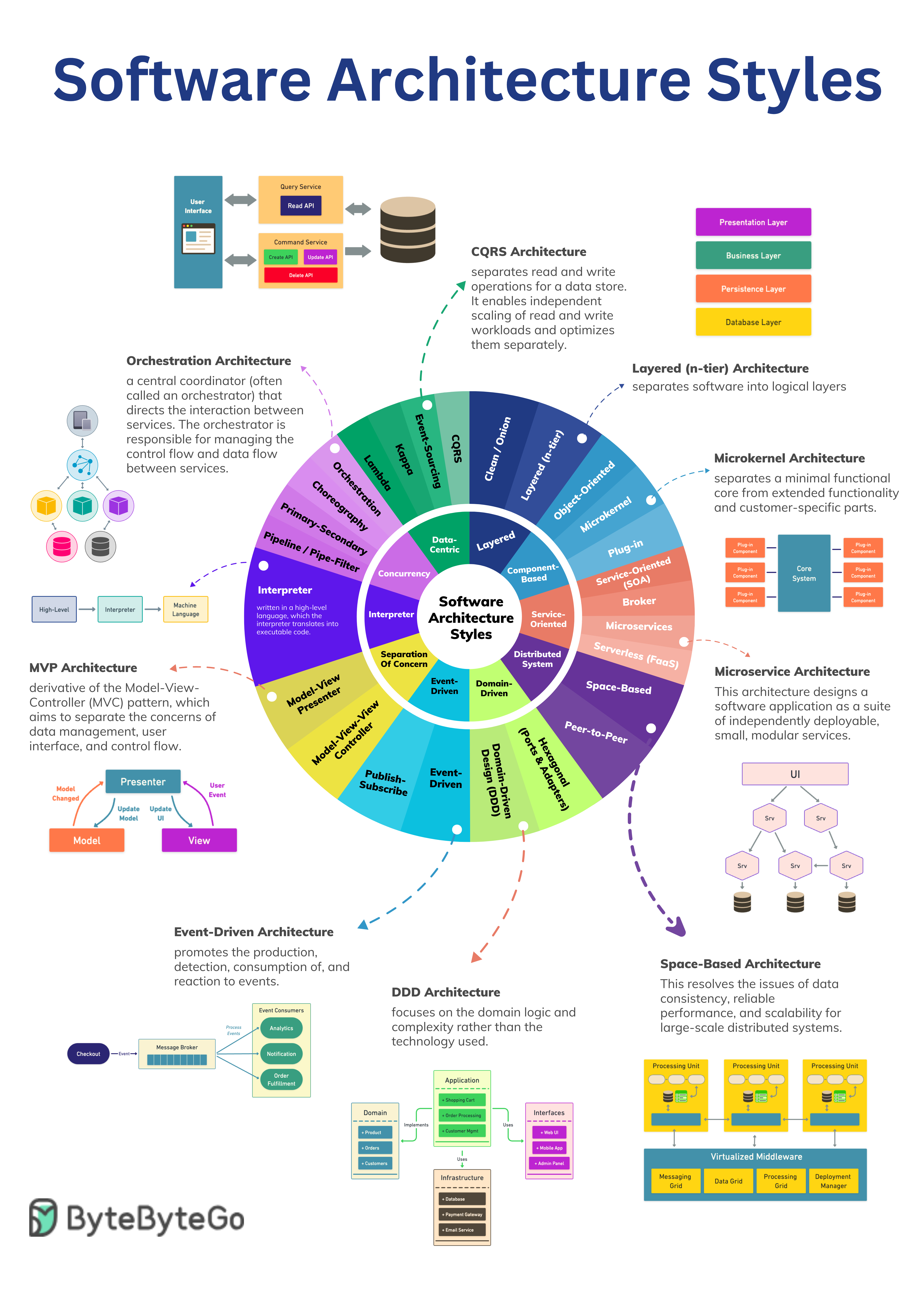 This pattern creates an abstraction layer that protects the core of an application and isolates it from external integrations for better modularity. Also known as ports and adapters architecture.
Benefits:
This pattern creates an abstraction layer that protects the core of an application and isolates it from external integrations for better modularity. Also known as ports and adapters architecture.
Benefits:
- Better modularity and testability
- Core business logic isolation
- Flexible external integrations
- Increased development time
- Steeper learning curve
- More initial complexity
Design Principles and Acronyms
SOLID Principles
SOLID principle is essential in object-oriented programming. There are 5 components:SRP - Single Responsibility Principle
Each unit of code should have one responsibility.
OCP - Open Close Principle
Units of code should be open for extension but closed for modification.
LSP - Liskov Substitution Principle
A subclass should be able to be substituted by its base class.
ISP - Interface Segregation Principle
Expose multiple interfaces with specific responsibilities.
DIP - Dependency Inversion Principle
Use abstractions to decouple dependencies in the system.
KISS Principle
“Keep it simple, stupid!” is a design principle first noted by the U.S. Navy in 1960. It states that most systems work best if they are kept simple.
Data and Communication Flow Patterns
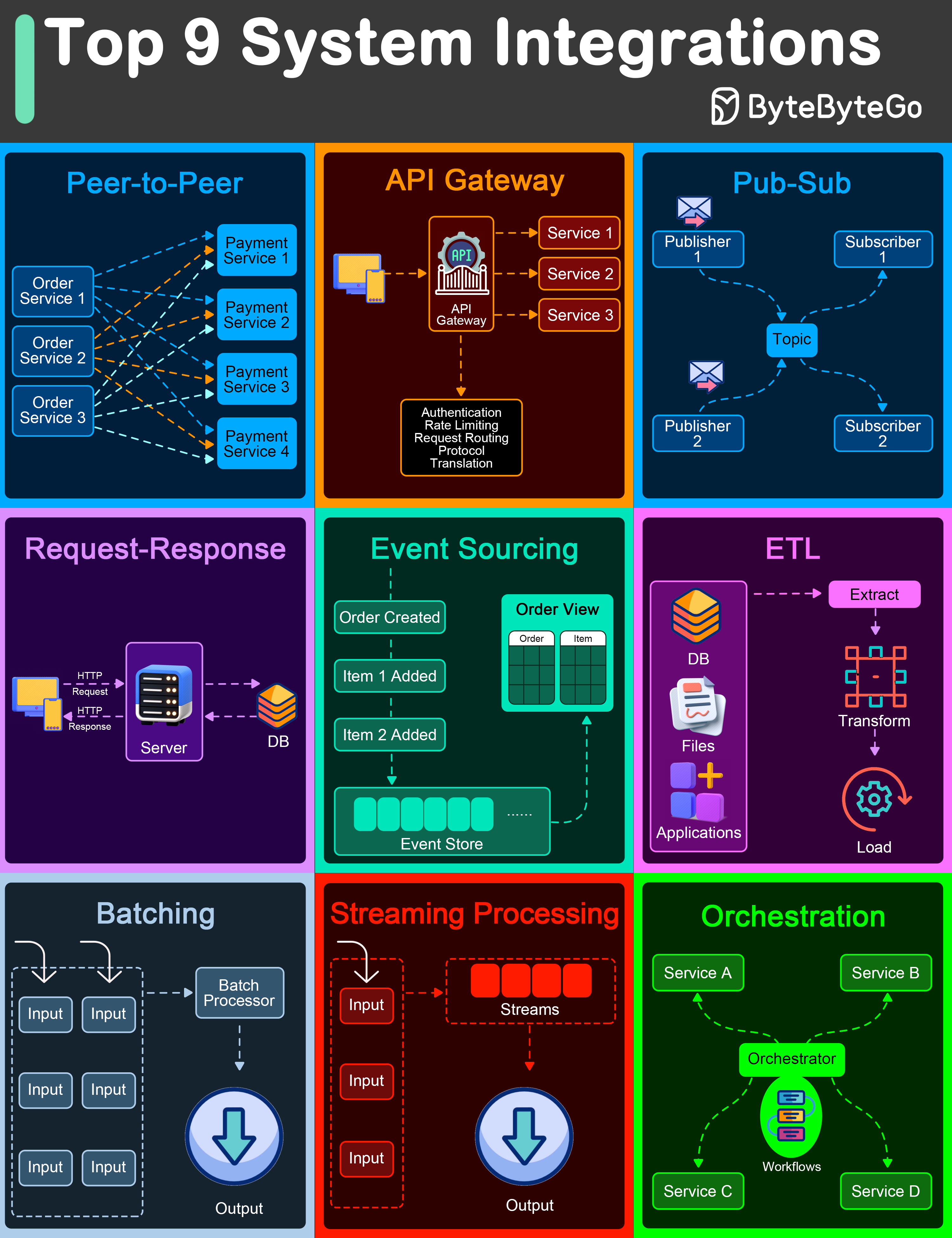
1. Peer-to-Peer
Direct communication between two components without the need for a central coordinator.2. API Gateway
Acts as a single entry point for all client requests to the backend services of an application.3. Pub-Sub
Decouples the producers of messages (publishers) from the consumers of messages (subscribers) through a message broker.4. Request-Response
One of the most fundamental integration patterns, where a client sends a request to a server and waits for a response.5. Event Sourcing
Involves storing the state changes of an application as a sequence of events.6. ETL (Extract, Transform, Load)
A data integration pattern used to gather data from multiple sources, transform it into a structured format, and load it into a destination database.7. Batching
Accumulating data over a period or until a certain threshold is met before processing it as a single group.8. Streaming Processing
Allows for the continuous ingestion, processing, and analysis of data streams in real-time.9. Orchestration
A central coordinator (orchestrator) manages the interactions between distributed components or services to achieve a workflow or business process.Client Architecture Patterns
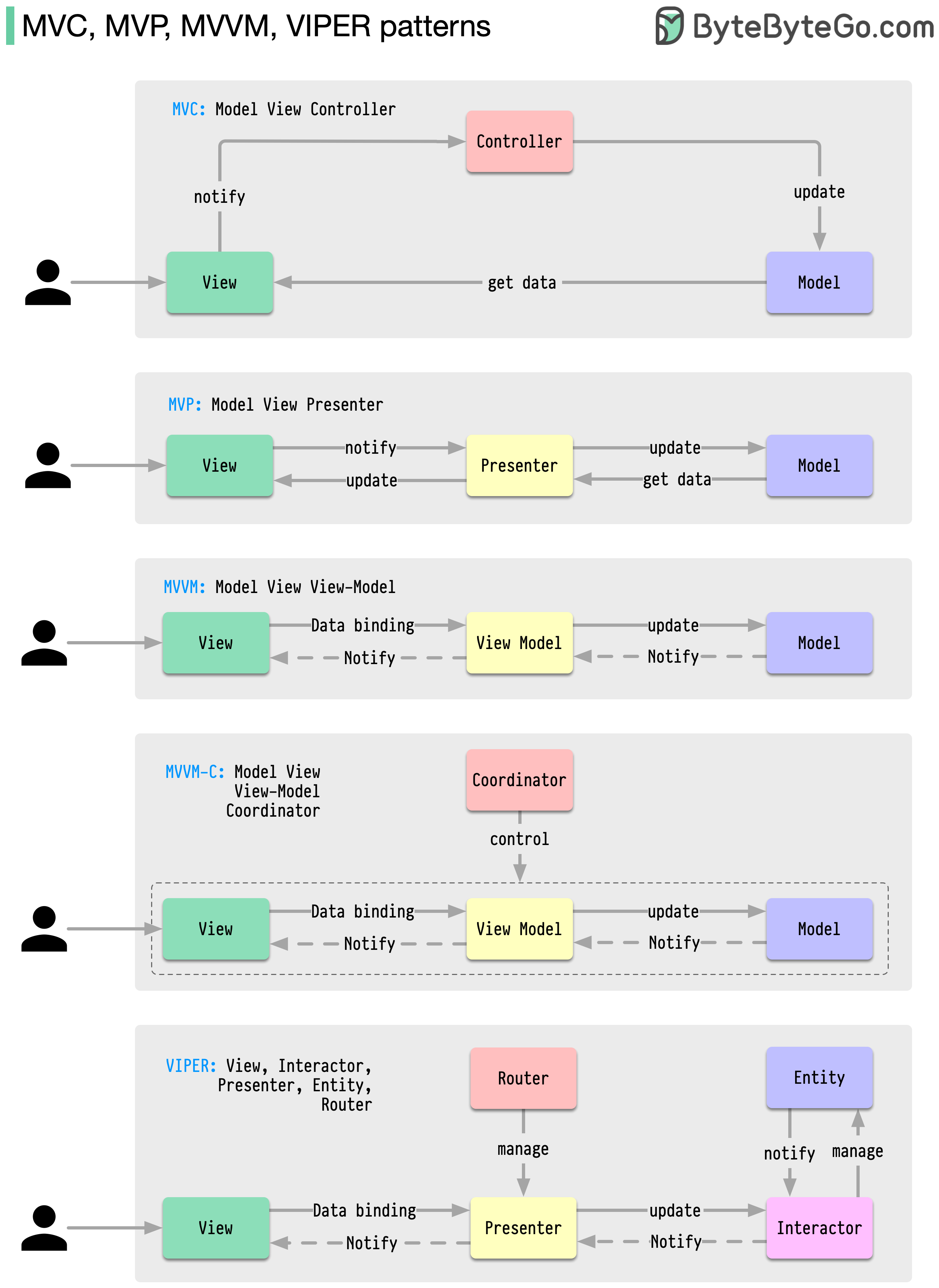
MVC, MVP, MVVM, and VIPER
MVC, MVP, MVVM, and VIPER
Key Differences:
- MVC - The oldest pattern, dating back almost 50 years
- Every pattern has a “view” (V) responsible for displaying content and receiving user input
- Most patterns include a “model” (M) to manage business data
- “Controller,” “presenter,” and “view-model” are translators that mediate between the view and the model
- These translators can be complex to write, so various patterns have been proposed to make them more maintainable
Best Practices
Next Steps
Design Patterns
Explore essential design patterns for software development
Microservices
Deep dive into microservices best practices
Scalability
Learn strategies to scale your systems effectively