What Are Microservices?
Microservices architecture breaks down a large system into smaller, more manageable components. Each microservice is designed to do one thing well and can be developed, deployed, and scaled independently.Systems built with microservices architecture are fault tolerant. Each component can be scaled individually, though it may increase the complexity of the application.
Typical Microservice Architecture
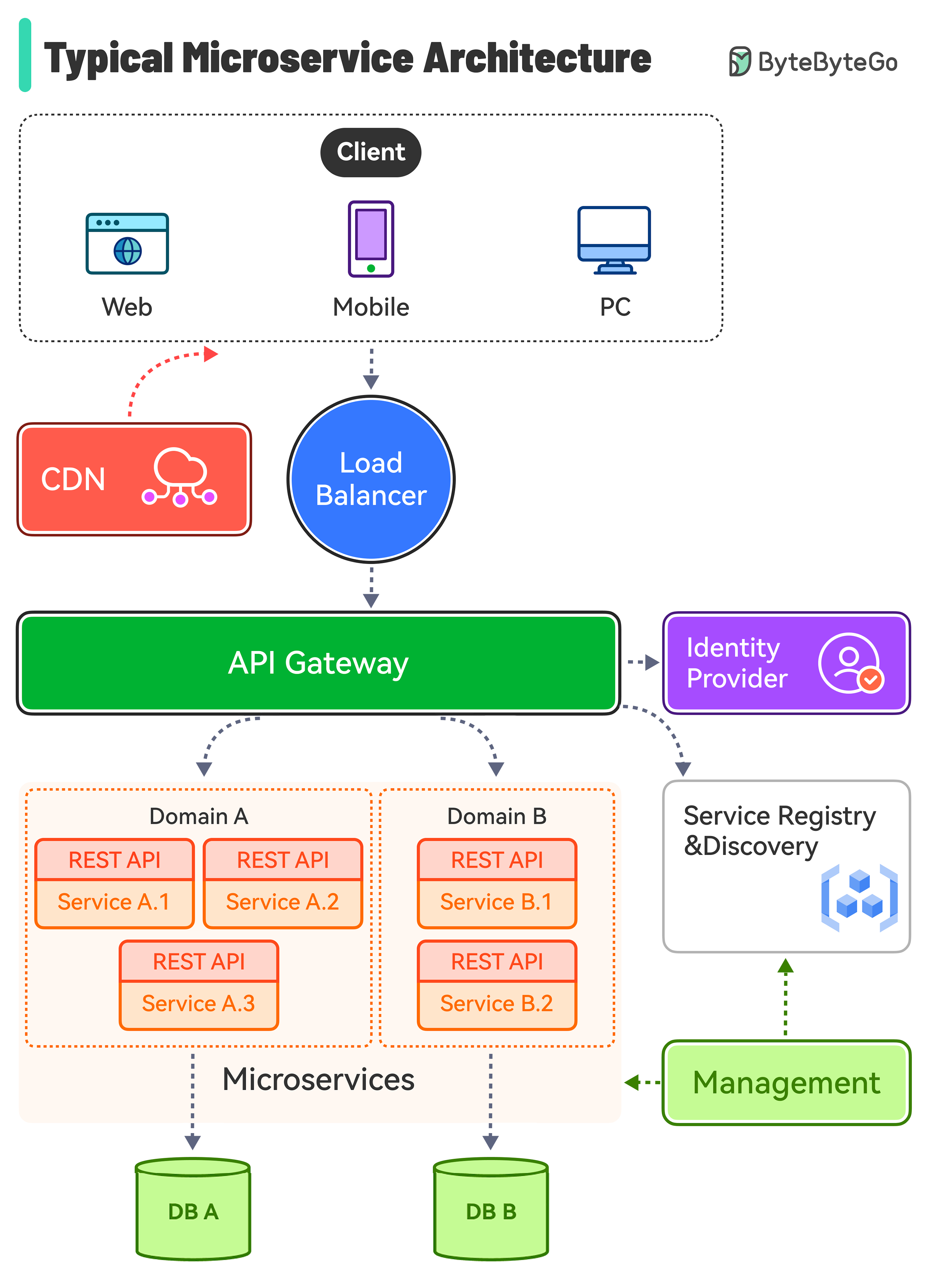 The diagram above shows a typical microservice architecture with all essential components.
Key Components
Load Balancer
Distributes incoming traffic across multiple backend services for high availability.
CDN
Content Delivery Network holds static content for faster delivery globally.
API Gateway
Handles incoming requests and routes them to relevant services.
Identity Provider
Handles authentication and authorization for users.
Service Registry
Microservice registration and discovery happens here.
Management
Monitors services, handles logging, and tracks metrics.
Load Balancer
Distributes incoming traffic across multiple backend services ensuring:- High availability
- Fault tolerance
- Optimal resource utilization
- Better response times
CDN (Content Delivery Network)
API Gateway
Handles incoming requests and routes them to the relevant services. It communicates with:- Identity provider for authentication
- Service discovery for routing
- Backend microservices
Service Registry & Discovery
How Service Discovery Works
How Service Discovery Works
Microservice registration and discovery happen in this component. The API gateway looks for relevant services in this component to communicate.Common Tools:
- Consul
- Eureka
- Zookeeper
- Kubernetes Services
9 Best Practices for Building Microservices
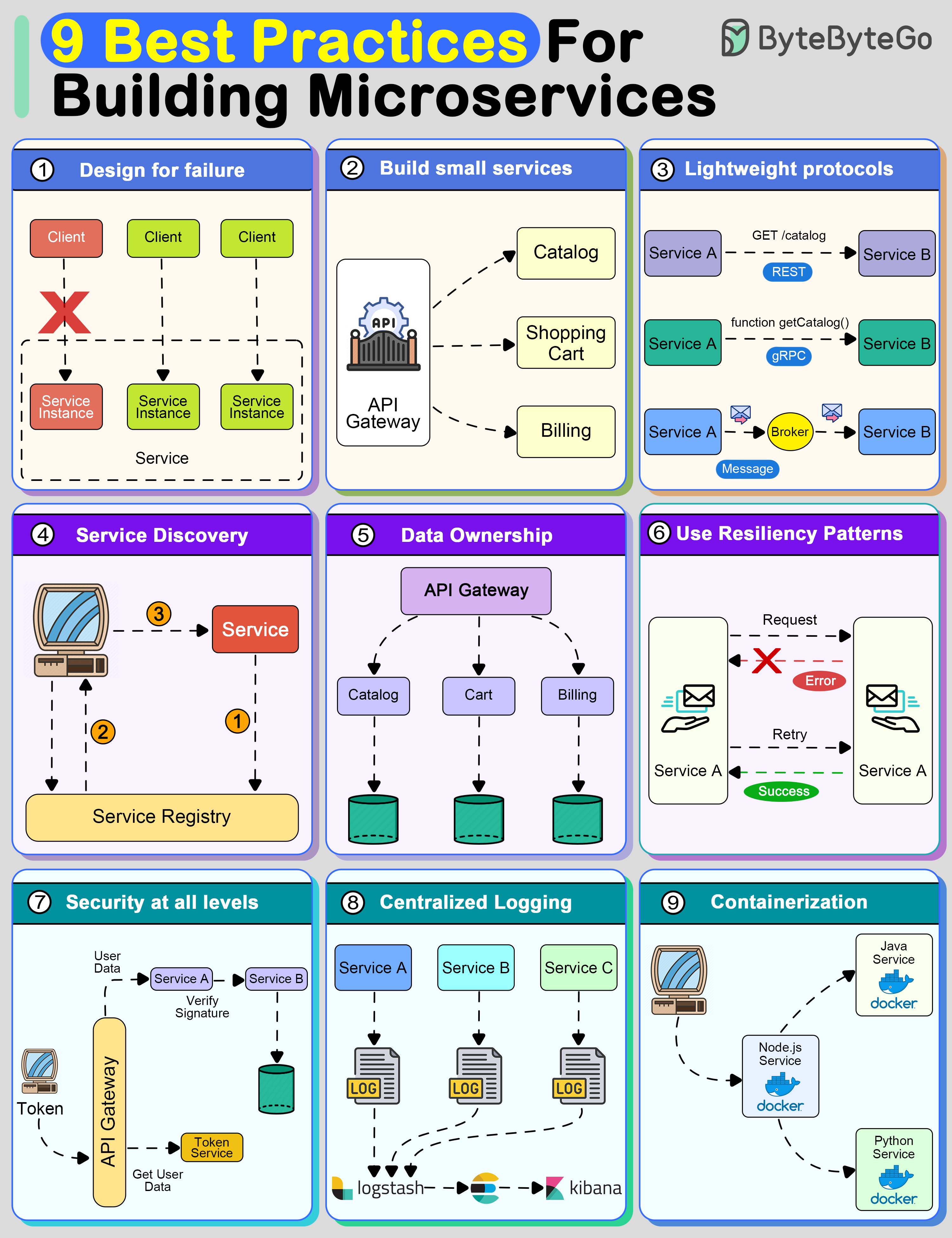 Creating a system using microservices is extremely difficult unless you follow strong principles.
1. Design For Failure
A distributed system with microservices will fail. You must design the system to tolerate failure at multiple levels such as infrastructure, database, and individual services.
- Implement circuit breakers
- Use bulkheads for isolation
- Apply graceful degradation methods
- Design for redundancy
- Plan for chaos engineering
2. Build Small Services
Single Responsibility Benefits:- Easier to understand and maintain
- Faster to develop and deploy
- Independent scaling
- Team ownership clarity
3. Use Lightweight Protocols for Communication
Communication is the core of a distributed system. Microservices must talk to each other using lightweight protocols.REST
Simple, widely adopted HTTP-based protocol
gRPC
High-performance RPC framework
Message Brokers
Kafka, RabbitMQ for async communication
4. Implement Service Discovery
To communicate with each other, microservices need to discover each other over the network. Tools:- Consul
- Eureka
- Zookeeper
- Kubernetes Services
- etcd
5. Data Ownership
Database Per Service Pattern
Database Per Service Pattern
In microservices, data should be owned and managed by the individual services.Goal: Reduce coupling between services so they can evolve independently.Benefits:
- Independent data schema evolution
- Technology choice flexibility
- Better scalability
- Clear ownership boundaries
- Data consistency across services
- Complex queries spanning services
- Distributed transactions
6. Use Resiliency Patterns
Implement specific resiliency patterns to improve service availability.Retry Policies
Automatically retry failed requests with exponential backoff
Caching
Store frequently accessed data to reduce load
Rate Limiting
Prevent service overload and ensure fair usage
Circuit Breaker
Stop cascading failures by breaking the circuit
7. Security at All Levels
In a microservices-based system, the attack surface is quite large. You must implement security at every level of the service communication path.
- API Gateway authentication/authorization
- Service-to-service authentication (mTLS)
- Data encryption in transit and at rest
- Secret management
- Network segmentation
- API rate limiting
8. Centralized Logging
Logging Stack:- Collection: Logstash, Fluentd
- Storage: Elasticsearch, S3
- Visualization: Kibana, Grafana
- Analysis: Distributed tracing (Jaeger, Zipkin)
9. Use Containerization Techniques
To deploy microservices in an isolated manner, use containerization techniques. Benefits:- Consistent environments
- Easy scaling
- Resource isolation
- Simplified deployment
- Docker - Container runtime
- Kubernetes - Container orchestration
- Helm - Package management
- Docker Compose - Local development
9 Essential Production Components
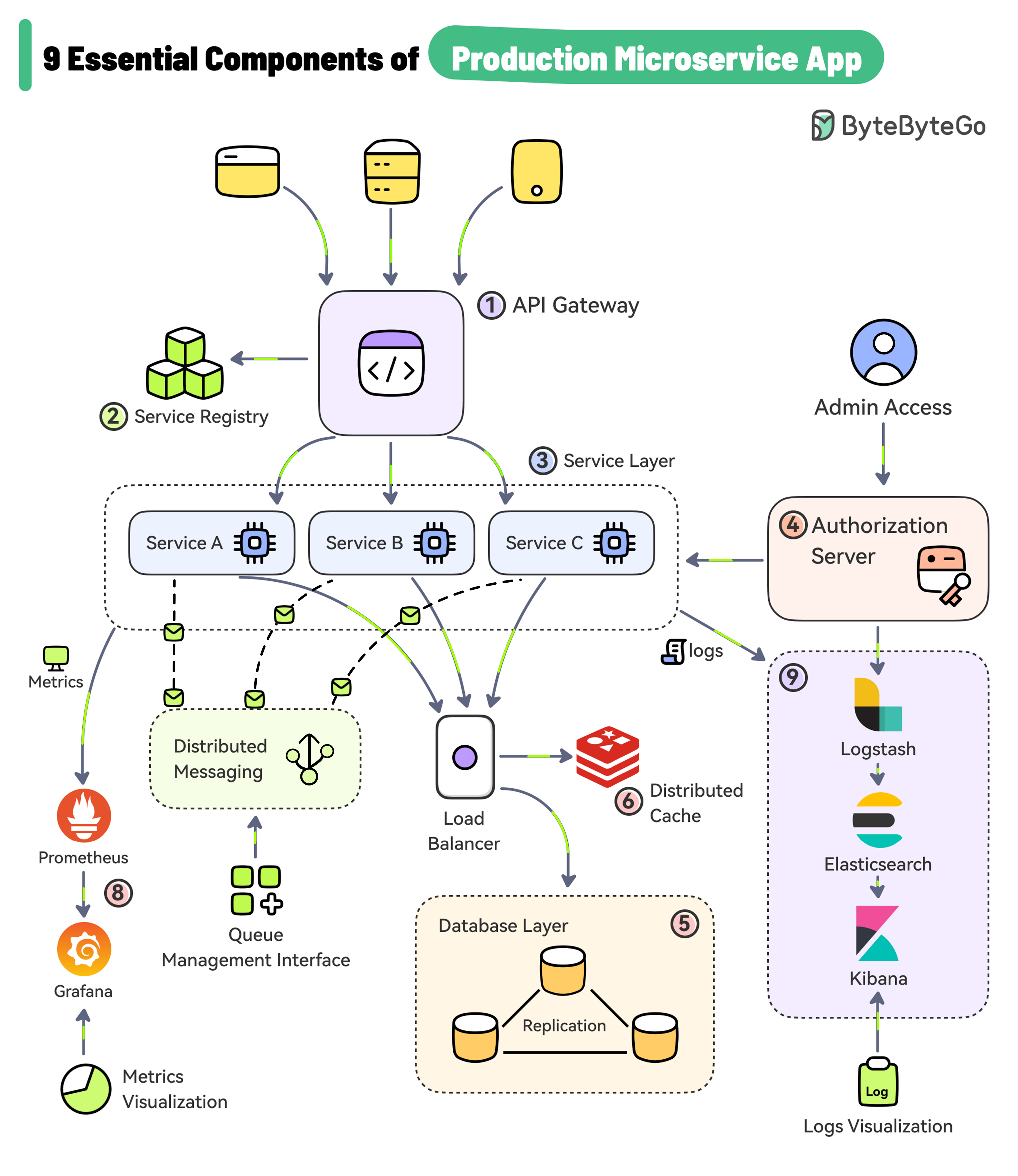
1. API Gateway
Provides a unified entry point for client applications. Handles:- Routing
- Filtering
- Load balancing
- Authentication
- Rate limiting
2. Service Registry
Contains the details of all services. The gateway discovers services using the registry. Options:- Consul
- Eureka
- Zookeeper
- etcd
3. Service Layer
Each microservice serves a specific business function and can run on multiple instances.Framework Options
Framework Options
Java/JVM:
- Spring Boot
- Quarkus
- Micronaut
- NestJS
- Express
- Fastify
- Go Kit
- Micro
- Gin
- FastAPI
- Flask
- Django
4. Authorization Server
Secures microservices and manages identity and access control. Solutions:- Keycloak
- Azure AD
- Okta
- Auth0
5. Data Storage
Databases store application data generated by services.SQL Databases
PostgreSQL, MySQL for relational data
NoSQL Databases
MongoDB, Cassandra for flexible schemas
6. Distributed Caching
Caching boosts application performance significantly. Options:- Redis
- Memcached
- Couchbase
- Hazelcast
7. Async Microservices Communication
Platforms:- Apache Kafka
- RabbitMQ
- Amazon SQS
- Google Pub/Sub
8. Metrics Visualization
Microservices publish metrics for monitoring and alerting. Stack:- Collection: Prometheus
- Visualization: Grafana
- Alerting: Alertmanager
9. Log Aggregation and Visualization
Logs generated by services need to be aggregated and analyzed. ELK Stack:- Logstash - Aggregation
- Elasticsearch - Storage
- Kibana - Visualization
Orchestration vs. Choreography
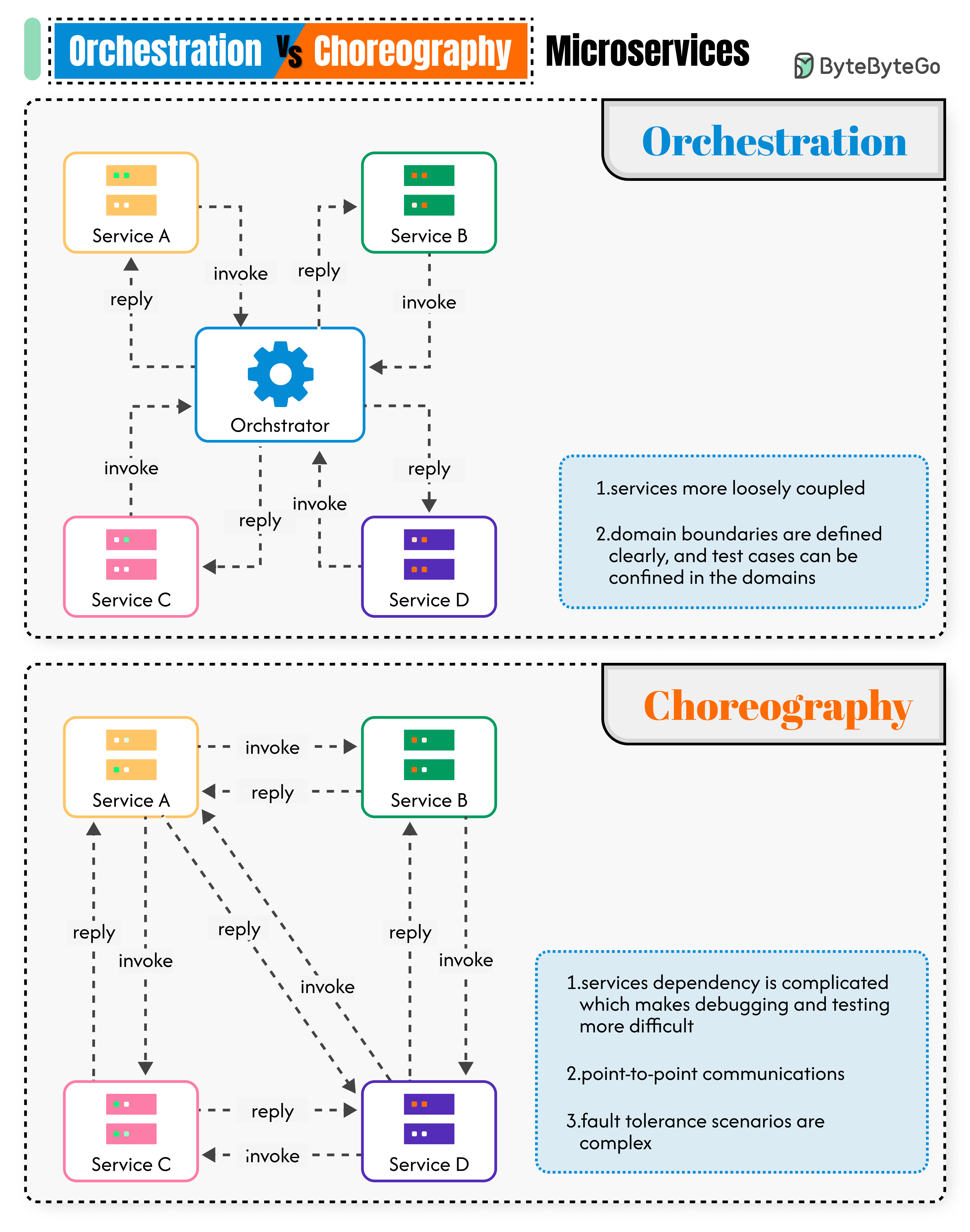 How do microservices collaborate and interact with each other? There are two approaches:
Choreography
How Choreography Works
How Choreography Works
Like having a choreographer set all the rules, then the dancers (microservices) interact according to them. Service choreography describes the exchange of messages and the rules by which microservices interact.Benefits:
- Loose coupling
- No central point of failure
- Services are autonomous
- Complex fault tolerance scenarios
- Difficult to understand overall flow
- Harder to modify interactions
Orchestration
The orchestrator acts as a center of authority, responsible for invoking and combining services. It’s like a conductor leading musicians in a symphony.
- Reliability - Built-in transaction management and error handling
- Scalability - Only the orchestrator needs modification when adding new services
- Visibility - Central view of the workflow
- Performance - Higher latency through centralized communication
- Single point of failure - Orchestrator must be highly available
When NOT to Use Microservices
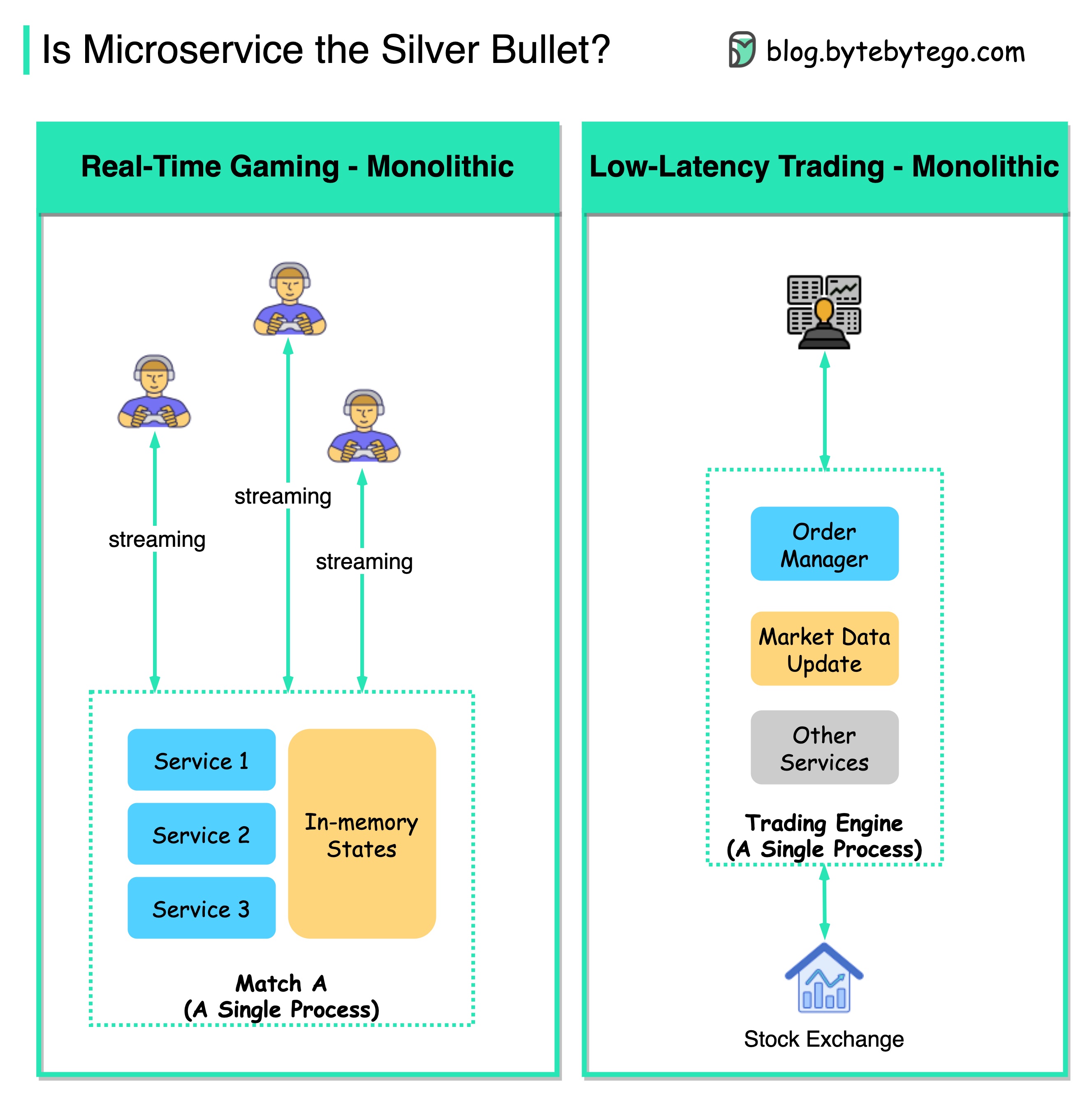
Microservice architecture is not a silver bullet. Some applications should use monolithic architecture.
Applications That Should Avoid Microservices:
1. Real-time Gaming- Requires millisecond-level latency
- Network latency is unbearable
- State must be stored in memory for quick updates
- Needs web socket connections and sticky routing
- Requires microsecond-level latency
- Cannot separate services into different processes
- Needs in-memory state storage
- High-frequency server communication required
Common Features Requiring Monolithic Architecture:
Latency Sensitive
Applications that cannot tolerate network latency
Stateful Operations
Systems requiring in-memory state for quick updates
High Frequency
Applications with high-frequency server communication
Single Process
Systems where separation causes performance issues
Best Practices Summary
Next Steps
Software Architecture
Learn about broader architectural patterns
Scalability
Discover how to scale microservices
Design Patterns
Explore patterns for microservices