Mintlify vs Fern: Which Platform Should You Choose for API Documentation in 2026?
Harkirat Chahal
Growth
Share this article
Harkirat Chahal
Growth
Share this article
Fern is a strong choice for API teams that primarily need to generate and maintain multi-language SDKs from OpenAPI or Fern Definition. Mintlify is the stron...
TL;DR
Fern is a strong choice for API teams that primarily need to generate and maintain multi-language SDKs from OpenAPI or Fern Definition. Mintlify is the stronger choice for teams that need a complete API documentation platform with polished reference pages, flexible MDX authoring, guides, changelogs, AI-ready outputs, MCP servers, AI traffic analytics, and an in-docs assistant in one managed system.
This guide compares Mintlify and Fern across SDK generation, API reference workflows, design flexibility, AI readiness, content scope, analytics, pricing, and migration so teams can choose the platform that matches how they publish and maintain API documentation.
Quick Comparison: Mintlify vs Fern
| Dimension | Mintlify | Fern |
|---|---|---|
| Primary focus | ✅ Complete documentation platform for API references, guides, changelogs, AI search, analytics, and agent-readable docs | ⚠️ SDK generation with a documentation layer |
| Spec format | ✅ OpenAPI 3.0+, AsyncAPI 3.0, standard Markdown, and MDX | ✅ OpenAPI and Fern Definition |
| API reference auto-generation | ✅ OpenAPI-generated endpoint pages with editable MDX and playground support | ✅ Yes |
| SDK generation | ⚠️ Via Speakeasy and Stainless integrations | ✅ Native, multi-language |
| Interactive playground | ✅ Live requests, configurable auth, and SDK examples via integrations | ✅ Yes |
| AI assistant in docs | ✅ Built-in assistant with RAG, citations, in-docs answers, Slack, and Discord bot | ✅ Ask Fern with citations, API access, Slack app, and Discord bot |
| llms.txt and skill.md | ✅ Auto-generated llms.txt, llms-full.txt, skill.md, and Markdown delivery | ⚠️ Auto-generated llms.txt and llms-full.txt |
| Auto-generated MCP servers | ✅ Auto-generated for documentation sites so agents can query docs directly | ⚠️ Available when Ask Fern is enabled |
| AI traffic analytics | ✅ Human vs. AI traffic filtering, search analytics, assistant logs, and analytics API | ⚠️ LLM traffic analytics for llms.txt usage |
| Design flexibility | ✅ MDX components, layouts, custom CSS, custom JavaScript, and React components | ⚠️ Theming and docs customization options |
| Content scope | ✅ API references, guides, changelogs, product docs, internal docs, and personalized content | ⚠️ API docs, SDK docs, guides, and changelogs |
| Migration portability | ✅ Standard OpenAPI, Markdown, and MDX files keep migration flexible | ⚠️ Fern Definition may add migration work |
Build AI-ready documentation with Mintlify →
Why API documentation needs AI-ready delivery in 2026
API documentation now serves developers, prospects, customers, and AI assistants simultaneously. Developers still visit docs pages directly, but AI tools such as ChatGPT, Claude, Perplexity, Cursor, and Windsurf also read those pages to answer product and implementation questions. When the documentation is incomplete, hard to parse, or missing structured AI content, AI tools can produce weaker answers about authentication, endpoints, SDK usage, and product behavior.
Customer-facing API documentation platforms serving human readers need clear navigation, polished reference pages, working playgrounds, and useful guides. AI systems need clean Markdown, structured indexes, stable page hierarchy, and machine-readable access through files such as llms.txt, llms-full.txt, and skill.md. MCP servers add another layer by enabling AI tools to query documentation directly and retrieve current product context via a standard interface.
When Fern is the right fit
Fern is a better fit in the situations below.
SDK generation is the primary requirement: Fern works well when the engineering team needs to generate, publish, and version multi-language client libraries alongside the API. The native SDK pipeline supports teams that treat SDKs as a core part of the developer experience.
Multi-language SDK coverage is needed in a single workflow: Fern can generate SDKs for languages such as Python, TypeScript, Java, and Go from a single API specification. Teams that would otherwise maintain these libraries manually can use Fern to centralize that generation process.
SDKs and reference pages need to stay connected: Fern fits teams that want generated SDKs and endpoint reference pages to come from the same source and update together. Sharing a single specification across both surfaces reduces mismatches between the client libraries and the API reference when the API changes.
The team is comfortable with Fern’s specification model: Fern supports OpenAPI and also offers Fern Definition for teams that want to use Fern’s own spec workflow. Teams already using Fern Definition or willing to adopt the format will find it easier to work with Fern’s SDK-first model.
When Mintlify is the right fit
The scenarios below cover the most common reasons API teams choose Mintlify over Fern.
Documentation shapes product evaluation: When developers, prospects, and customers consult the docs before talking to sales or trying the product, the quality of the design, navigation, search, and page performance influences how they evaluate the API. Mintlify’s MDX component library, layout options, custom CSS, and custom JavaScript help teams create documentation that feels connected to the product experience.
AI-readable delivery is a requirement: Teams that want ChatGPT, Claude, Perplexity, Cursor, and similar tools to represent the product accurately need clean source material for AI retrieval. Mintlify generates llms.txt, llms-full.txt, skill.md, and MCP servers, serves pages in Markdown, and provides teams with analytics on AI agent traffic.
Documentation extends beyond API reference: Getting-started guides, conceptual pages, tutorials, changelogs, internal docs, and personalized content often need to live beside endpoint references. Mintlify supports those content types in the same docs experience, with API key prefilling, conditional content blocks, and group-based page visibility available for teams that need personalized documentation.
Teams want managed infrastructure: Mintlify handles hosting, search, AI delivery, analytics, preview deployments, and checks for broken links and style issues. Engineering teams can maintain a Git-based workflow without having to maintain a custom docs site, search index, analytics setup, and AI retrieval layer.
Anthropic, Cursor, Perplexity, and Zapier use Mintlify for developer-facing documentation. Trophy migrated its developer documentation from Fern to Mintlify to take advantage of a better authoring experience, native React component support, and cost-effective custom-domain hosting.
Teams can start a free Mintlify project on the Hobby tier with a custom domain, API playground, search, and LLM optimizations included.
Mintlify vs Fern: Feature-by-feature comparison
Docs design and customization: Mintlify gives teams a documentation-first authoring system with MDX, reusable components, custom CSS, custom JavaScript, and headless frontend support for teams that need full presentation control. API references, guides, changelogs, and product documentation can share the same branded experience. Fern also supports docs customization through docs.yml, custom CSS, custom JavaScript, and custom React components, but its customization is still more closely tied to API and SDK documentation workflows.
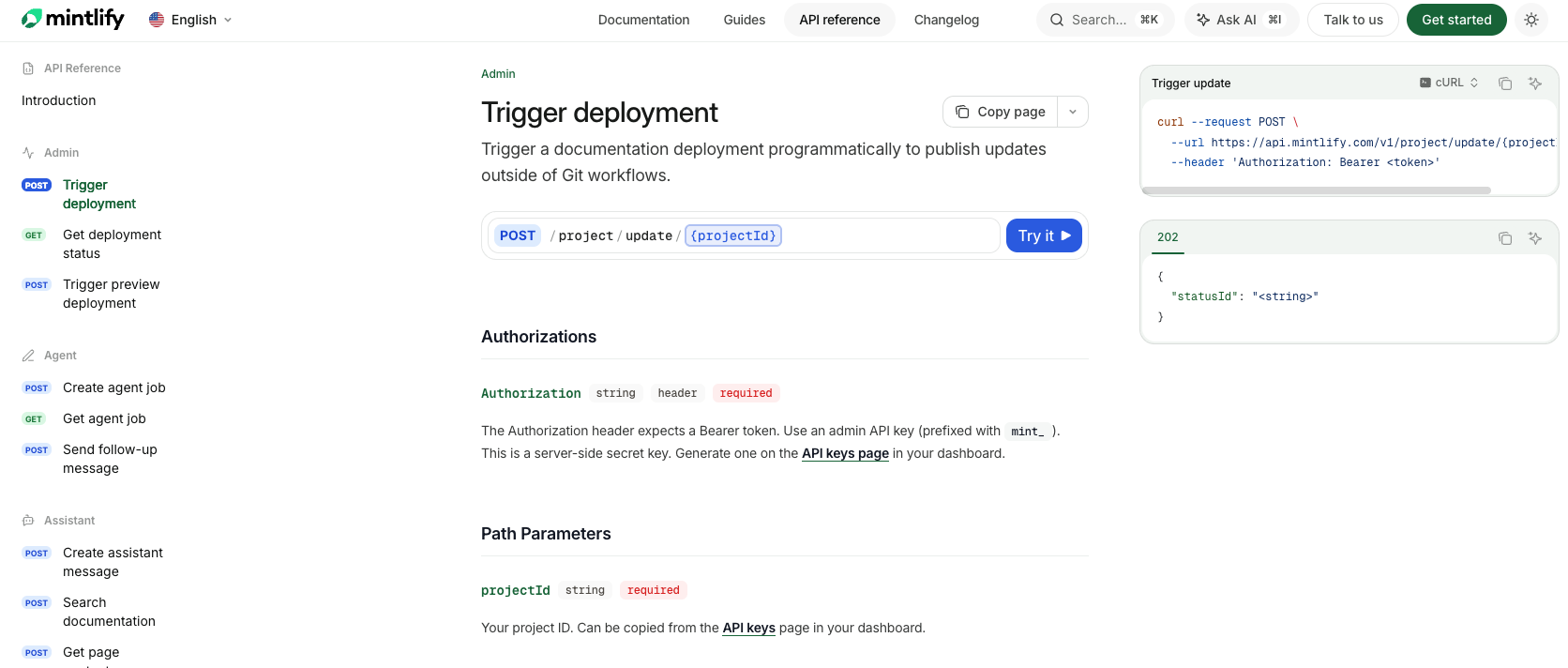
API reference generation: Mintlify generates interactive API documentation from OpenAPI and AsyncAPI specs, including endpoint pages, request builders, navigation, authentication fields, and API playground support. Teams can also create custom endpoint pages with MDX when they need more control over examples, warnings, or narrative context. Fern generates REST API references from OpenAPI and also supports other API reference types, but Mintlify offers a stronger documentation experience when reference pages need to live beside broader product content.
SDK generation: Fern offers native SDK generation, generating multi-language SDKs directly from API definitions. Mintlify does not generate SDKs natively, but it integrates with Speakeasy and Stainless to display generated SDK code samples in the interactive playground. For teams that want the documentation platform to remain the main customer-facing surface, Mintlify keeps SDK examples inside a richer docs experience without making SDK generation the center of the product.
AI features: Mintlify is stronger for AI-ready documentation because AI delivery is part of the core platform. Mintlify serves pages as Markdown, auto-generates llms.txt, llms-full.txt, and skill.md, hosts documentation, MCP servers, includes an in-docs AI assistant, and supports an agent that can open pull requests for documentation updates. Fern supports Ask Fern, llms.txt, llms-full.txt, Markdown access, and LLM traffic analytics, but Fern’s AI surface is narrower and sits closer to the docs and SDK experience.
Interactive playground: Mintlify’s playground lets developers test endpoints within the docs, send real requests, show responses, and generate interactive pages from OpenAPI or AsyncAPI. Fern also provides an API Explorer for testing endpoints, but Mintlify’s playground is better positioned when testing, guides, changelogs, AI-readable outputs, and analytics need to work together on a single documentation platform.
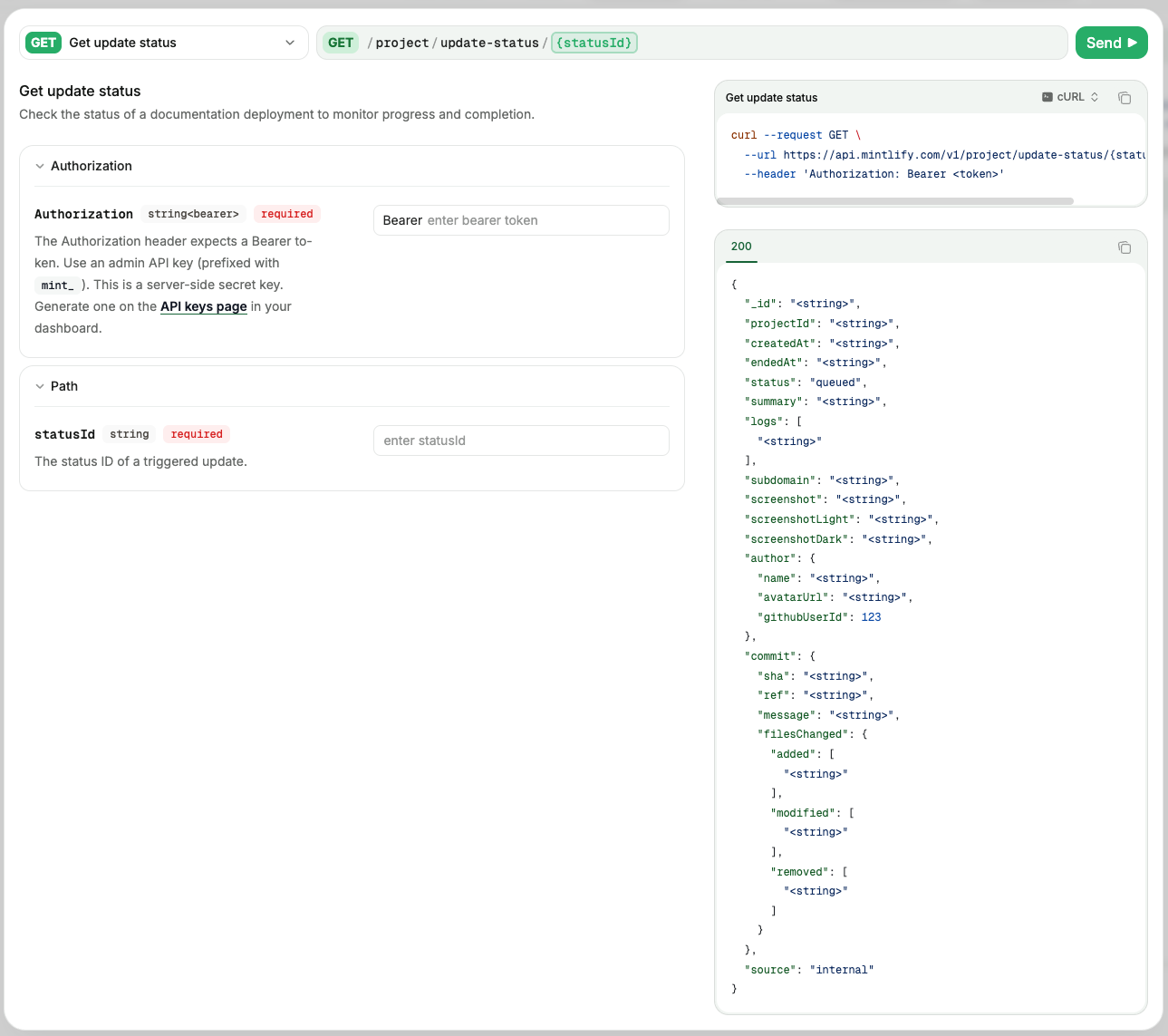
Changelogs and broader content: Mintlify supports API references, guides, changelogs, product documentation, reusable snippets, and personalized content within a single MDX-based system, helping teams publish the full documentation customers and AI assistants need to understand the product. Fern supports docs pages, API references, SDK documentation, and changelogs, but its strongest fit remains API and SDK publishing.
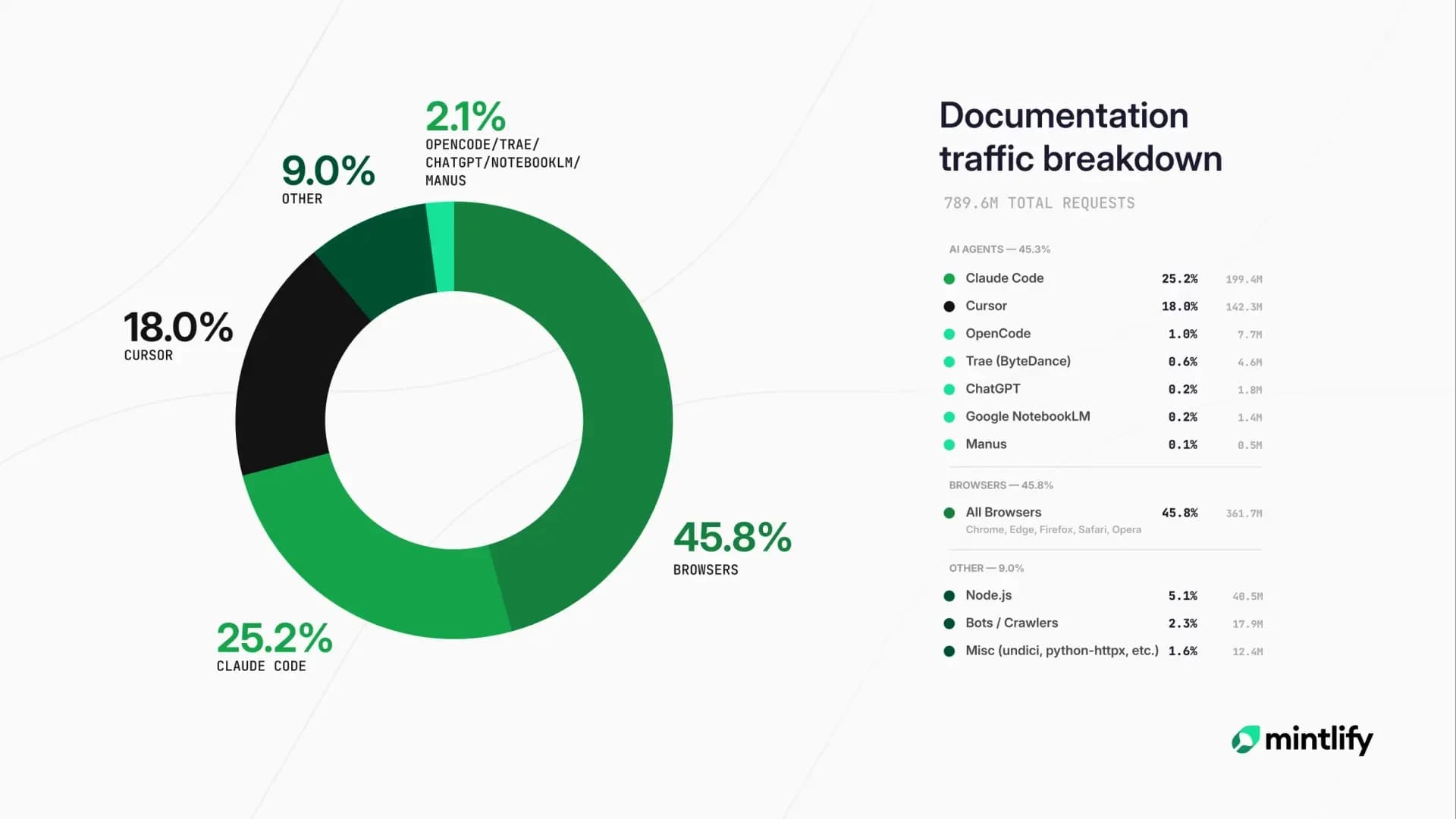
Analytics: AI traffic analytics gives documentation teams native visibility into page traffic, search queries, user feedback, AI assistant conversations, and AI-versus-human visitor data. Mintlify also exposes analytics through the CLI and API, so teams can inspect documentation performance without assembling a separate reporting layer. Fern provides LLM traffic analytics for llms.txt usage and can integrate with third-party analytics tools, but Mintlify offers a stronger native analytics layer for documentation teams.
Spec format and portability: Mintlify keeps API documentation close to standard OpenAPI, AsyncAPI, Markdown, and MDX files, which makes the documentation easier to manage in Git and easier to migrate later. Fern supports OpenAPI and Fern Definition, which can be useful for teams adopting Fern’s SDK workflow. For teams that want documentation content to stay portable and documentation-first, Mintlify offers a cleaner long-term structure.
Mintlify vs Fern Pricing
Mintlify offers two documentation plans: Hobby and Enterprise. The free Hobby plan includes the full platform, one dashboard member, a custom domain, a web editor, an MCP server, and custom components. Enterprise offers custom pricing, unlimited members, an assistant agent, a writing agent, preview deployments, password protection, Workflows with self-updating support, boosted performance, enterprise security and legal support, and migration support. Mintlify provides an API playground, Git sync, search, integrations, webhooks, WebSockets, developer API, analytics, AI-ready outputs, agent analytics, user feedback, and agent feedback across all pricing tiers, including the free tier.
Fern separates pricing across Docs and SDKs. Fern Docs starts with a free Hobby plan, followed by Team at $150 per month and Enterprise at custom pricing. The Docs plans include features such as API references, changelogs, API Explorer, web editor, docs-as-code, Markdown and MDX guides, custom CSS and JavaScript, custom React, /llms.txt, AI search, and MCP server support depending on plan coverage. Fern SDK pricing starts at $250 per SDK per month; Pro at $600 per SDK per month; and Enterprise at custom pricing per SDK.
For API teams, the clearer question is whether the documentation platform covers the full workflow directly or requires additional tools around it. Mintlify combines the documentation site, API playground, Git workflow, AI-ready outputs, analytics, and collaboration features into a single documentation platform. Fern Docs covers the documentation layer, while native SDK generation is priced separately through Fern SDK plans. Teams that need a polished documentation experience first will find Mintlify easier to scope, while teams with SDK generation as a separate product requirement may find Fern’s split pricing easier to justify.
How to migrate from Fern to Mintlify
Teams moving from Fern to Mintlify can usually reuse the core API specification, then rebuild the documentation experience around Mintlify’s MDX, Git, and API playground workflow.
Reuse the OpenAPI specification: If the API is already documented in OpenAPI, the same spec can feed into Mintlify’s scraper CLI to generate endpoint MDX files. Teams using Fern Definition can export the API definition to OpenAPI first, then use the exported spec for the Mintlify import.
Move narrative content into MDX: Guides, conceptual pages, tutorials, and onboarding content written in Markdown can be migrated to Mintlify with minimal rewriting. Mintlify’s MDX components cover common documentation patterns such as callouts, cards, tabs, accordions, code groups, snippets, and diagrams, so teams can recreate the reader experience while simplifying custom formatting.
Regenerate API references in Mintlify: Mintlify can generate editable endpoint pages from the OpenAPI spec and connect them to the interactive playground. Teams can add examples, warnings, implementation notes, and deeper explanations directly inside MDX pages where the API reference needs more context.
Preserve SDK examples through integrations: Teams that used Fern for SDK generation can continue using a dedicated SDK generator, such as Speakeasy or Stainless, and then surface the generated SDK examples in Mintlify’s playground. This keeps the documentation layer in Mintlify while preserving SDK coverage for developers.
Set up the Mintlify Git workflow: Mintlify uses docs.json for navigation, styling, integrations, and API settings. After the content and OpenAPI spec are in place, teams can use Git sync, local previews, and pull request previews to review documentation changes before publishing.
Teams that want to manage the move internally can follow Mintlify’s migration documentation and use the @mintlify/scraping package where the workflow fits the source content. Teams that want hands-on help can use Mintlify’s migration tooling or white-glove service through the Switch program.
Mintlify vs Fern: Which one should you choose?
The choice between Mintlify and Fern depends on whether the team’s main requirement is a complete documentation platform or a native SDK generation pipeline.
Fern fits API teams whose primary customer-facing artifact is the SDK. Fern helps teams generate and maintain multilingual client libraries from OpenAPI or Fern Definitions, and publish reference documentation alongside the generated SDKs. Fern is a practical fit when SDK versioning, language coverage, and generated client libraries sit at the center of the developer experience.
Mintlify is for teams that want documentation to be the primary product surface for developers, prospects, customers, and AI assistants. Teams can publish OpenAPI and AsyncAPI references, interactive playgrounds, guides, changelogs, and product documentation on a single managed platform. Mintlify also adds AI-ready delivery through Markdown serving, llms.txt, llms-full.txt, skill.md, MCP servers, AI traffic analytics, and an in-docs assistant, with migration support available through Mintlify’s documentation and Switch program.
Choose Fern when native SDK generation is the main requirement, and the documentation layer primarily needs to support the generated libraries. Choose Mintlify when the goal is to publish, maintain, and scale customer-facing API documentation without assembling design, hosting, AI retrieval, analytics, and migration workflows across separate tools.
Teams can start on Mintlify’s free plan or use a Pro trial to compare the managed documentation workflow against their current API docs setup.
FAQs: Mintlify vs Fern
What is the best alternative to Fern for API documentation?
Mintlify is the best Fern alternative for teams that need a complete API documentation platform, not only an SDK generation workflow. Mintlify supports OpenAPI and AsyncAPI references, interactive playgrounds, guides, changelogs, AI-ready outputs, MCP servers, AI traffic analytics, and an in-docs assistant within a single managed documentation system. Fern is a better fit when native multi-language SDK generation is the primary requirement.
Does Mintlify generate SDKs?
Mintlify does not generate SDKs natively. Teams can use Speakeasy or Stainless to generate SDKs and surface the resulting code samples in the Mintlify playground, keeping Mintlify focused on the customer-facing documentation experience while still providing developers with language-specific examples in the API reference.
Can Mintlify import my Fern docs?
Teams can reuse an existing OpenAPI specification to generate Mintlify endpoint pages and rebuild API references inside the Mintlify playground. Guides, tutorials, and conceptual pages written in Markdown or MDX can be migrated with minimal rewriting. Teams using Fern Definition can export to OpenAPI first, then follow Mintlify’s migration documentation or use the Mintlify Switch program for guided migration support.
How does Mintlify handle multi-language API examples?
Mintlify includes cURL, Python, and JavaScript code examples in the playground out of the box, generated from the OpenAPI specification. Teams that need broader language coverage with idiomatic SDK code can integrate Speakeasy or Stainless, both of which surface generated SDK examples directly in the Mintlify playground. The combined setup gives readers production-quality code samples in the languages they actually use.
How long does it take to migrate from Fern to Mintlify?
Trophy's full migration from Fern to Mintlify took roughly one week, covering OpenAPI spec reuse, content porting, design setup, and SDK integration through a partner. Timeline varies with the volume of custom narrative content and the complexity of the existing site structure, but teams with a standard OpenAPI specification and Markdown-based guides typically complete the move in one to two weeks.
More to read
The Complete Guide to Quick Start Guides for Software Products
Learn how to create software quick start guides that take new users from setup to a verifiable first success, with examples and maintenance best practices.
September 11, 2026Harkirat Chahal
Growth

Troubleshooting Guide Best Practices for Software Companies
Learn how to write troubleshooting guides with symptom-based diagnosis, safe recovery steps, clear escalation paths, and ongoing maintenance.
September 11, 2026Harkirat Chahal
Growth