Mintlify Alternatives: What to Consider (and Why There's No True Substitute)
Cole Gottdank
GTME
Share this article
Cole Gottdank
GTME
Share this article

Mintlify connects docs as code, autonomous documentation maintenance, AI-native delivery, product-grade design, a built-in AI assistant, automatic MCP server generation, and an interactive API playground in a single platform with a shared content foundation.
Why there's no one-to-one Mintlify alternative
Mintlify connects docs as code, autonomous documentation maintenance, AI-native delivery, product-grade design, a built-in AI assistant, automatic MCP server generation, and an interactive API playground in a single platform with a shared content foundation.
Alternatives cover pieces, not the full workflow:
- Docusaurus — docs as code with full React control, but your team owns all infrastructure, tooling, and maintenance. No AI assistant, no MCP, no autonomous agent.
- ReadMe — polished API reference with a visual editor, but Git sync and AI assistant are both in beta. No docs-as-code workflow backing the playground.
- GitBook — strong WYSIWYG editing for non-technical contributors with MCP support added, but no agent analytics, no autonomous maintenance, and no AI-native architecture.
- Redocly / Stoplight — strong API reference rendering, but reference-only. No guides, no AI assistant, no MCP, no autonomous maintenance.
- MkDocs — static site generator. No AI features, no playground, no agent.
Pick Mintlify if you need the complete workflow from authoring to AI-agent delivery in one platform.
If you're here, you're probably doing one of three things: running a vendor comparison before committing budget, pressure-testing whether a simpler or cheaper tool covers what you actually need, or asking whether a managed platform is overkill at your current stage. All three are reasonable starting points.
The problem is that documentation tooling has historically been fragmented, and that fragmentation shapes how people evaluate alternatives. If you've only used static site generators, you might assume "docs platform" means "builds HTML from Markdown." Documentation has moved well past that.
Mintlify combines seven capabilities on a shared foundation: docs as code, autonomous documentation maintenance via Workflows, AI-native delivery, product-grade design, a built-in AI assistant, automatic MCP server generation, and an interactive API playground. Alternatives exist for individual layers, but no single tool replicates the entire integrated Mintlify system. The right way to evaluate Mintlify alternatives is capability by capability and at the end of the day, there really is no direct alternative.
No one-to-one alternative to Mintlify
Mintlify is a documentation platform built for technical teams shipping fast. Under one roof, Mintlify covers docs as code, autonomous documentation maintenance, AI-native delivery, product-grade design, a built-in AI assistant, automatic MCP server generation, and an interactive API playground.
Those capabilities share a common content foundation and feed into each other. The MDX you write in Git feeds Workflows, the autonomous agent that keeps docs current as code ships. That structured content improves agent retrieval via auto-generated llms.txt and MCP servers. The built-in assistant searches the same corpus to deflect support tickets. The API playground renders live endpoint testing from the same OpenAPI spec powering your reference docs. That chain is what makes documentation stay accurate and useful over time instead of decaying behind the product.
Most tools in this space cover one or two of those capabilities. A static site generator hosts your content but does not keep it current. An AI search integration retrieves answers but does not know when your API changed. An API reference renderer displays your endpoints but does not connect to the guides, assistant, or agent layer sitting above it.
To replicate what Mintlify does, you would need Docusaurus or MkDocs for hosting, Algolia or Typesense for search, a custom integration for AI retrieval, a hand-built MCP server, plugin configuration for an API playground, and either manual doc maintenance or an internal script to watch for code changes. That is five to six tools minimum, each with its own configuration, data model, and failure modes. Every handoff between them requires ongoing synchronization with your actual product. Every integration is a place where something breaks after a Friday deploy.
Teams at Anthropic, Cursor, Perplexity, and Zapier use Mintlify for their developer-facing documentation. These are not internal wikis. Zapier reported a 20% increase in traffic and adoption after switching, driven by better navigation and a faster developer experience. That kind of outcome requires tight integration across authoring, delivery, and AI retrieval, and stitching together point solutions does not deliver it.
1. Documentation as code
Without version-controlled documentation, every new release puts your documentation out of date. Engineering teams ship faster than anyone can document, especially now with AI-assisted coding tools. If you’re relying on your developer relations team or community team to ship changes to docs as your engineers ship code, you’re never going to keep up with the latest changes.
Mintlify makes it easy for developers to update docs without leaving their workflow. Docs live directly in Git as markdown files. Every change goes through a PR, and branches map to preview deployments. Coding agents like Claude Code, Codex, and Cursor read Mintlify's schema, style guide, and file structure natively, so AI-assisted authoring works without special configuration. Bi-directional Git sync means engineers edit locally in their IDE while product managers use the WYSIWYG web editor, and both write to the same repo.
Alternatives:
- Docusaurus: Full React control, but your team owns hosting, search, deployment, and all tooling maintenance.
- ReadMe: Git sync in beta; no docs-as-code workflow backing the editor.
- MkDocs: Static site generator with no AI-assisted authoring or maintenance.
2. Workflows
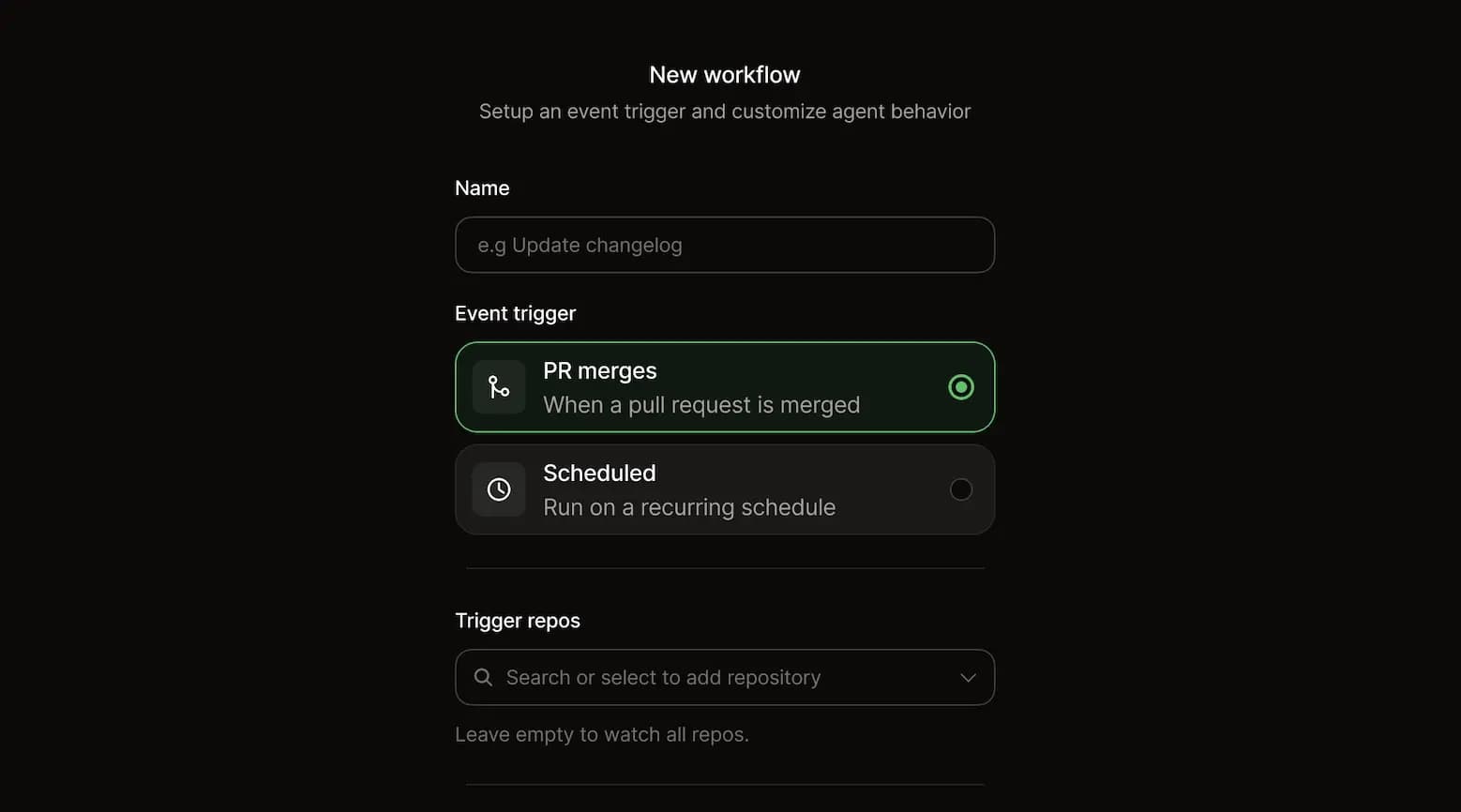 Documentation decays because keeping it current is a manual task that competes with shipping. Every sprint that merges without a doc update is a gap that compounds. As AI coding tools accelerate shipping velocity, the documentation debt accumulates faster than any team can manually address it.
Workflows is Mintlify's autonomous documentation agent. It continuously monitors code repositories and documentation, detects drift, and automatically generates pull requests with proposed updates. Powered by Claude Opus 4.6, Workflows runs on OpenCode and Daytona in sandboxed environments: it reads your code changes, understands the context, drafts the documentation update, and opens a PR for review. Triggers are configurable: run on a cron schedule, fire on a webhook when code ships, or invoke manually. It operates like a new hire who submits PRs for your team to approve. The human review loop is preserved, but the "docs are three releases behind" problem is eliminated. Full documentation is available in the Workflows agent docs.
Alternatives:
- Docusaurus / ReadMe / MkDocs / GitBook: No autonomous maintenance agent; documentation updates are manual or require custom scripts.
3. Built for AI
Traditional analytics don't distinguish agent traffic from human traffic. Nearly half your documentation traffic may be invisible to you right now. If you can't see which AI agents are reading your docs, you can't optimize for how developers actually consume them.
 Mintlify analyzed 790 million requests across its network over 30 days. Of those, 357.6 million (45.3%) came from AI agents. Claude Code alone generated 199.4 million requests, more than Chrome on Windows at 119.4 million. Cursor generated 142.3 million (18.0%). Mintlify's architecture accounts for AI consumption at every layer: appending
 .md to any URL serves clean Markdown to agents; llms.txt, llms-full.txt, and skill.md are generated and hosted automatically; semantic HTML with clear heading hierarchies reduces token noise. Mintlify also uses content negotiation, so the same URL serves rich HTML to browsers and clean structured Markdown to agents, with no duplication. AI traffic analytics show which agents visit, which pages they read, and where they drop off. LLM optimizations are free on every plan, including Starter. Agent traffic analytics are on Pro and Enterprise.
Alternatives:
- Docusaurus / MkDocs / Redocly: Built for browser-first reading; no agent-specific architecture or traffic analytics.
- GitBook: MCP support added; no published traffic data and no agent analytics.
4. Docs look beautiful
Documentation is the first impression for a technical buyer evaluating your API. A generic-looking docs site signals that the product behind it might be generic too. Design quality directly affects developer trust and conversion.
 Mintlify ships a component library (cards, tabs, accordions, syntax-highlighted code blocks, Mermaid diagrams, callouts, and interactive elements) with rich MDX that gives teams full styling control without being locked into a default layout. Anthropic, Cursor, and Perplexity all chose Mintlify, a meaningful signal from companies whose developer audiences are among the most discerning in the industry. Zapier saw a 20% increase in traffic and adoption after switching, attributed to easier navigation and improved design.
Alternatives:
- Docusaurus: Full React control, but design quality falls entirely on your engineering team.
- MkDocs / Redocly: Functional output, visually generic by default.
- ReadMe: Polished but a less flexible component library.
5. The Mintlify Assistant
Without a built-in assistant, developers read pages and file support tickets. Every repetitive question answered by a human is a support cost that scales directly with adoption. As your developer base grows, support volume grows with it, unless documentation can answer questions on its own.
 The Mintlify Assistant uses agentic RAG with tool calling. It searches your content, retrieves the right context, cites sources with navigable links, and generates copyable code snippets. Users trigger it via a button, keyboard shortcut (Cmd/Ctrl+I), text highlighting, or URL deep linking by appending
 ?assistant=YOUR_QUERY to any docs page. The Mintlify Assistant is embeddable into custom applications via API (/api/assistant/create-assistant-message), not limited to the docs site, and available as a Slack bot and Discord bot. It can be configured to search external domains for additional context, and includes support deflection routing: when it can't answer confidently, it surfaces an email or support button instead of failing silently. Semantic search understands intent rather than just matching keywords, and the Mintlify Assistant suggests relevant pages even on 404 errors.
Alternatives:
- Docusaurus / MkDocs / Redocly: No built-in assistant.
- ReadMe: AI assistant in beta.
- GitBook: AI content generation for drafting, not an agentic retrieval assistant; not embeddable via API.
6. Automatic MCP server generation
Without an MCP server, AI coding agents can't connect to your docs directly. Developers using Claude Code or Cursor have to copy-paste context manually, or work without it. Every manual step between your documentation and a developer's coding environment is friction that slows adoption.
 MCP (Model Context Protocol) is how AI coding agents connect to external tools and data sources. Mintlify auto-generates and hosts an MCP server for every docs site with zero configuration, so developers connect Claude, Cursor, or any MCP-compatible client directly to your docs for up-to-date product context. But MCP is one part of a three-layer system: Mintlify also auto-generates
 llms.txt and llms-full.txt as structured indexes for LLM ingestion, and skill.md as an agent capability discovery file. Every page also has a contextual menu to query AI tools, connect to MCP, or copy the page as Markdown in one click. All of this is free on every plan, including Starter.
Alternatives:
- GitBook: MCP support noted; not auto-generated from documentation content.
- All others: No MCP generation; some teams build custom servers manually, which don't stay current as docs change.
7. The Mintlify Playground
Without a live playground, developers read about your API instead of testing it. The gap between reading and doing is where activation stalls. Every extra step between "I found the endpoint" and "I got a successful response" increases drop-off.
 The Mintlify Playground lets developers test endpoints directly in documentation with live responses, requiring no context switching and no separate tool. Auth is configurable across bearer tokens, basic auth, and API keys. Multi-language code examples (cURL, Python, JavaScript) are generated automatically. On Enterprise plans, the Mintlify Playground prefills API keys from the authenticated session so developers see their own credentials immediately, not placeholder values. The Mintlify Playground auto-generates from OpenAPI 3.0+ specs and also supports AsyncAPI 3.0 for WebSocket documentation, making it one of the only playgrounds that covers both REST and real-time APIs in the same surface. It is available on every plan, including the free Starter plan.
Alternatives:
- Redocly / Stoplight: Render API references well; playground less polished and not integrated with surrounding docs.
- Docusaurus: Requires plugins and custom setup.
- ReadMe: Has a playground; not backed by a docs-as-code workflow.
- Postman: Full API testing client; docs are a byproduct, not the primary surface.
Why organizations choose Mintlify
These seven capabilities form a chain where each link strengthens the next. MDX in Git gives you version-controlled content. Workflows watches your codebase and opens PRs to keep that content current. Clean, structured MDX improves agent retrieval through auto-generated llms.txt and MCP servers. The Mintlify Assistant searches that same corpus to deflect support tickets before they're filed. The Mintlify Playground turns reference docs into live testing environments that accelerate developer activation. One content source powers all seven surfaces because they share a single foundation.
Anthropic, Cursor, Perplexity, Zapier, Browserbase, and Baseten run their documentation on Mintlify. These are teams whose developer audiences are sophisticated and whose documentation directly influences revenue. Zapier's 20% traffic and adoption increase after switching tells you what happens when documentation works as a product surface rather than an afterthought. Documentation influences the full technical buyer funnel: awareness, evaluation, activation, retention. A shared platform means engineers, PMs, and support teams work from the same data and the same content, eliminating the coordination overhead that fragmented tooling creates.
No alternative to Mintlify's integrated system
Every capability section in this guide included alternatives. In each one, the alternative tools covered a piece of what Mintlify handles in a single platform. Docusaurus gives you docs as code but no Workflows, no Mintlify Assistant, no MCP server. ReadMe gives you a playground but no autonomous maintenance. GitBook gives you a WYSIWYG editor but no agent analytics and no embeddable assistant. Redocly renders API references but stops there. No single alternative combines a GA AI assistant, automatic MCP server generation, Workflows for autonomous maintenance, AI traffic analytics, and a live playground on one shared content foundation.
The decision is straightforward: assemble Docusaurus, Algolia, a custom MCP server, a chatbot vendor, and a playground plugin, then maintain every seam yourself indefinitely, or adopt a single platform built for how documentation works now. Mintlify's LLM optimizations, MCP server generation, and the Mintlify Playground are free on the Starter plan.
Start for free at mintlify.com. If you want to see the full workflow before committing, request a demo.
Frequently Asked Questions
Is Mintlify just a prettier Docusaurus?
Docusaurus is a static site generator. Mintlify is a managed documentation platform. Mintlify includes an AI assistant, the Workflows autonomous agent, automatic MCP generation, hosted analytics, and semantic search. Teams on Docusaurus own all infrastructure and tooling maintenance, which means engineering time spent on docs infrastructure instead of product.
Do I need Mintlify if I already have API docs in ReadMe?
ReadMe covers visual editing and basic API reference rendering. Mintlify adds a full docs-as-code workflow, autonomous documentation maintenance via Workflows, AI-native delivery with agent analytics, and an embeddable AI assistant. ReadMe's Git sync and AI assistant are both in beta as of mid-2025.
Is Mintlify worth it for a small team?
The Starter plan is free and includes a custom domain, the API playground, Git sync, LLM optimizations, and MCP server generation. Pro costs $450/month billed annually or $540/month billed monthly, comes with a 14-day free trial, and adds analytics, the AI assistant, the writing agent, automations, preview deployments, and unlimited editor seats. Small teams benefit most from automations because it reduces the documentation maintenance burden that typically falls on one or two engineers.
What if we only need API reference docs?
Redocly and Stoplight render references well at lower cost. Mintlify adds guides, search, the AI assistant, and agent-readiness on top of reference rendering. Teams that start with reference-only documentation often expand scope as developer adoption grows, and starting on a platform that supports that expansion avoids a migration later.
Can AI coding agents use Mintlify docs directly?
Yes. Auto-generated MCP servers, llms.txt files, and Markdown serving are zero-config defaults on every Mintlify site. Claude Code and Cursor connect directly to any Mintlify-powered docs. 45.3% of traffic across the Mintlify network already comes from AI agents.
What does migration to Mintlify look like?
Migration guides are available for Docusaurus, ReadMe, and other platforms. MDX files are portable, so content is not locked into a proprietary format. Trophy completed a full migration from Fern in approximately one week.
More to read

Best Online Documentation Software in 2026
Software teams need documentation platforms that can keep up with rapid release cycles, support both human readers and AI agents, and stay maintainable as engineering, product, support, and technical writing all contribute to the same knowledge base.
April 20, 2026Cole Gottdank
GTME
Online documentation software: what to look for in 2026
Online documentation software helps teams publish, manage, and scale docs in one platform. Learn what features matter most and how to evaluate tools in 2026.
April 20, 2026Cole Gottdank
GTME