We Replaced Our Internal Wiki With a Slack Bot. You Should Too.
5 minutes read
Nick Khami
Engineering
Ani Bruna
Writer
Share this article
Nick Khami
Engineering
Ani Bruna
Writer
Share this article
Slack Message Kickoff
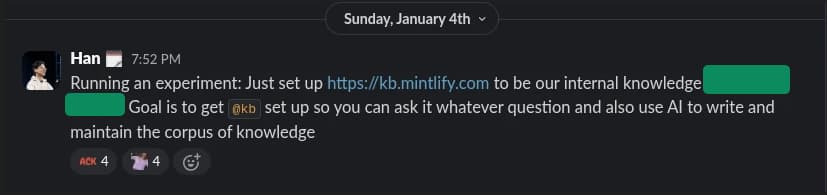
On a dark and stormy night in January 2026 (literally, I looked it up, heavy rain, mist, 1.32 inches of precipitation, the whole thing), Han Wang, Mintlify's co-founder, posted this into the team Slack:
As we sold more heavily to enterprise customers in 2025, we kept hearing that teams needed internal knowledge management, not just external-facing docs. So we built the infrastructure by revamping our no-code editor so non-developers could use Mintlify without writing markdown. Then, almost on cue, we tripled in headcount and ran straight into the problem ourselves. The institutional knowledge that used to fit inside one room suddenly didn't.
Decisions were happening in Slack threads between four people at 11pm and dying there. The people with the most context always had the least time to write any of it down. You can give an agent access to an MCP for your Slack, but to prevent work slop, you still need human judgement for what's worth documenting and when the quality is good enough. That's the gap our slack agent is designed to fill.
In a future where agents are the primary users of software and approaching trillions in number, what will they know about how your company actually works? If you're going to sell internal knowledge infrastructure to enterprises, you should probably be running on it yourself. We realized that the edge in 2026 is not the wiki itself, but rather an agent built specifically for internal knowledge that lives in Slack and turns conversations into documentation without anyone leaving the tools they already use.
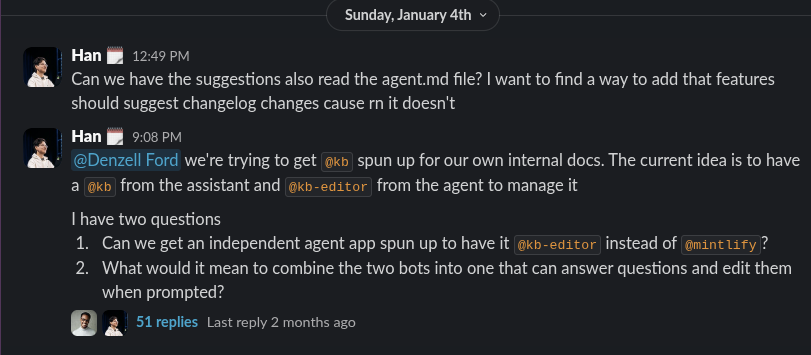
That agent is what the rest of this post is about.
Life after KB: 419 Contributions in 66 Days
Anahita Sahu, Mintlify's Chief of Staff, built the company's entire internal knowledge base in a single afternoon using nothing but Slack and a web browser. She pasted content into a conversation with the @kb agent, told it where things should go, and migrated ten pages in five minutes. Then the entire team started using it unprompted.
We have made 419 contributions across 66 days since the internal launch — roughly 6.3 updates per day, with authorship coming every single team member. Nobody set up a template with aspirational section headers that everyone would politely ignore by February. The friction was close to zero, and people used it because they were already in Slack and it was easier to @ the bot than to open another app.
Where Knowledge Actually Dies vs Where It Thrives
The real problem with internal knowledge is not search, it's that nobody has the activation energy to leave slack and write things down. The gap between where knowledge gets created (Slack) and where it's supposed to live (some other tool) is just far enough that it never connects. KB closes that gap entirely.
You @ the KB agent in any Slack channel or DM in plain language like "KB, document the case study pipeline from the thread above." The agent reads the context, synthesizes it, and opens a pull request on GitHub. You never leave Slack. Everything KB creates is version-controlled with full change history and reviewable PRs, the same workflow your team already trusts for code. KB also answers questions directly from Slack, so your internal knowledge base is always one @ away.
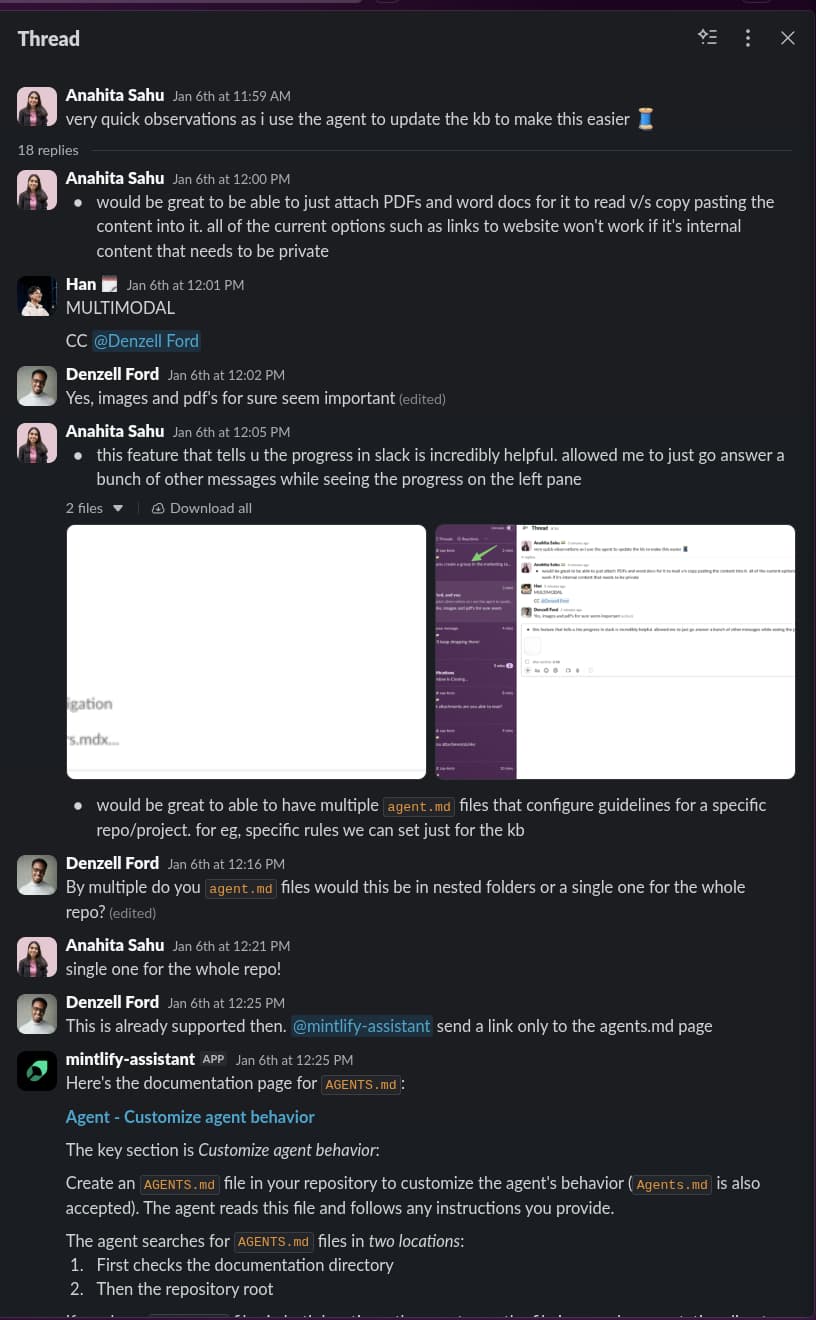
What genuinely surprised us is the AGENTS.md file. You define your formatting and style preferences once, and the agent follows them every time. Dozens of people across departments can all prompt KB, and the output stays structured and on-brand. In casual terms, it's "incredibly sick".
When the Agent Reads the Room: Aligned, Ack, Documented
Right now, KB works because a human tells the agent to document something. We're building toward the agent detecting on its own when a conversation has resolved — when a thread crosses a certain threshold and the final reply reads "aligned" or "ack," KB recognizes a decision just happened and documentation should follow. We're watching how people trigger KB manually to learn what those signals look like, with the goal of making the agent increasingly autonomous over time.
Under the hood, KB is not a chatbot with a Slack integration. It's powered by the same purpose-built harness that runs all of Mintlify's AI, built on OpenCode and Daytona, the same stack behind Automations. It runs agentic search with multiple iterative queries that reformulate as they go. Ask KB about "customer stories" and it also searches "case studies," "customer success stories," and whatever the PM who left in Q2 tagged them as. It works the way a human researcher actually works.
Why not just point Claude at your Slack and DIY it? You could, but you'd spend the next year relearning every lesson Mintlify has learned from thousands of customers. Even Anthropic uses Mintlify instead of building their own documentation system.
The Bigger Vision: Knowledge for Trillions of Agents
Levie's thesis suggests enterprises will run 100x or 1,000x more agents than people. If that's true, knowledge infrastructure can't just be readable by humans browsing a wiki — it needs to be readable by agents. KB already does this: every KB site ships with an MCP server, so you can expose your internal wiki to Claude, Cursor, and any other AI tooling your team uses. Your internal knowledge becomes something agents can query programmatically.
That's where KB and Automations converge, knowledge is infrastructure. In a world of trillions of agents, documentation needs to be agent-maintained, agent-readable, version-controlled, and always current. A wiki someone updates quarterly won't cut it.
You can sign up for Mintlify, connect your Slack, and try the KB agent out for yourself. We're still very early, so any feedback you have time to provide will likely make it into the product surface in the next few weeks.
More blog posts to read
Meet Mintlify Desktop
Mintlify Desktop is a dedicated app for writing and managing documentation, from internal knowledge to public docs. Available in beta for Mac, Windows, and Linux.
September 24, 2026Justin Torre
Engineering Manager
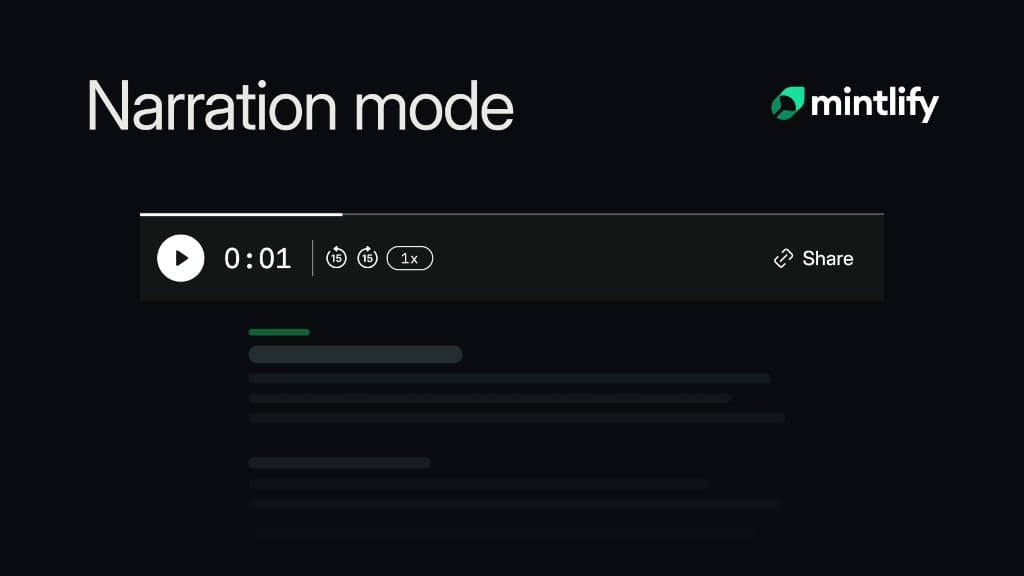
Announcing narration for your docs
Narration lets readers listen to supported documentation pages while Mintlify highlights each sentence and keeps their place on screen.
September 22, 2026Brandon McConnell
Senior Frontend Engineer