Mintlify vs ReadMe (2026): AI agents, speed, and pricing
Cole Gottdank
GTME
Share this article
Cole Gottdank
GTME
Share this article

AI agents now make up most of the traffic to docs on Mintlify. Docs are often the highest-traffic, highest-intent part of a company's funnel, and more buyers now send an agent there first, like a developer asking Cursor to write an integration.
of traffic to docs on Mintlify came from AI agents in October so far
Agent share of traffic by month: January 15%, February 20%, March 24%, April 28%, May 38%, June 57%, July 66%, August 66%, September 70%, October 78%.
That makes what agents get from your docs the first thing to compare, and it's where Mintlify and ReadMe differ most. If you remember nothing else, remember these two things:
- Mintlify is better for AI agents, keeping docs current, and editing as a team. We've built for agents since 2024, when we popularized llms.txt and co-developed llms-full.txt with Anthropic.
- ReadMe is better at per-developer API tools, like usage logs for each developer and OAuth sign-in when they try your API.
Mintlify vs ReadMe at a glance
| Feature | Mintlify | ReadMe |
|---|---|---|
| Agent search over MCP | ||
| Agent search over MCP | Every plan, including free | $150/mo Ask AI add-on |
| Docs updates start from | ||
| Docs updates start from | Merged PRs, schedules, reader questions, Slack | Opened GitHub PRs |
| Ways to edit | ||
| Ways to edit | Visual editor, Git, or Slack | Rich-text editor or Git sync |
| AI assistant for readers | ||
| AI assistant for readers | On Pro with credits, current as of your last publish | Lite included, full is $150/mo |
| API reference | ||
| API reference | REST, WebSocket, GraphQL, and SDK pages | REST, with Swagger 2.0 and Postman import |
| Per-developer API tools | ||
| Per-developer API tools | Prefilled API keys on Enterprise | Usage logs, OAuth sign-in, personal keys |
| Free plan | ||
| Free plan | 5 editors, agent search, custom components | 1 admin |
| Pro price | ||
| Pro price | $450/mo, unlimited editors | $250/mo for 6 seats, $20 per extra seat |
A check marks the stronger option, in our view. We compare the Pro plans unless we say otherwise, at annual-billing prices, as of October 12, 2026.
Built for humans and agents
Your docs now have two readers: the developer and the agent working for them. We tested both on ten live docs sites, five on each platform.
Search for agents over MCP
Agents in tools like Claude Code and Cursor can search your docs through an MCP server. Search takes them straight to the right page. Without it, they click through links, guess URLs, or answer from training data that may be out of date.
All five Mintlify sites in our test let agents search their docs, since search is on by default, on every plan. Of the five ReadMe sites, only ReadMe's own docs did. On ReadMe, an admin has to turn the MCP server on, and doc search needs the $150-a-month Ask AI add-on.
- Search the docssearch_perplexity
- Read full pages and API specsquery_docs_filesystem_perplexity
- Report a wrong or outdated pagesubmit_feedback
- Look up API endpointslist-endpoints, get-endpoint, search-endpoints
- Read spec detailslist-specs, get-server-variables
- Call your APIexecute-request
From our tools/list requests to Perplexity's docs on Mintlify and OneTrust's docs on ReadMe, October 2, 2026, with the same tools on October 9 and 12.
How well each search works
We put the same docs on both platforms and had Claude Code answer 130 questions through each one's MCP server.
| Feature | Mintlify | ReadMe |
|---|---|---|
| Search and answer quality | ||
| Search and answer quality | Even | Even |
| One search covers guides and API reference | ||
| One search covers guides and API reference | Yes | No, separate endpoint tool |
| Median time per search | ||
| Median time per search | 0.6s | 4.5s |
| Median time to an answer | ||
| Median time to an answer | 7.1s | 12.2s |
| Tool calls per answer | ||
| Tool calls per answer | 2 | 3 |
October 12, 2026. Even means no statistically significant difference. See how we compared.
Quality came out even. Speed and steps didn't. Ours searched more than seven times faster, answered faster on 128 of 130 questions, and covered guides and API reference in one search, so agents needed fewer steps.
What agents read without MCP
Most agents skip MCP and read your docs as plain files. All ten sites served Markdown pages, but only the Mintlify sites served llms-full.txt and skill.md.
Anthropic compares a skill to "an onboarding guide for a new hire," and llms-full.txt is the handbook that goes with it.
October 12, 2026. Of the four ReadMe sites without doc search, OneTrust's MCP server had endpoint tools only, Asana and NVIDIA had no public server, and Akamai's returned an error.
When docs are well-structured and agent-accessible, devs can save huge amounts of time and effort. ... In customer conversations we're already seeing this emerge as a competitive differentiator.

Mo King
Lead DX Engineer at Together AI, which moved its docs from ReadMe
How fast pages load for people
We ran Lighthouse, Google's lab test for page performance, on one API reference page per site.
- Scores: Mintlify's pages scored higher, with medians of 55 vs 23 on mobile and 90 vs 74 on desktop.
- First content: every Mintlify page showed content before any ReadMe page did, a statistically significant gap. On a simulated slow phone, the medians were 3.2 seconds vs 10.3.
- Layout shift: on mobile, the sidebar or article moved while the page loaded on every ReadMe site we tested.
Lighthouse 13.5, median of 3 runs per page, October 12, 2026. Lab timings on a simulated slow phone and connection, so real visitors see faster times on both platforms.
Self-updating by design
Both can draft a docs update when your code changes. The difference is everything else that makes docs go stale.
- A merged pull requestIn a connected code repo on GitHub or GitLab
- A schedule you setSuch as drafting a changelog
- A change to your docsRuns translation and cleanup on each push
- A webhook requestFrom CI or any other system
- Assistant conversationsGaps in what readers ask the AI assistant
- Reader feedbackRatings and comments on pages
- A message in SlackAsk @mintlify to update the docs
- An opened pull requestIn a connected GitHub repo, through the GitHub AI WriterStarts earlier, when the PR opens
From our automations docs and ReadMe's GitHub AI Writer docs, October 9, 2026. Enterprise-only triggers are left out.
Most updates end in a pull request for someone on your team to review. Anyone can also ask for one by tagging our writing agent in a Slack thread.


@mintlify update the CNAME.mintlify-dns.com to be docs.mintlify.builders

PR: https://github.com/mintlify/docs/pull/5642
- Updated CNAME target from
cname.mintlify-dns.com→docs.mintlify.buildersincustomize/custom-domain.mdxplus the ES/FR/ZH translations.
A teammate's Slack request and the agent's reply, recreated from our listing in the Slack Marketplace.
Translations keep up too. We re-translate changed pages on every push, while ReadMe's AI translation needs Enterprise.
Edit in the browser, your IDE, or Slack
A PM spots an outdated step in your quickstart. Here's what fixing it looks like on each.
- On Mintlify, the PM fixes it in a visual editor, like a Google Doc, while an engineer edits the same page's Markdown. Anyone can also ask our agent in Slack to make the change.
- On ReadMe, the two can edit together until the engineer opens Raw Mode. ReadMe's editor docs say "Turning on Raw Mode locks the page for everyone else until you turn it off." Its Slack app sends notifications about suggested edits rather than making the change.
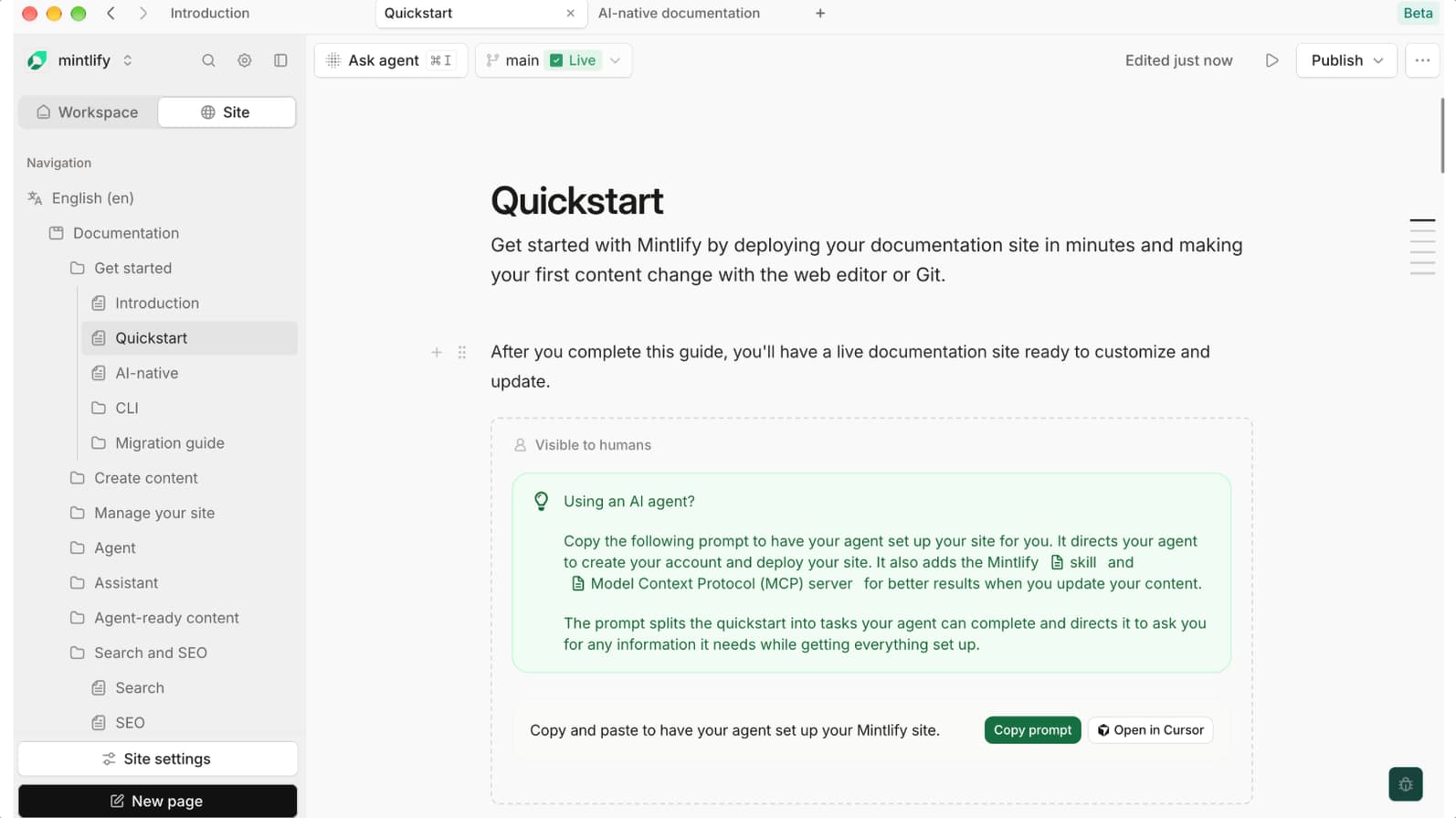
Every change saves to your Git repo. Publish straight to your live site, or work on a branch and send it for review like code. Teammates who'd rather not edit can leave a comment or suggest a change.
Harvey moved its API docs from ReadMe, and its solutions architects now own them without pulling in engineering.
People really like using [Mintlify]. It's much better than the vendor we came off of previously. It's easier to use. It's more visually appealing.

Danae Mullen
Solutions Architect at Harvey
Answer questions before they become tickets
A developer trying your product for the first time asks the chat on your docs how to get an API key. If the answer is wrong, they may not come back.
Ours answers from the page you published a minute ago. ReadMe's Ask AI re-indexes every two hours, so right after a fix it can still answer from the old page. When ours can't answer, it hands the reader to your support team by email form or a link.
See how your docs perform
Both track page views, searches, and page ratings. Ours also splits traffic between people and agents, by tool, like ChatGPT, Claude, and Cursor, and shows the pages agents flag as wrong or outdated. Our automations then turn those gaps into pull requests.
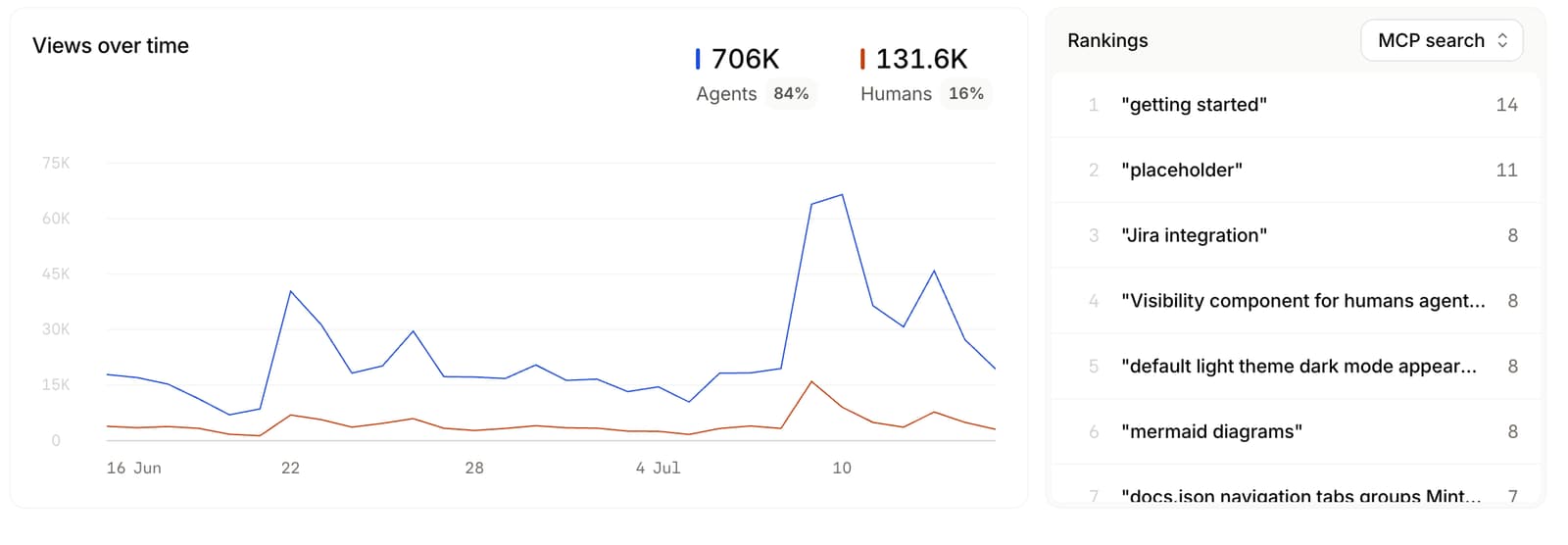
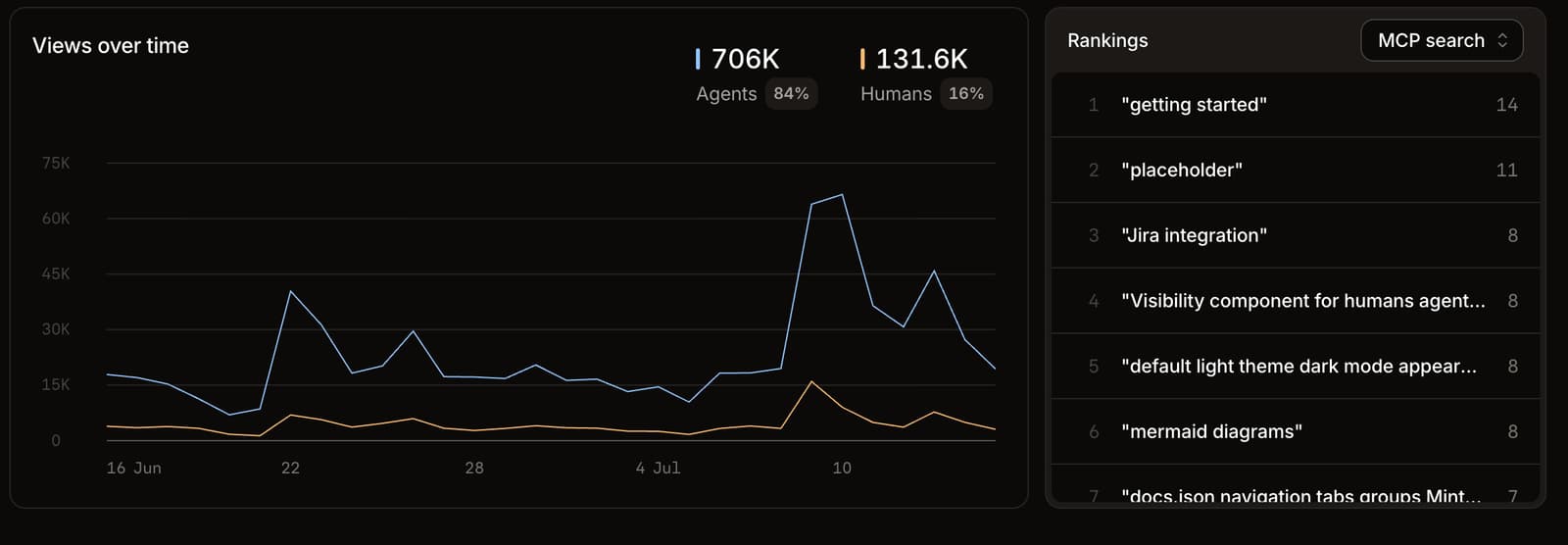
From our analytics docs. Anthropic's Claude Code docs team pulls page feedback and broken code-sample reports through our analytics API every few hours, then has an agent draft fixes.
How do the API references compare?
Both build an interactive reference from your OpenAPI spec.
- Ours covers more kinds of API: REST, WebSocket, and GraphQL references, plus SDK pages built from tools like TypeDoc and Javadoc, all next to your guides. ReadMe's reference is built around REST, and its own docs call its GraphQL support "feature incomplete."
- ReadMe goes deeper on the playground. Its Try It can run OAuth flows and lets logged-in developers use their own API key, which takes Enterprise on Mintlify. It also imports Swagger 2.0 specs and Postman collections, which we don't.
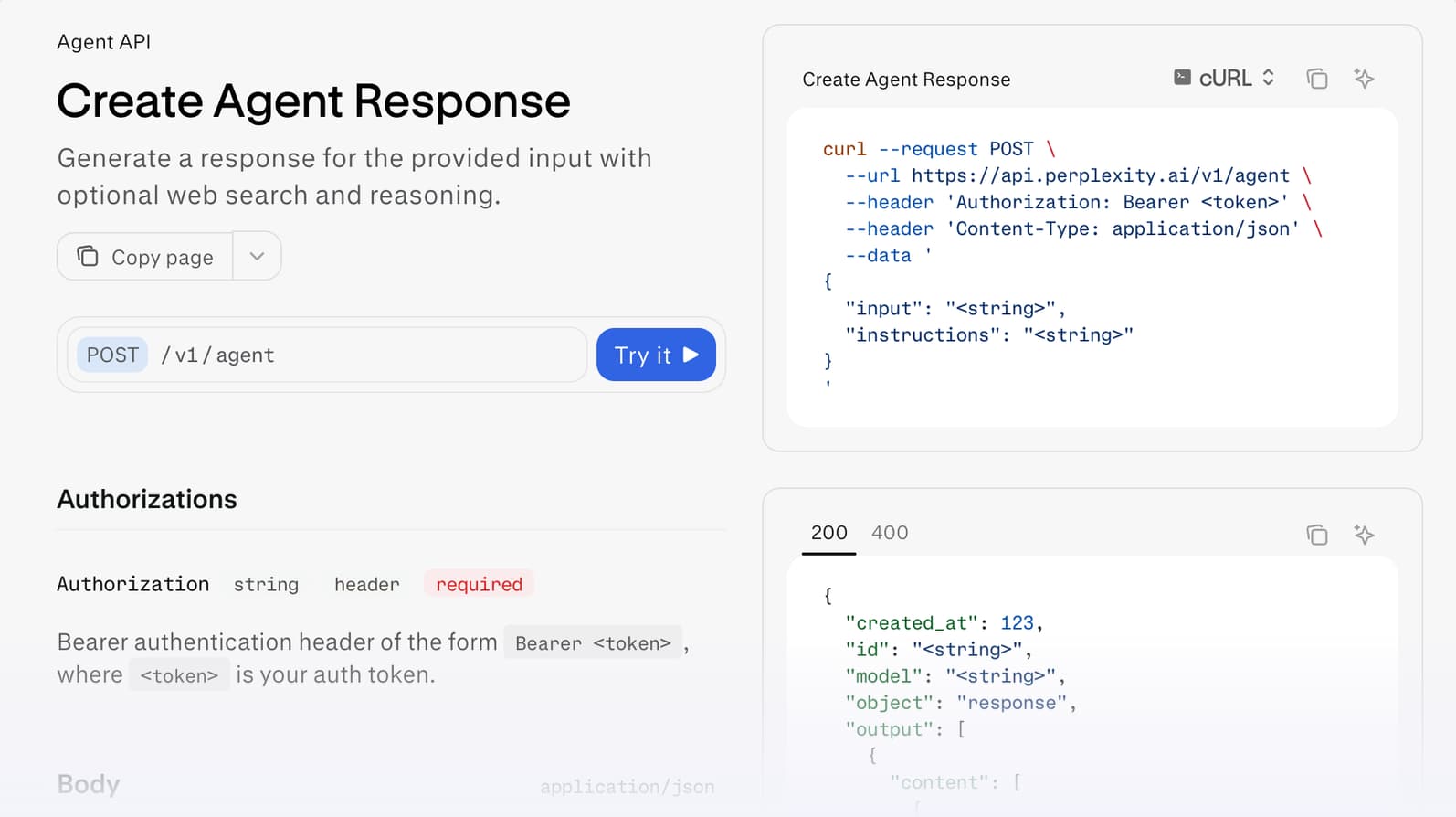
Perplexity's API reference on Mintlify. Polymarket documents its TypeScript, Python, and Rust SDKs alongside its API the same way.
API docs are a direct lever on developer adoption. The playground alone changes whether a developer builds on Kalshi or moves on.

Brian Ta
Founding Growth Product Lead at Kalshi
How does pricing compare?
Both have a free plan and a paid Pro plan. Ours gives you more for free, then charges one flat price on Pro, with discounts for startups and open source projects.
Do Mintlify and ReadMe have free plans?
Yes, both do, but ours covers more. We love developers and never want to stop supporting them. That's why we keep our free plan generous. 💚
| Feature | Mintlify Starter | ReadMe Starter |
|---|---|---|
| Price | ||
| Price | $0 | $0 |
| Editors | ||
| Editors | 5 | 1 admin; inviting teammates takes Pro |
| Agent search over MCP | ||
| Agent search over MCP | Yes | $150/mo add-on |
| llms-full.txt | ||
| llms-full.txt | Yes | No |
| Custom components and CSS | ||
| Custom components and CSS | Yes | Pro plan |
| Custom domain | ||
| Custom domain | Yes | Yes |
| Doc metrics | ||
| Doc metrics | Pro plan | Yes |
From Mintlify pricing and ReadMe pricing, checked October 12, 2026.
How do the Pro plans compare?
- Mintlify Pro is a flat $450 a month for any number of editors.
- ReadMe Pro is $250 a month for six seats, plus $20 for each one after that. Its team docs say "all teammates are Admins," so every teammate takes a seat.
- Agent search comes with Mintlify. On ReadMe it takes the $150-a-month Ask AI add-on, and with it, ReadMe costs about the same as Mintlify at eight editors and more from there.
- Mintlify Pro$450
- ReadMe Pro + Ask AI$480
- ReadMe Pro$330
List prices, billed annually, checked October 12, 2026, on Mintlify pricing and ReadMe pricing. ReadMe's docs don't say whether its project owner is one of the five admins, so we assumed not, which lowers its price.
Startups and open source projects pay less. Through our startup program, eligible venture-backed startups and YC alumni get 50% off Pro for 12 months, and companies in the current YC batch get 12 months free. Non-commercial open source projects get Pro free, forever, through our OSS program.
When is ReadMe the better choice?
Pick ReadMe if you want your docs to double as a dashboard of who's using your API.
- My Developers shows each developer's API calls, searchable by key, email, or company. The data comes from Try It requests, and from production traffic once you install ReadMe's Metrics SDK. We don't offer per-developer API logs.
- Restless, ReadMe's new SDK, logs every API and MCP call by customer and adds a fix to error responses so agents can recover.
- It's ahead in smaller ways too. Its MCP server can call your API for an agent, and it has discussion forums and recipes built in.
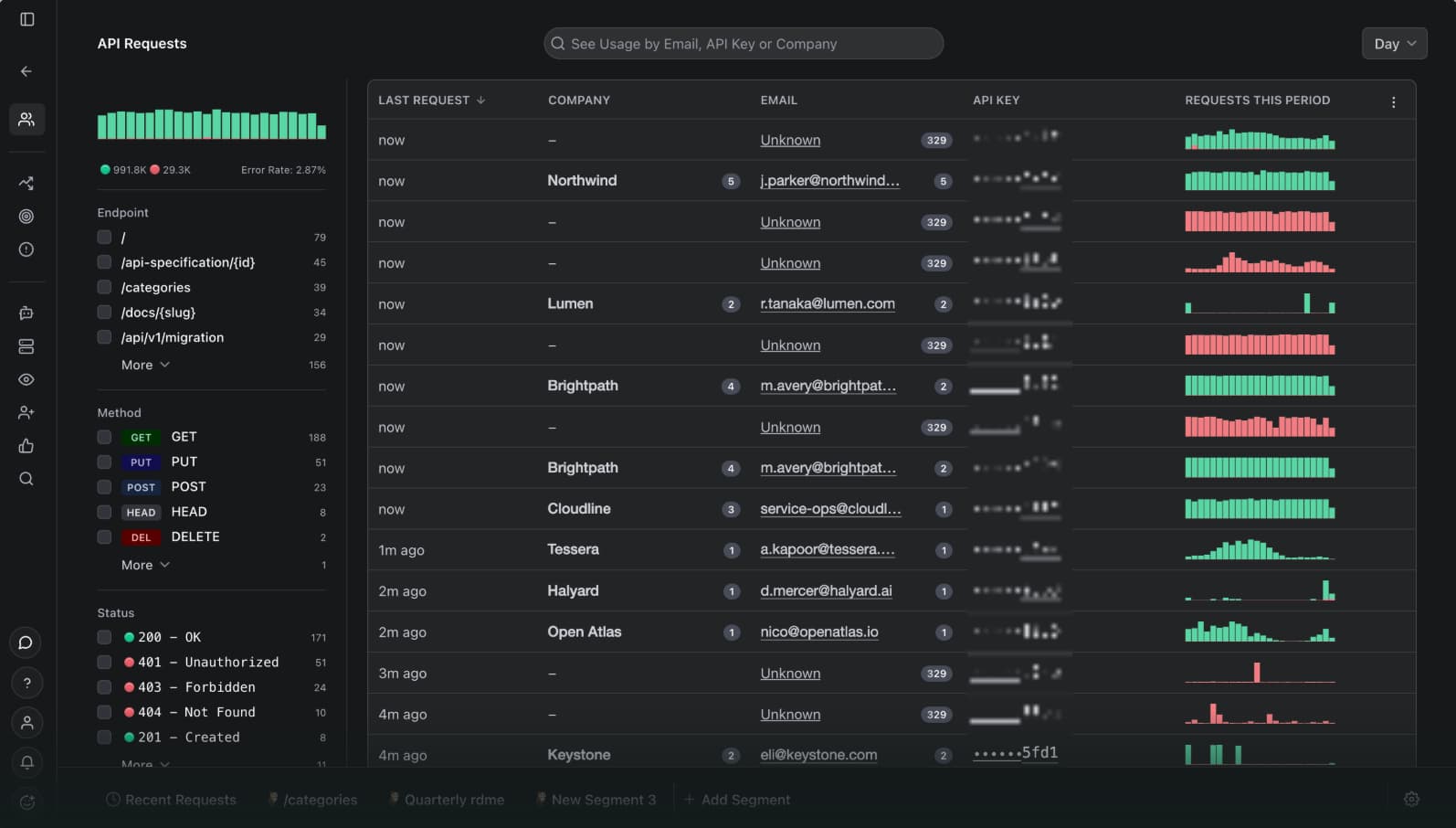
From ReadMe's My Developers docs
How do you move from ReadMe?
You can do it yourself with our ReadMe migration guide, which turns your ReadMe export or public site into a Mintlify project. Or have our team do it. We move and check your content, give you a preview to review, and stay on for 14 days of support after you go live.
Before you cancel ReadMe, save any My Developers logs or forum threads you want to keep, since we don't offer an equivalent.
Frequently Asked Questions
Which is better for AI agents, Mintlify or ReadMe?
Mintlify. Every Mintlify site gives agents a search tool and llms-full.txt by default. On ReadMe, doc search takes an admin turning the MCP server on plus the $150-a-month Ask AI add-on. In our test, search quality came out even, and ours answered faster in fewer steps.
Is Mintlify cheaper than ReadMe?
It depends on team size. Both have a free plan, and ours includes five editors and agent search. On Pro, Mintlify is a flat $450 a month, billed annually, for any number of editors, while ReadMe charges per admin. ReadMe is cheaper for small teams, but once you add the Ask AI add-on that agent search needs, it costs more than Mintlify from nine editors up.
Is Mintlify only for engineers?
Not at all. Writers and PMs edit in a visual editor, like a Google Doc. At Replit, PMs, marketers, support, and sales all contribute to the docs, and Harvey's solutions architects run its API hub for 140,000+ legal professionals without engineering.
Can Mintlify be self-hosted?
Yes, and so can ReadMe. Talk to our sales team to learn more.
Can AI agents read private docs?
Yes, on both. Mintlify's MCP server searches only the pages each signed-in reader is allowed to see. ReadMe's MCP docs say its server "exposes the same content to all users."
Which tool is best for API documentation?
Mintlify, for REST, WebSocket, GraphQL, and SDK reference next to your guides. ReadMe, for OAuth sign-in in the playground, per-developer API logs, or Swagger 2.0 and Postman imports. See our roundup of API documentation tools.
Can one docs site cover several products?
Yes, on both. One Mintlify project can hold several products, each with its own navigation. Coinbase's developer docs cover wallets, onramp, staking, its exchange, and more on one site, and Mirage keeps its help center and API docs together.
How we compared
- Live sites. On October 12, 2026, we tested Perplexity, Resend, Together AI, Coinbase, and Polymarket on Mintlify, and Asana, Akamai, NVIDIA, OneTrust, and ReadMe's own docs on ReadMe. For each, we checked the files it serves agents, connected to its MCP server, and ran Lighthouse on one API reference page. Anyone can rerun these plain web requests.
- Search quality. We put the docs of Ory Kratos, an open-source identity product, on both platforms, renamed so the agent couldn't answer from memory. ReadMe ran on Pro with the Ask AI add-on, which we paid for. Ours ran on Enterprise, though our search works the same on every plan. Claude Code answered 130 questions through each MCP server, and two AI graders checked every answer against facts written in advance. Correct answers were 116 each under one grader and within two under the other. Ours answered faster on 128 of 130 questions and needed fewer tool calls on 85, while ReadMe's needed fewer on 16.
- Page speed. Lighthouse 13.5, three runs per page, on mobile and desktop settings. Lab data, not timings from real visitors.
- Prices. Annual list prices, checked October 12, 2026. We assumed ReadMe's project owner isn't one of its five admins, which lowers its price. Our assistant and automations run on monthly credits, with 10,000 included on Pro.
- Significance. A significant difference is unlikely to be chance (p below 0.05).
AI tools helped research, draft, and fact-check this post against each vendor's own pages.
More to read

Mintlify's Starter Plan
A homegrown docs site looks cheap until your team owns search, authentication, AI-readable content, and maintenance. Mintlify Starter handles the core infrastructure for free.
September 28, 2026Harkirat Chahal
Growth
Best Free Documentation Software in 2026
Free documentation tools divide into free-to-license open source and free-to-run managed tiers. This guide compares five free options on what ships at $0, the upkeep each requires, and the teams they fit.
June 18, 2026Harkirat Chahal
Growth