Introduction
One of the most fundamental decisions in system design is choosing between SQL (relational) and NoSQL databases. Each has distinct characteristics, strengths, and ideal use cases. This guide will help you understand when to use each type.What is a Database?
First off, what’s a database? Think of it as a digital playground where we organize and store loads of information in a structured manner. Databases enable applications to persist, query, and manage data efficiently.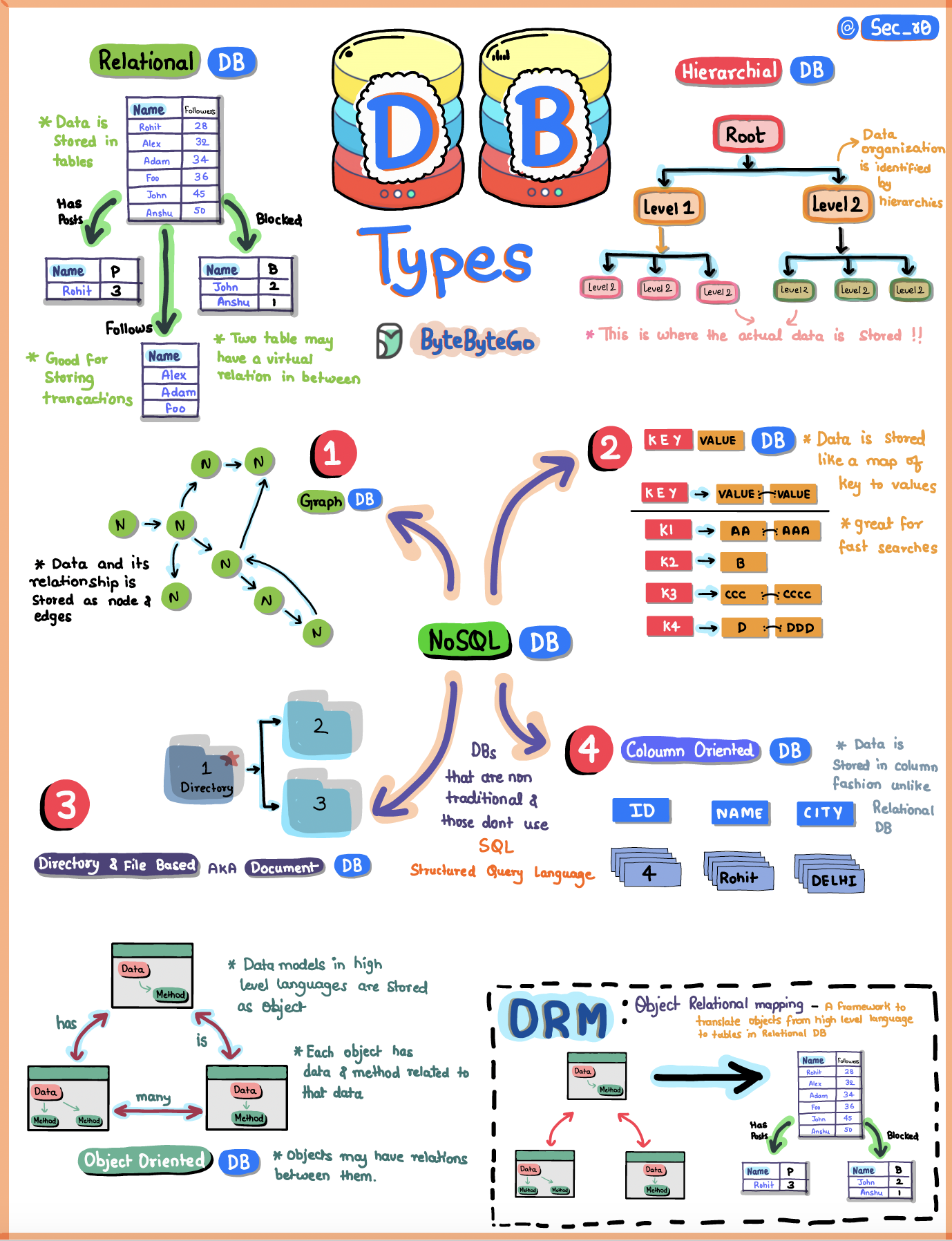
Relational Databases (SQL)
Overview
Relational databases organize data in tables (relations) consisting of rows (tuples) and columns (attributes). Introduced by E.F. Codd in 1970, the relational model represents one of computer science’s most influential ideas.Key Characteristics
Fixed Schema
Data structure is defined upfront with tables, columns, and relationships
ACID Compliance
Guarantees Atomicity, Consistency, Isolation, and Durability
SQL Language
Standardized query language for data manipulation
Relationships
Built-in support for foreign keys and joins
Strengths
Data Integrity: Relational databases support data integrity through:- Primary and foreign key constraints
- Unique constraints
- Check constraints
- Referential integrity
- Complex joins across multiple tables
- Aggregations and grouping
- Subqueries and CTEs (Common Table Expressions)
- Window functions for advanced analytics
- Atomic operations (all-or-nothing)
- Consistent state transitions
- Isolation between concurrent transactions
- Durable writes that survive failures
- Organized table structures
- Elimination of duplicate data
- Efficient storage utilization
Weaknesses
Popular SQL Databases
- PostgreSQL: Feature-rich, excellent for complex applications
- MySQL/MariaDB: Fast, reliable, widely adopted
- Oracle: Enterprise-grade with advanced features
- Microsoft SQL Server: Strong Windows ecosystem integration
- SQLite: Embedded, serverless, perfect for mobile/desktop apps
NoSQL Databases
Overview
NoSQL databases say “No” to traditional SQL approaches, offering flexibility and horizontal scalability. They come in four main flavors, each optimized for different use cases.Types of NoSQL Databases
1. Key-Value Stores
Think of it like a treasure chest: Each item has its unique key. Finding what you need is a piece of cake.Key-value stores are the simplest NoSQL databases but can be extremely powerful for caching and session management.
- Simple data model (key → value)
- Extremely fast lookups
- High scalability
- No complex queries
- Session storage
- User preferences
- Shopping carts
- Caching layers
2. Document Databases
Document databases store information in a format similar to JSON. They’re designed for working with documents instead of tables. Characteristics:- Store semi-structured data
- Flexible schema
- Nested objects and arrays
- Rich query capabilities
- Content management systems
- Product catalogs
- User profiles
- Event logging
3. Column-Family Stores
Imagine slicing and dicing your data like a chef prepping ingredients. Column stores are efficient and speedy for analytical workloads. Characteristics:- Data organized by columns, not rows
- Optimized for write-heavy workloads
- Compression-friendly
- Wide row support
- Time-series data
- Analytics and reporting
- Event logging
- IoT applications
4. Graph Databases
Think of social networks: The relationships between people matter most. It’s like mapping who’s friends with whom. Characteristics:- Native graph storage
- Efficient relationship traversal
- Pattern matching
- Relationship-first design
- Social networks
- Recommendation engines
- Fraud detection
- Network mapping
SQL vs NoSQL: Key Differences
Schema Design
Schema Design
SQL: Fixed schema defined upfront. Changes require migrations.NoSQL: Flexible or schema-less. Documents can have different structures.
Scalability
Scalability
SQL: Primarily vertical scaling (bigger servers). Horizontal scaling is complex.NoSQL: Designed for horizontal scaling across commodity hardware.
Transactions
Transactions
SQL: Full ACID support with multi-row transactions.NoSQL: Often eventual consistency. Some support ACID at document level.
Query Language
Query Language
SQL: Standardized SQL across vendors (with variations).NoSQL: Database-specific APIs. No standard query language.
Data Relationships
Data Relationships
SQL: Built-in support via foreign keys and joins.NoSQL: Relationships handled at application level or through denormalization.
When to Use SQL
Choose relational databases when you need:Structured data with clear relationships
ACID transactions for data integrity
Complex queries with joins and aggregations
Data consistency is critical
Mature tooling and ecosystem
- Financial applications
- E-commerce platforms
- ERP systems
- Traditional web applications
- Systems requiring complex reporting
When to Use NoSQL
Choose NoSQL databases when you need:Flexible schema that evolves over time
Horizontal scalability across multiple servers
High throughput for writes
Simple queries (key-based lookups)
Eventual consistency is acceptable
- Real-time big data applications
- Content management systems
- IoT and time-series data
- Social networks
- Gaming leaderboards
- Caching layers
Hybrid Approaches
Modern applications often use both SQL and NoSQL databases:Common Misconceptions
Migration Considerations
If you’re considering migrating from SQL to NoSQL (or vice versa):Conclusion
There’s no universal winner between SQL and NoSQL. The best choice depends on:- Your data model and relationships
- Consistency requirements
- Scaling needs
- Query patterns
- Team expertise
Next Steps
Choosing a Database
Learn how to select the right database type
Database Sharding
Scale your database horizontally
CAP Theorem
Understand trade-offs in distributed systems
ACID Properties
Deep dive into transaction guarantees